
SEO for Home Builders: Make Your Work Easier to Find and Trust
A practical sequence for local search, service pages, project stories and useful answers. Cameron's website and AI-search explanations provide the context; current Google guidance supports the technical steps.
Watch the workshop below, or jump to the written walkthrough and work through the steps.
Cameron Upton · Source explanation
How Custom Builders Can Get Found on ChatGPT
Cameron explains a self-reported AI-search enquiry and why clear services, territory and project evidence matter. The written guide combines that teaching with current search documentation. One reported enquiry does not establish a repeatable AI-acquisition result.
Demand playbook · About 19 min read · Updated October 2026
Teaching by Cameron Upton, Contractor Scale founder and trade-qualified engineer turned strategist.
Written guide adapted by Contractor Scale from Cameron’s recorded explanations and source-backed editorial guidance. Suggested scripts and worked examples are labelled; they are not transcript quotations. See the original teaching and evidence.
What you get from this guide
A Prioritised Search Plan
Separate discovery, relevance, proof and enquiry-path problems before writing more pages.
Evidence Buyers Can Check
Show actual services, areas, process and completed projects in a connected website.
Useful Measurement
Distinguish indexing and visibility from clicks, enquiries and later sales progress.
The problem this playbook fixes
Your website may show beautiful work while leaving basic questions unanswered. What do you build? Where do you work? How does someone start? A homeowner should not have to guess, and search engines need accessible pages that explain the same facts. SEO connects discoverability with a useful buying journey. Start by identifying the missing part, then improve the pages and evidence that help the right homeowner make a decision.
How this fits the Growth System
Demand is how the right homeowners find you, trust you, and put their hand up before a competitor takes the attention. Without it the next two stages have nothing real to work with.
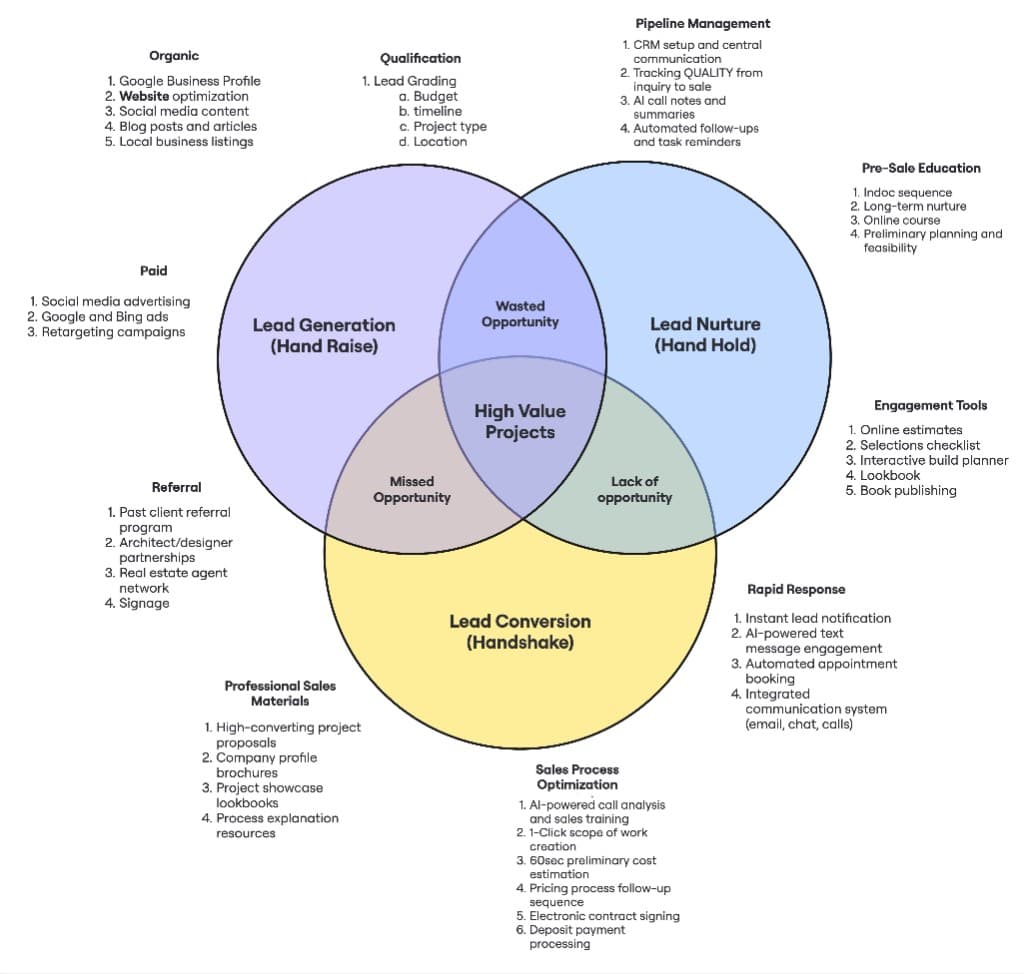
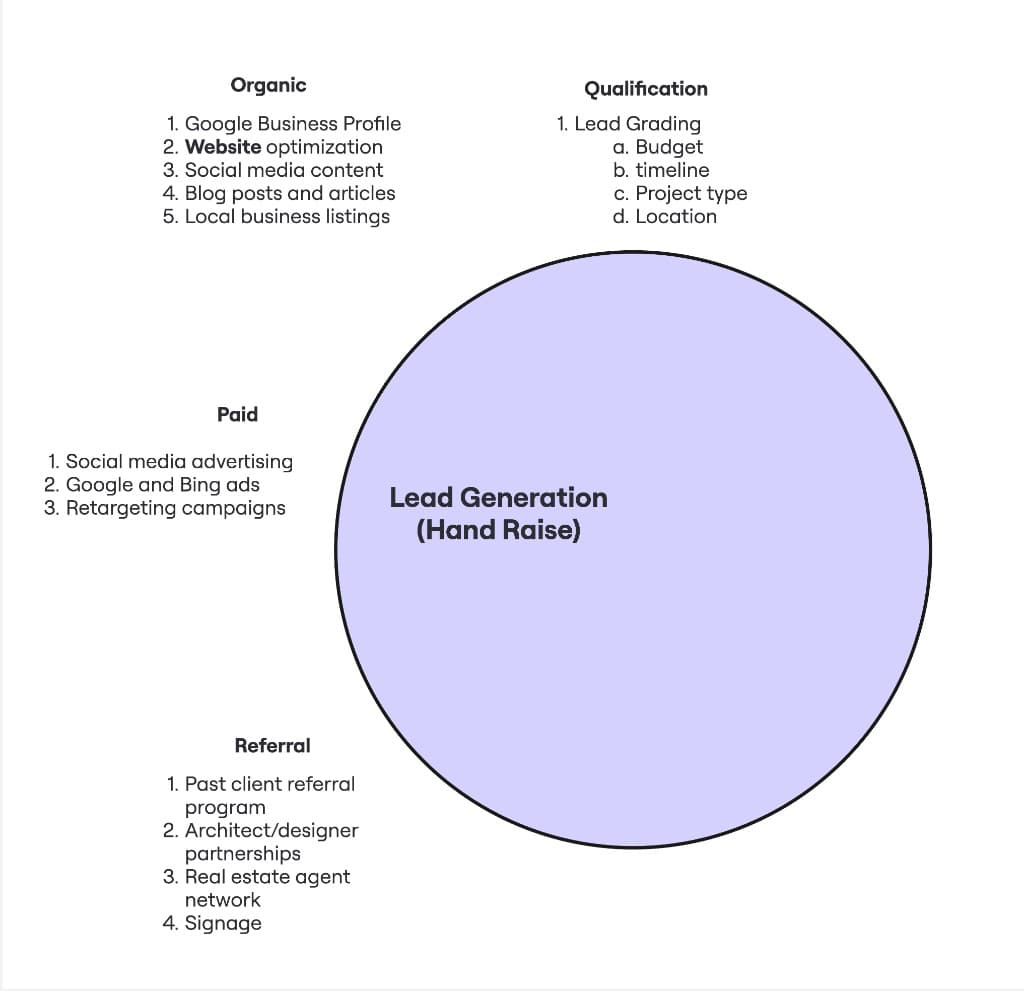 This playbook
First circle — hand raise
Generation
Right homeowners find you, then get graded before your estimators burn hours.
Open pillar + workshop →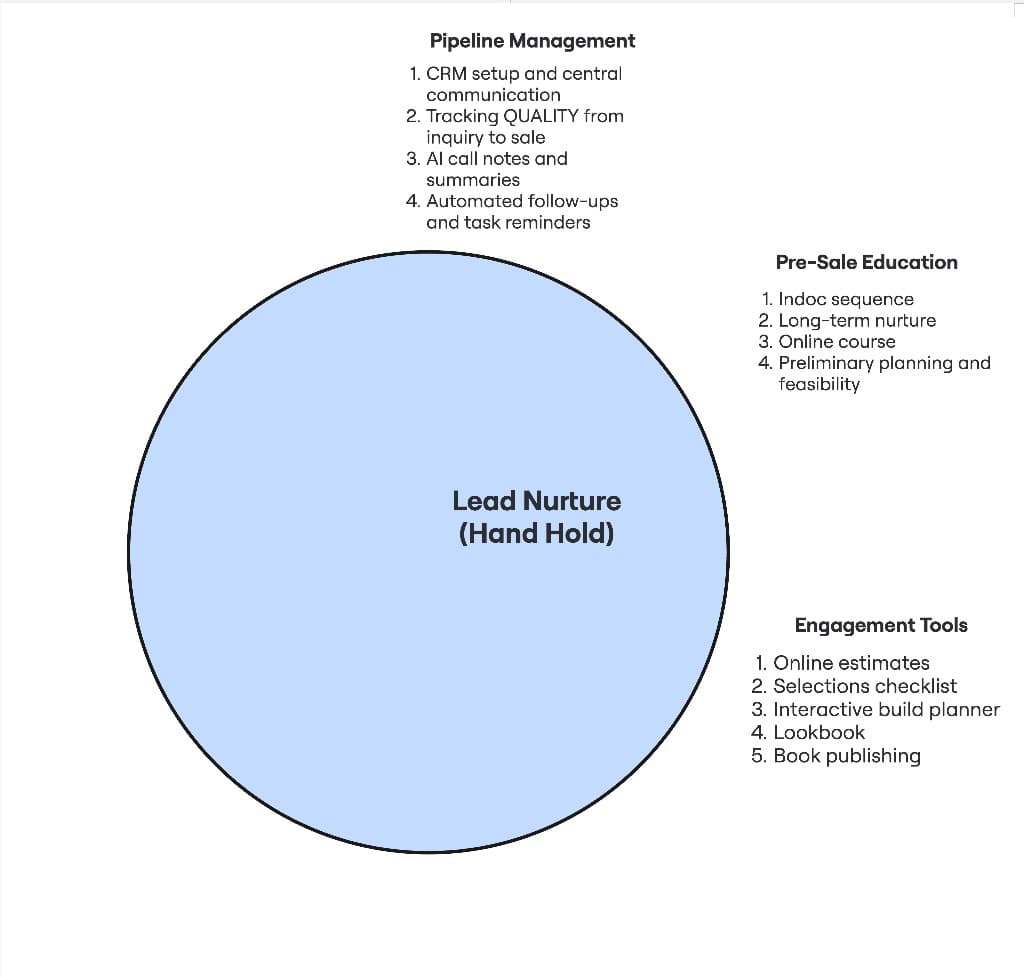
Middle circle — momentum
Nurture
Speed-to-lead, pipeline discipline, and education between interest and signature.
Open pillar + workshop →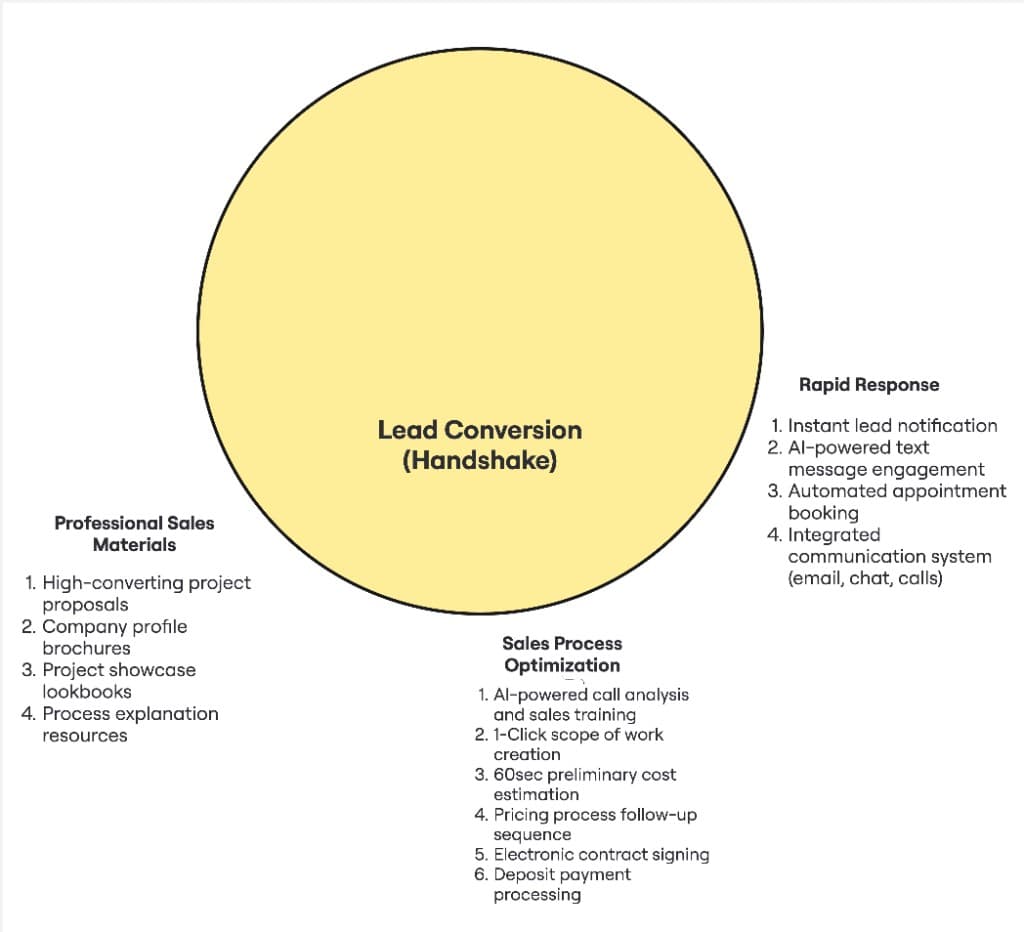
Third circle — signed work
Conversion
A repeatable sales process that does not depend on one heroic estimator.
Open pillar + workshop →If you want priorities by revenue stage, the Builder Growth Roadmap maps the same sequence across Stage 1 ($0–$500K) through Stage 5 ($5M+) so you can see what to tighten first at your current size.
01Diagnose the Search Problem Before Adding Content
TL;DR
A page that cannot be found needs a different fix from one that gets clicks but fails to generate enquiries.
- Separate indexing, visibility, relevance and conversion.
- Choose the service and area that matter to the business.
Start with the service you want to grow and the area you actually serve. Review whether the site has a page answering that commercial search, then inspect what happens when someone reaches it.
Use four questions. Can Google access and index the page? Does it receive impressions for relevant searches? Do people click? Does the page help suitable homeowners enquire? These are separate problems, even when someone describes all of them as “our SEO isn't working”.
Read Search Console by page and query, including the relevant country and device. Separate searches for your company name from searches for a service. Branded clicks can reflect existing awareness; they do not prove you are reaching new local buyers.
Look at current results for the topic. Is the searcher choosing a builder, researching a cost or comparing a process? The format should match that need. A service page explains your delivery and next step. A guide answers the planning question. Neither should repeat the other just to hold the same keyword.
Write a short diagnosis with evidence and one first intervention. If a relevant indexed service page gets clicks but the form fails on mobile, more articles will not repair the enquiry path. If no page covers an accepted service, clarify that service and its proof before expanding into remote topics. Keep your booked workload and capacity in the decision, so the search plan supports work you can deliver.
Set the acquisition goal and channel priorities — Match the SEO work to forward workload and the opportunities the business needs.
02Check Whether Google Can See the Intended Page
TL;DR
A reachable public page, an indexable page and Google's indexed version are different checks.
- Inspect the exact public URL and its canonical.
- Check the crawl date before assuming Google saw a rewrite.
Open the public URL and follow any redirect. Confirm that it shows the intended page rather than a login, error or old destination. Then use Search Console's URL Inspection for that exact URL.
The indexed report describes Google's stored version. Read crawl availability, last crawl and the Google-selected canonical. A live test checks whether the current page might be indexable; it does not guarantee indexing or predict the selected canonical. Compare those results when a page has recently changed.
Give a developer a concrete issue: the affected URL, what is visible, what the inspection reports and the intended behaviour. Check unintended noindex directives, blocking rules, failed responses and conflicting versions. Some utility, confirmation and private pages should remain outside search. Do not remove their protections simply to increase an indexed-page count.
Check the page is linked from an appropriate public page and appears in the relevant sitemap. If an older route moved, confirm the redirect and update internal links to the final destination. Preserve useful query information where it is part of a working journey.
After a fix, recheck the live page and inspection. Request a recrawl where appropriate, then allow Google to process it. A successful request is a submission receipt, not indexing proof. Keep the date and result so you can distinguish an unresolved problem from a change Google has not processed yet.
Read Google's URL Inspection guidance — Understand what the indexed report and live test can each establish.
03Build Service and Area Pages Around Real Delivery
TL;DR
Help a homeowner verify what you do and where, rather than swapping suburb names through identical copy.
- Give each important service a clear job.
- Use actual local work and delivery information.
Cameron's website explanation starts with clarity: state what you do and where you do it. Use the language your homeowners recognise. “Home extensions in our service area” tells them more than a slogan that could belong to any business.
For each substantial service, explain the projects you accept, how your process works, what information starts the conversation and the next step. Add relevant completed work and real client feedback where permission allows. State scope boundaries without promising a final price or programme before the required investigation.
Use area coverage to help people decide whether to enquire. A general service-area page may be enough. A separate local page earns its place when you have useful local material: actual work, delivery considerations, appropriate project examples and a clear explanation of service coverage.
Hypothetical planning example: a builder has completed several extensions in one district and routinely works there. A page can explain the service, illustrate those projects and link to the extension process. It should not invent council rules or imply an office exists there.
Avoid dozens of near-identical town pages leading to the same generic destination. Google identifies doorway abuse and keyword stuffing in its spam policies. A large location list is not a substitute for useful coverage.
Use a descriptive title and one clear page heading. Keep the service vocabulary consistent across navigation, page text and enquiry choices. The homeowner should be able to recognise the same service all the way through the journey.
See the builder website service — Review the scope of website work if the current structure cannot explain services and areas clearly.
Read Google's doorway and link-spam policies — Check proposed location pages and external-link activity against the primary policy.
04Turn Completed Projects into Useful Evidence
TL;DR
Explain the challenge, decisions and outcome behind the photos so readers can assess your experience.
- Use permissioned images and confirmed project facts.
- Connect each story to the relevant service and process.
A gallery shows the finish. A project story helps a homeowner understand what it took to get there. Cameron's website teaching calls for the journey, rather than a photo dump.
Start from your own project records. What did the client want? What constraint shaped the job? Which decisions did your team help resolve? What work did you actually deliver? Tell the story with enough detail to help someone considering a comparable project.
Choose images that support those stages: the initial condition where useful, work in progress and the completed result. Add captions explaining what the reader is seeing. Describe images for accessibility without filling the description with search terms. Use a client quote only with permission and preserve its meaning.
Check privacy before publishing. A general area may be appropriate while the street address, family details or financial circumstances are not. Verify any cost, timeframe, award or performance claim from the relevant record. If an outcome was reported by the client, identify it accordingly.
End the story by explaining which service or planning decision it illustrates. Link to that service and to a useful explanation of your process. From the service page, link back to the most relevant projects. That gives a homeowner a way to test the promise against actual work.
Create the record while the project context is available. Ask the person who knows the job to check the facts before publication. A shorter accurate story is more valuable than a long case study padded with imagined challenges.
Place project proof within the enquiry journey — Help readers use the evidence when deciding whether the business fits their project.
05Answer Questions from Actual Homeowner Conversations
TL;DR
Write one complete, useful answer to a real planning question before expanding the article list.
- Use your own explanations, decisions and examples.
- Make assumptions and limits visible.
Your enquiry conversations contain the questions worth answering. Where should someone start? What affects the budget? What information do you need before pricing? How do they compare scope between builders? Choose a question that matters to the services you actually provide.
Write the direct answer first, then explain the decisions and exceptions. A cost article needs the location, date, inclusions and assumptions behind any figures. A planning article should say what your team does and where another professional's input is required. Do not turn a rough example into general advice for every property.
Add material only your business can supply: a worked hypothetical scenario, a reviewed project lesson, a process demonstration or the reasoning behind a recommendation. Label illustrations. If AI helps organise a recorded explanation, check the draft against the source and protect private client information.
Google's helpful-content guidance favours useful original substance and clear, accurate authorship. It has no preferred word count, and E-E-A-T is not one specific ranking factor. Treat experience and trust as things the reader can assess through the content and evidence.
Give the page a distinct purpose. If an existing service page already answers the question well, improve that section rather than create a competing article. If the question deserves a guide, connect it to the service, relevant project and next explanation. Revisit it when facts or process change; changing the date without changing the content is not enrichment.
Use Google's helpful-content questions to review the guide — Check usefulness, originality, sourcing and whether the reader can act on the answer.
06Connect the Pages at the Reader's Decision Points
TL;DR
Internal links should help someone move from a question to a service, example or next step with clear context.
- Use descriptive anchors in the explanation.
- Check important pages have relevant incoming links.
A useful website is a connected explanation. Someone reading about extension costs may need the extension service, a comparable project and your planning process. Give them those paths where the question arises.
Map the main relationships before inserting links. The service page links to relevant projects and guides. The guide links back to the service it explains. A project links to its service and the process decision it illustrates. Link related guides when one answers the natural next question.
Use anchor text that describes the destination. “How our extension planning works” is clearer than “click here”. Make ordinary links crawlable and visible. Avoid a long list of unrelated destinations inserted solely to increase a link count. Google's linking guidance has no ideal numerical quota.
Check incoming links as well as outgoing links. A newly published guide should be reachable from an appropriate hub and from existing pages where its answer is useful. A sitemap entry does not replace the reader's route through the site.
Hypothetical link plan: an extension cost guide links to the extension service when discussing accepted scope, a real extension story when explaining a cost driver, and the planning process when describing the next step. Those links each answer a different need.
After publication, click the links on a phone. Confirm the final destination, anchor meaning and any chapter target. Fix old links pointing through avoidable redirects. Keep the page's main action clear while the supporting links help someone make a more informed decision.
Read Google's link best practices — Check crawlable links, useful anchor text and contextual relevance.
07Keep the Local Profile and Reviews Accurate
TL;DR
Use a genuine business profile and honest customer feedback; review count alone does not determine local rank.
- Maintain real categories, contact details and service coverage.
- Ask for genuine reviews without incentives or rating filters.
Review your Google Business Profile as a homeowner would. Check business name, contact details, category, opening information, website and actual service coverage. Resolve inaccurate listings so someone does not call an old number or visit a location that does not receive customers.
Represent the business honestly. Follow Google's rules for service-area businesses, including address visibility where customers are not served at the address. Adding a service area does not create a physical office. Do not create pretend branches or insert extra search terms into the business name.
Google describes local results through relevance, distance and prominence. Complete information helps relevance. Links, reviews and ratings can contribute to prominence. A competitor with fewer reviews can still rank differently because the other factors and the searcher's location matter.
Set a practical review-request process tied to real customer experience. Send the correct link, invite an honest account and let the customer choose what to write. Do not offer rewards, write favourable reviews for them or use a satisfaction screen to send only happy clients to Google.
Give feedback a responsible owner. Reply appropriately without publishing private project information. An unresolved issue needs service attention, not pressure to change a rating.
Maintain photographs and project information that accurately represent the business. Check any association or directory profile against the same facts. Useful consistency makes it easier for buyers to verify you; arbitrary punctuation differences should not become an invented explanation for every ranking change.
Read Google's local-ranking explanation — Keep relevance, distance and prominence separate from review-count assumptions.
Check Google's review-request guidance — Use genuine customer feedback and avoid incentives.
Check service-area profile rules — Represent where you work without implying an office exists in every area.
08Earn Relevant References through Actual Work
TL;DR
Useful external recognition should reflect real expertise or collaboration, rather than purchased ranking credit.
- Start with genuine suppliers, designers and industry relationships.
- Verify the published mention and its destination.
List the people and organisations already connected to your work. An architect, supplier, association or relevant publication may have a genuine reason to reference a completed project or your expertise.
Offer something useful to their audience. A shared project story can credit each contributor and explain a decision. A supplier feature can show how a product was used, with approved photographs and factual captions. An association profile can help someone verify your membership and services.
Keep permission and facts clear. Do not imply an endorsement, award or membership you do not hold. Do not publish another professional's plans, images or client details without the required approval. Let the publisher make its own editorial choice.
The goal is an accurate reference a buyer can check, with a relevant link where helpful. Google prohibits buying or exchanging links to manipulate rankings. Advertising and sponsorship can be legitimate when links are qualified appropriately. Avoid making reciprocal ranking links a condition of doing business.
Keep a simple record: relationship, useful contribution, approved material, published page and linked destination. Check the actual published page rather than count a promised placement as live. Review whether it represents your services correctly.
One relevant project feature is an asset your sales team can use as well. Hundreds of low-value listings do not provide the same explanation of your work. Build on real relationships over time and keep the website ready to substantiate what those references say.
Review Google's link-spam policy — Separate genuine references and properly qualified sponsorship from ranking-link schemes.
09Treat AI Search as Another Discovery Surface
TL;DR
Clear services, accessible answers and credible evidence remain useful; crawler access is not proof of a recommendation.
- Separate Google AI features from other providers.
- Record actual citations, referrals and buyer-reported sources.
Cameron's AI-search recording illustrates a homeowner reporting an AI source and research drawing on several public references. That is a useful reason to make your service, area, process and project evidence easy to verify. It does not establish that every AI-sourced enquiry is better or that one prompt measures the whole market.
For Google's AI Overviews and AI Mode, the existing SEO foundation applies. Google says no special AI file or schema is required. A supporting page must be indexed and eligible for a Search snippet; meeting the requirements does not guarantee appearance. Important explanations should be available as text, supported by relevant media.
Keep providers and controls separate. Search retrieval, indexing and model training are different operations. Review the current provider documentation before changing crawler permissions. Permitting a training crawler is not evidence that your business will be cited or recommended.
Maintain a small, dated set of relevant questions for observation: service and area, process comparisons and suitable project needs. Record the provider, wording and sources shown. Results can vary, so avoid treating one answer as a permanent ranking.
Ask enquirers how they found you while retaining the site's recorded source information. A person's report and an analytics referral are distinct evidence. Use both where available, and check what the enquiry became. Keep improving the useful website rather than building a separate set of unsupported “AI optimisation” promises.
Read Google's AI-search website guidance — Understand eligibility, ordinary SEO foundations and the limits of appearance claims.
10Prioritise the Work and Measure Its Real Effects
TL;DR
Fix evidenced obstacles, strengthen important pages and track buyer progress without calling publication a ranking gain.
- Review mobile experience and truthful markup.
- Measure comparable periods and allow for processing and sales delay.
Turn the findings into a bounded work list. First fix obstacles preventing intended pages or enquiries from working. Then strengthen the main service pages and their project evidence. Add useful guides where a real question remains unanswered. Connect the pages and maintain relevant public profiles.
Review the actual phone experience alongside technical reports. Can someone read the service, inspect the proof and complete the next step? Core Web Vitals measure loading, interaction and visual stability. Good scores support experience, but they do not guarantee high rankings. Fix the specific problem shown rather than use a speed score as the entire SEO strategy.
Use structured data that accurately describes visible content. Validate it and keep organisation, page and author facts correct. Eligibility for an enhancement does not guarantee a rich result. Avoid invented ratings, affiliations or claims hidden only in markup.
Save the baseline before releasing changes. Record the changed pages, purpose and publication date. Review Search Console for relevant query and page movement, separating brand searches. Then compare enquiry receipt, useful conversations and later sales progression through the same period.
Hypothetical review: a rewritten extension page is indexed, earns more relevant impressions and receives more clicks. That supports improved discovery. If suitable enquiries do not improve, inspect the page and response path before declaring a business win. A signed contract later needs its source and chronology checked separately.
Choose the next intervention from the evidence. Keep the system manageable enough that useful content, proof and measurement continue when the business gets busy.
Check Google's Core Web Vitals guidance — Assess page experience without treating a good score as a ranking guarantee.
Check structured-data eligibility and limits — Keep markup accurate and avoid promising rich-result displays.
Keep search enquiries moving through follow-up — Connect any improved discovery to an owned conversation and next action.
Who this guide is for
- Home builders, renovators and design-and-build teams improving their existing local search presence.
- Owners with real project evidence who want that experience reflected across the website.
- Businesses evaluating SEO work through qualified enquiries and sales progression, alongside search visibility.
Common mistakes builders make
Most of these problems are not caused by effort alone. They come from the wrong sequence, the wrong assumptions, or a missing layer in the system.
- Adding articles before diagnosing indexing, relevance or a broken enquiry path.
- Generating near-identical suburb pages without actual local evidence or useful differences.
- Using project photographs without explaining the decisions and confirming permission.
- Promising a ranking, a fixed timeframe, FAQ displays or review stars from markup.
- Treating review quantity as the only local-ranking factor or offering rewards for reviews.
- Calling AI crawler permission proof of a citation, referral or superior lead.
- Reporting publication, indexing or traffic as though it proves qualified enquiries or signed work.
Frequently asked questions
How long does SEO take for a home builder?
There is no fixed result date. The starting site, competition, search demand and work completed affect the outcome. Google also needs time to crawl and process changes. Set a useful review plan covering indexing, relevant visibility and enquiries, while maintaining another acquisition path if the business needs conversations sooner.
Do I need a page for every suburb?
No. Use a clear service-area page unless a separate local page offers genuinely useful coverage and evidence. Actual projects and delivery information can support a local page. Swapping place names through the same text creates little value and can drift into doorway-page behaviour. Start with the areas and services you can substantiate.
Should a builder publish long articles to rank?
Publish enough to answer the question accurately and help the reader act. Length follows the subject. A complex cost or planning explanation may need depth; a narrow answer may not. Use your own process, examples and evidence, then remove repetition. Word count is not a substitute for usefulness or trust.
Will more Google reviews put us first in the map results?
More genuine reviews and positive ratings can help local prominence, but they do not establish a number-one result. Google also considers relevance and distance. Keep the profile accurate and invite honest feedback without rewards or selective requests. Review visibility from relevant search locations alongside enquiry outcomes.
Do we need special pages or files to appear in Google AI answers?
Google says its AI search features do not require a special AI file or special schema. Build on the ordinary SEO foundation and keep important answers accessible and supported by evidence. Appearance remains uncertain. Check other providers separately, and record actual citations or referrals instead of assuming access creates a recommendation.
Can SEO work with our existing website?
Often the first step is improving what you already have. Check whether the site can support accessible service pages, useful project stories, internal links and a working mobile enquiry path. A rebuild needs a specific reason and scope. It should not be the default answer to every search-performance problem.
Original teaching and evidence
Use the recordings to hear the explanation in Cameron’s own words. Historical fees, software screens and examples belong to their original context; choose your process and terms for the work you actually deliver.
- Cameron's AI-search explanation
Full recording reviewed. 5:47–9:11 provides the service, process, project and public-reference context. This is an explanation, not a full SEO course; current technical advice was checked against Google primary guidance.
- The three jobs of a builder website
Full captions reviewed, 0:00–2:55: look good, convert and get found; explain the service and area, and tell the project story.
- Search within the wider acquisition plan
20:00–25:16 and 31:47–33:20: choose priorities against workload and cash flow. Historical timing and economics were not reused as promises.
- Google's SEO Starter Guide
Primary reference for ordinary discovery, content and site organisation. Checked 13 October 2026.
- Google's helpful-content guidance
Primary reference for original usefulness, trust and accurate authorship. Checked 13 October 2026.
- Google's local-ranking guidance
Primary reference for relevance, distance and prominence. Checked 13 October 2026.
- Google's AI-search guidance
Primary reference for Google AI Overviews and AI Mode. Guidance for other providers must be checked separately.
Put the process in context
See where this fits in your building business
The Builder OS Map sets out 157 workflows, from marketing through handover and warranty. Use it to locate the process in this guide and see where an owner, hand-off or next step needs to be clearer.
Get the free Builder OS MapRegional implementation context: New Zealand home builder marketing and Australia home builder marketing.