
The Ultimate SEO Playbook for Home Builders
How to dominate local search and own the high-intent homeowners in your territory — compounding, defensive visibility that keeps generating pipeline while you're on-site.
Demand playbook · About 12 min read · Updated April 2026
What you get from this guide
Appear on Page One
Own the searches homeowners are running right now — 'custom home builder [your city],' 'luxury new build near me,' and dozens of variations.
Compounding Authority
Every piece of content and every citation builds on the last. SEO gets cheaper and more powerful over time.
Own Local Search
Dominate the Map Pack, the organic results, and the answer boxes that capture homeowner attention before they ever click a competitor.
The problem this playbook fixes
Most builder websites are invisible. They were built to look good, not to rank. If you're not appearing on page one for 'custom home builder [your city]' or 'luxury home builder near me,' you're handing those leads to competitors every single day. The problem goes deeper than keywords. Most builder sites fail Google's trust signals: slow load times, thin content, no authoritative backlinks, inconsistent local citations, and no strategic content structure. SEO done right isn't a trick — it's a deliberate program of authority building that makes your website the most credible result Google can return for the searches that matter.
How this fits the Growth System
Demand is how the right homeowners find you, trust you, and put their hand up before a competitor takes the attention. Without it the next two stages have nothing real to work with.
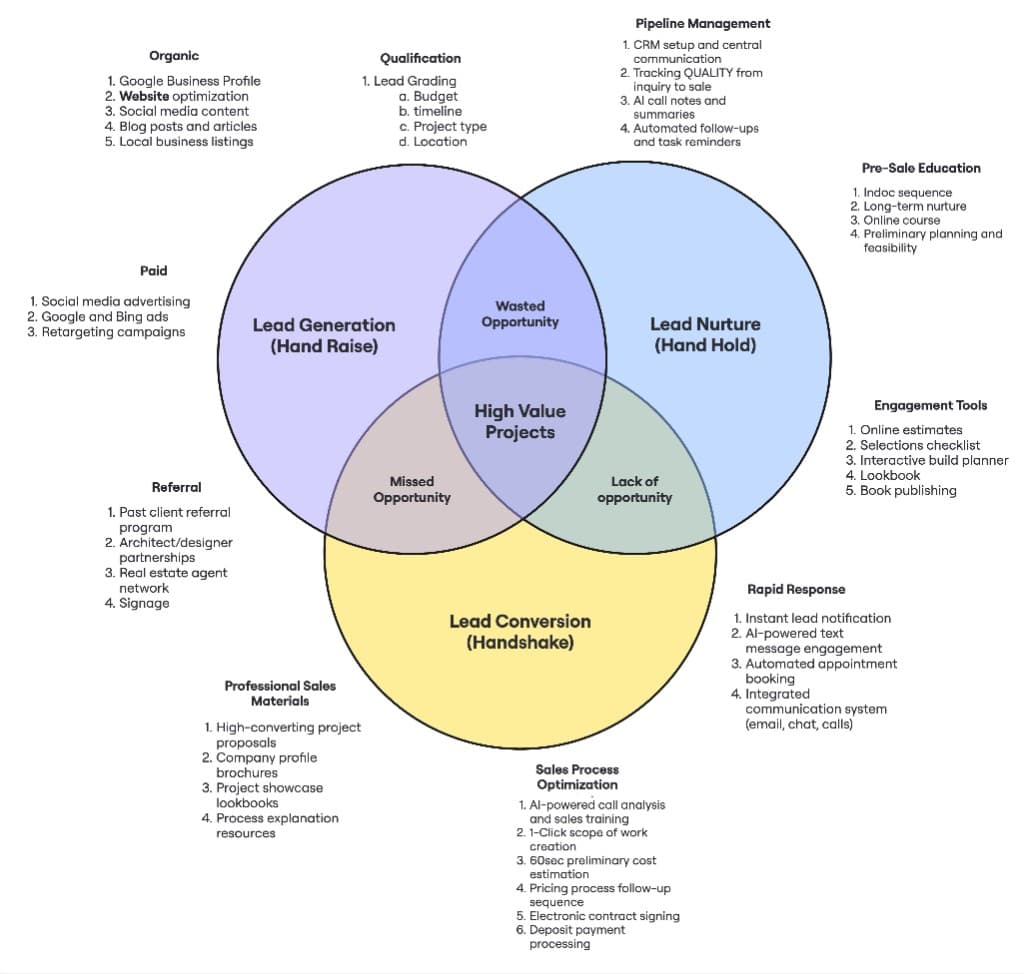
 This playbook
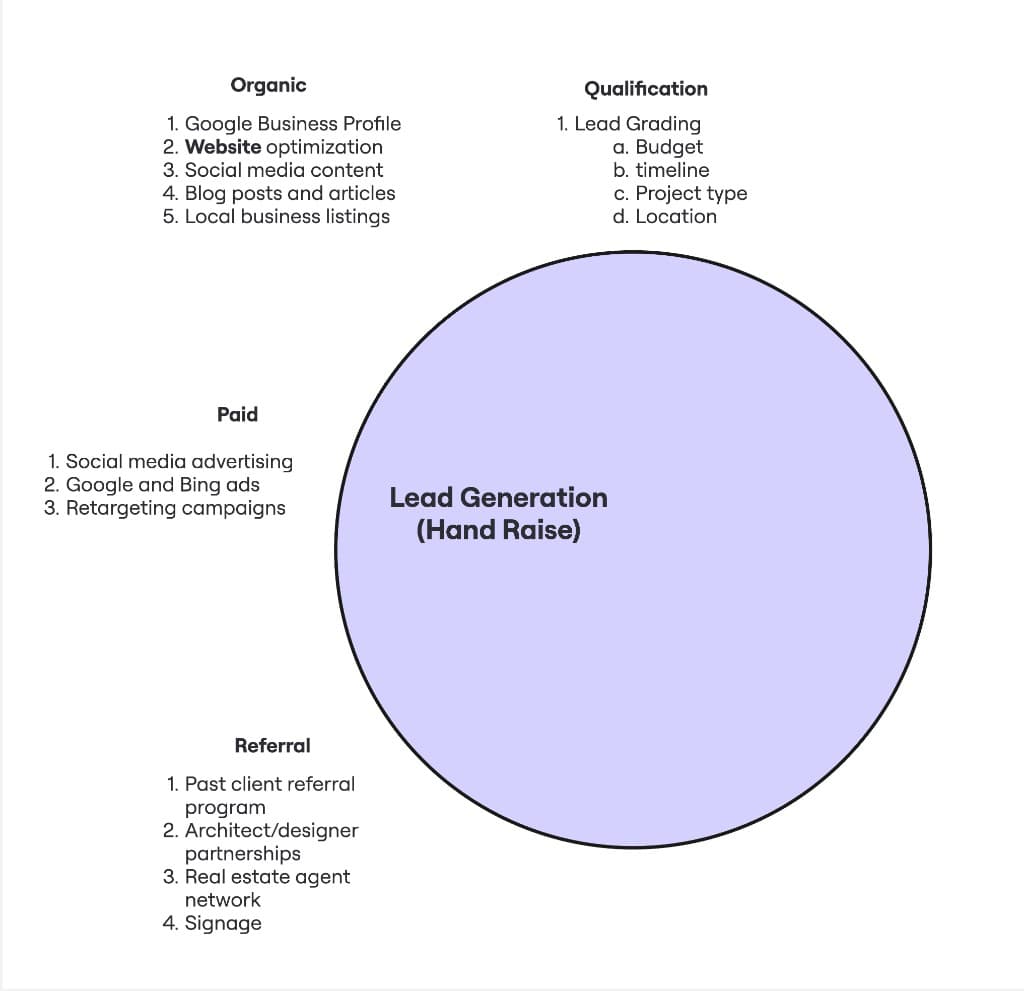
First circle — hand raise
Generation
Right homeowners find you, then get graded before your estimators burn hours.
Open pillar + workshop →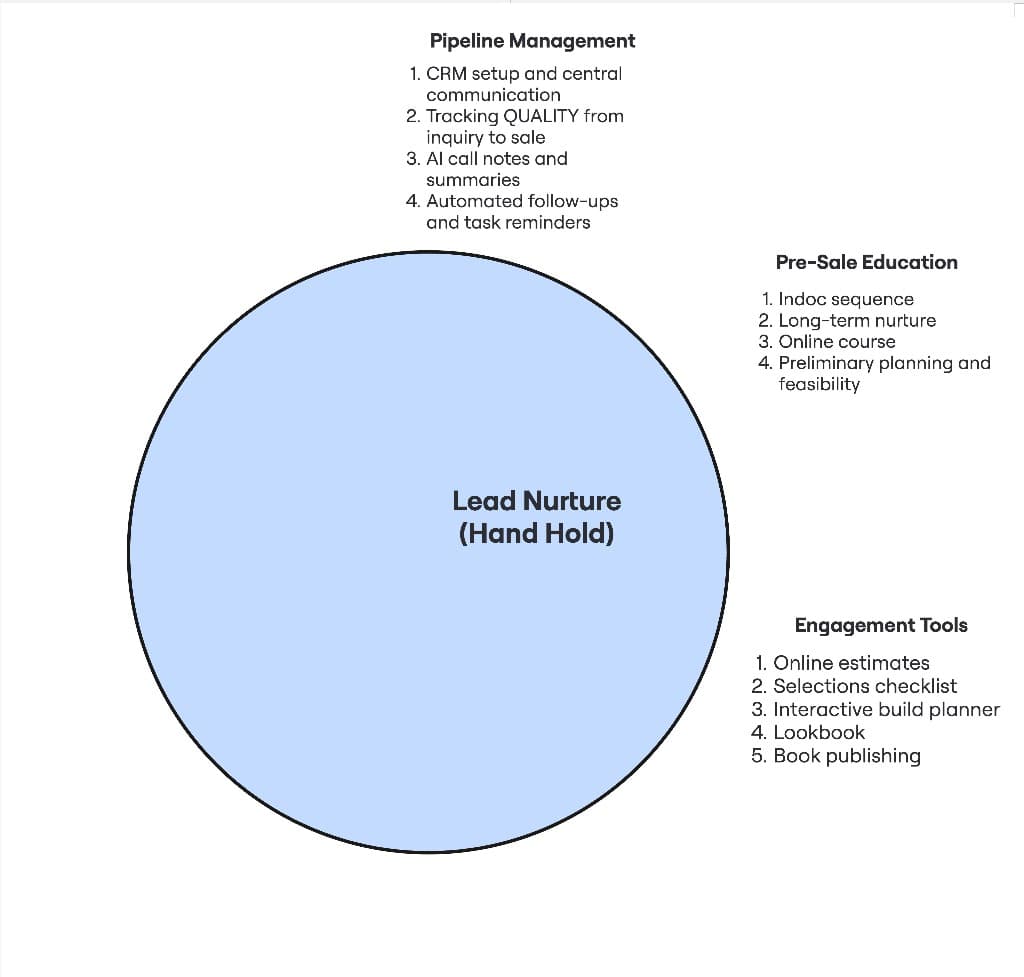
Middle circle — momentum
Nurture
Speed-to-lead, pipeline discipline, and education between interest and signature.
Open pillar + workshop →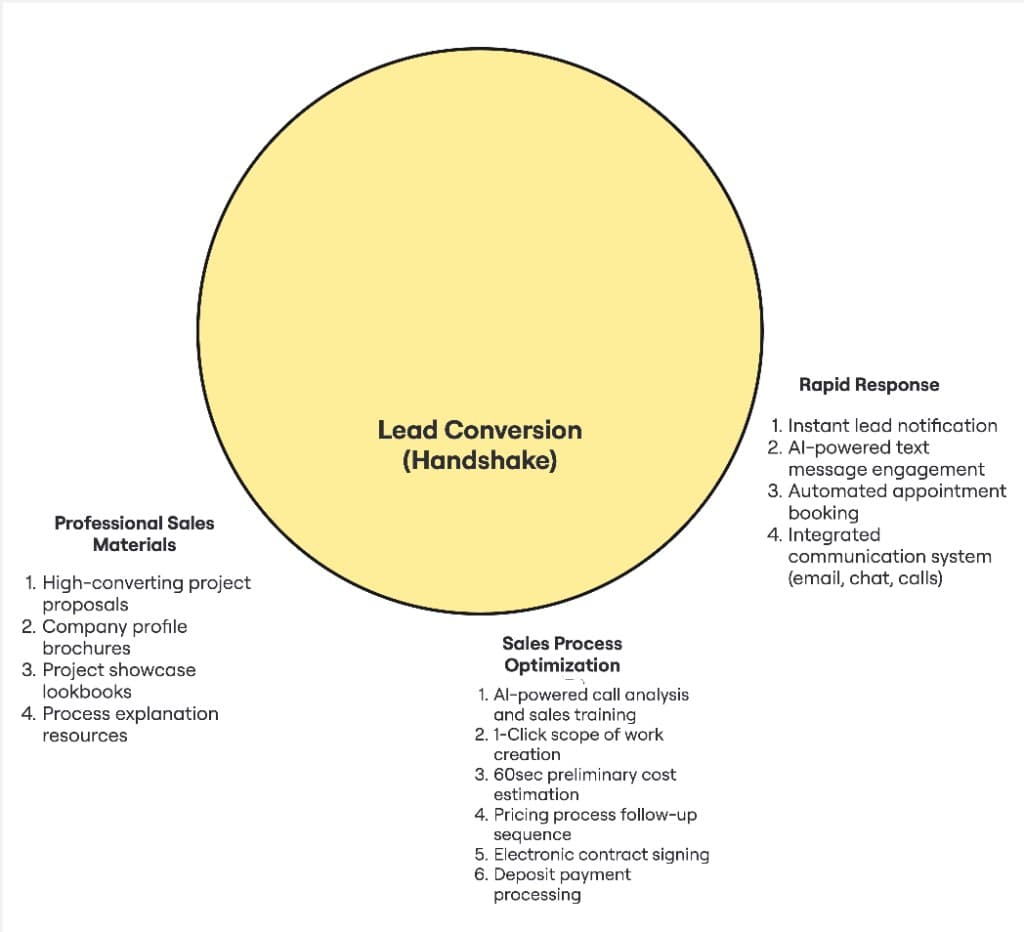
Third circle — signed work
Conversion
A repeatable sales process that does not depend on one heroic estimator.
Open pillar + workshop →If you want priorities by revenue stage, the Builder Growth Roadmap maps the same sequence across Stage 1 ($0–$500K) through Stage 5 ($5M+) so you can see what to tighten first at your current size.
01Why Most Builder Websites Are Invisible
TL;DR
Rankings die when relevance, trust signals, or technical health fail together—not only keywords.
- Thin generic pages miss query specificity Google rewards.
- Proof and backlinks separate seasoned builders from fly-by-night shells.
- Core technical hygiene unlocks everything layered above.
Google has one job: return the most relevant, credible, and trustworthy result for any given search. For "custom home builder Auckland" or "luxury builder Austin," it's looking for a website that signals local relevance, demonstrated expertise, real client proof, and technical integrity. Most builder websites fail on at least three of these four.
The relevance problem: pages that say "we build homes" instead of "we build custom homes in [specific suburb] for homeowners with a $600k–$2M budget." Vague, generic content doesn't match the specificity of search queries — and Google reads specificity as expertise.
The trust problem: most builder websites have thin content, no blog, no project documentation, no genuine testimonials with names attached, and no backlinks from credible local sources. Google can't tell this website apart from a business that opened last week. Authority has to be earned.
The technical problem: slow load times (especially on mobile), no schema markup, broken internal links, missing canonical tags, and no structured data telling Google what the site is about. These aren't cosmetic issues — they're ranking signals. Fix the technical foundation first or nothing else matters.
Understanding these three failure modes tells you exactly where to start. You don't need a clever strategy. You need a site that passes the tests Google is already running on it.
02Local SEO Foundation — Signals That Say 'I'm Here'
TL;DR
GBP depth plus citation discipline anchors Map Pack eligibility beyond generic websites.
- Categories, coverage maps, and geo posts reinforce locality.
- Matching NAP across directories removes suppression triggers.
- Suburb pages need genuine narrative—not duplicated placeholders.
Local SEO is a distinct discipline from national SEO. The signals Google uses to determine local relevance are different, and the tactics that work are specific to geography. Getting this right is what moves a builder from invisible to dominant in their specific market area.
The foundation is your Google Business Profile. Most builders have one but haven't optimised it. A fully built-out GBP — correct categories, complete service area, project photos with geo-tagged metadata, regular posts, and consistent review generation — is the single fastest-moving lever in local SEO. It directly determines whether you appear in the Map Pack.
Citation consistency is the next layer. Citations are every mention of your business name, address, and phone number across the web — directories, association listings, local business profiles. Inconsistent NAP data (different phone numbers, abbreviated address formats) confuses Google and suppresses rankings. Auditing and standardising your citations is unglamorous work that has a direct impact on Map Pack placement.
On-page local signals complete the picture. Service area pages, suburb-specific landing pages, geo-tagged project photos, and location mentions woven naturally into page copy all reinforce the signal that you operate in specific places. A builder doing work in 12 suburbs shouldn't have 12 identical pages — each one should have genuine, locally relevant content that makes it the best page on the internet about building in that area.
03Winning the Map Pack
TL;DR
Prominence comes from reviews plus locally relevant links—not guessing distance.
- Map placement blends relevance, proximity, and prominence scores.
- Review cadence beats dormant five-star averages.
- Local editorial or association links compound trust.
The Google Map Pack — the three business listings that appear above organic results for local service searches — is the most valuable piece of real estate in local search. Users click Map Pack results at a higher rate than organic results. If you're not in it, you're effectively invisible to a large segment of searching homeowners.
Map Pack ranking is determined by three factors: relevance (does your GBP match what they're searching for), distance (how close are you to the searcher), and prominence (how well-known and trusted is your business in Google's model). You can't control distance, but you can control the other two.
Prominence is primarily driven by reviews and links. Review volume and recency are strong Map Pack signals. A builder with 40 recent Google reviews consistently outperforms a competitor with 10 older ones, even with similar service areas. Engineering a review generation system — asking every satisfied client at the right moment, with a direct link to your review page — is one of the highest-ROI activities in local SEO.
Local links reinforce Map Pack authority. A mention from the local newspaper, a feature in a home design blog, a listing in the local builders association, a case study published on an architect's website — all of these create topically relevant, geographically local authority signals. You don't need hundreds. You need consistent accumulation from genuinely relevant local sources.
04Technical Infrastructure — The Engine Under the Hood
TL;DR
Speed, mobile parity, and schema earn crawl budget before thought leadership pays off.
- Core Web Vitals tie directly to ranking and conversion.
- Mobile-first indexing judges worst-case experiences honestly.
- Structured data reduces guesswork for crawlers.
Technical SEO is the foundation everything else is built on. A site with slow load times, poor mobile experience, broken structure, or missing markup can't rank well regardless of how good the content is. Google rewards sites it can crawl, understand, and trust. Most builder sites need significant technical work before content investment starts to compound.
Page speed is the most common technical failure. Google's Core Web Vitals measure loading performance, interactivity, and visual stability — and they're ranking signals. A site that takes 4+ seconds to load on mobile loses roughly half its visitors before they see anything. Fixing image optimisation, removing render-blocking scripts, enabling browser caching, and moving to a fast host are not glamorous changes, but they directly impact rankings and conversion rates.
Mobile-first indexing means Google primarily evaluates your mobile experience, not your desktop version. Most builder websites look fine on desktop and break or slow to a crawl on mobile. If your site isn't optimised for mobile — responsive layout, touch-friendly navigation, fast load times on 4G — you're being evaluated on the worst version of your site.
Schema markup is the layer that tells Google explicitly what your content is about — your business type, service area, review aggregate, project types, and FAQ content. Without schema, Google has to guess from your HTML what your site means. With schema, you're giving it structured data it can parse accurately. It's not optional for competitive local SEO. It's what gets you rich results, review stars in search, and FAQ snippets that take up more real estate on the page.
05Content Strategy — Topic Clusters and Long-Tail Authority
TL;DR
Cornerstone guides plus supporting spokes prove depth better than thin keyword repeats.
- Clusters map buyer questions across entire journeys.
- Long-tail captures researchers months ahead of RFQs.
- Helpful prose beats engineered fluff every algorithm refresh.
Content is how you earn authority on topics that matter to your ideal clients. Not generic content — content that answers the specific questions homeowners are asking when they're considering a custom build, choosing between builders, or trying to understand what a project actually costs.
The topic cluster model is the most effective structure for builder SEO. You build a cornerstone page — a comprehensive, authoritative guide — around a high-value keyword like "custom home building process" or "how much does a new build cost in [city]." Then you build supporting pages around related subtopics that link back to the cornerstone. This architecture tells Google you have deep, structured expertise on the topic, not just a service page with the keyword mentioned three times.
Long-tail content captures the conversations happening at every stage of the buying journey. "How long does a custom home build take," "what's included in a custom home contract," "do I need an architect or a design-build builder" — these searches come from homeowners who are months away from being ready but are actively educating themselves. Showing up for these searches builds familiarity and trust long before they're making calls.
The critical principle: every piece of content should be written for a real buyer, not a search engine. The builders who write thin, keyword-stuffed pages to game rankings are getting less out of it every year. Google's algorithm rewards depth, clarity, originality, and evidence of genuine expertise. Writing content that actually helps a homeowner understand a complex decision is both good SEO practice and good sales practice — because the person who learns something useful from your article is already more likely to trust you with their project.
06Link Authority and Off-Page Signals
TL;DR
Earn links from trades you already collaborate with—spam directories subtract instead of add.
- Earned mentions beat purchased irrelevant placements.
- Architect or supplier showcases naturally cite credibility.
- Guest expertise doubles PR plus SEO simultaneously.
Links from other websites to yours are one of Google's strongest authority signals. A backlink is effectively a vote of confidence from one website to another. Links from high-authority, locally relevant sites carry significantly more weight than random directories.
For builders, the most natural link-building opportunities are genuine industry relationships. An architect who links to your portfolio on their website. A local home design publication that features a project case study. The builders association listing that includes a link to your site. A supplier who includes you in a "projects" showcase. These links exist because the relationship is real — and they're the ones Google values most.
Guest content is another legitimate approach. Contributing a builder's perspective to a local home design blog, writing an article for a trade association publication, or participating in a "local business spotlight" feature generates links and genuine visibility simultaneously. The goal is never just the link — it's the combination of the link, the brand mention, and the new audience that comes from it.
Link building has to be patient and genuine. There are no shortcuts that work long-term. Paid link schemes, low-quality directory spam, and link exchanges from irrelevant sites are actively penalised by Google. The builders who win local search are the ones building real relationships that naturally generate citations and links over time — which means starting now, before a competitor gets there first.
Who this guide is for
- Builders who want to own local search instead of renting attention forever through paid traffic.
- Businesses with enough proof, project work, and credibility to support a long-term search strategy.
- Owners who want search visibility that compounds over time rather than disappears the moment spend stops.
Common mistakes builders make
Most of these problems are not caused by effort alone. They come from the wrong sequence, the wrong assumptions, or a missing layer in the system.
- Assuming a nice-looking website is automatically an SEO strategy. Visual design and search performance are almost entirely separate disciplines.
- Publishing thin service pages without enough authority, proof, or local relevance. A page that says 'we build homes in [city]' with 200 words of generic copy isn't a ranking page — it's a placeholder.
- Expecting SEO to solve a short-term pipeline emergency. SEO is a 3–12 month compounding investment. If you need leads in the next 4 weeks, that's a Google Ads problem, not an SEO problem.
- Ignoring Google Business Profile optimisation while investing in website SEO. The Map Pack is often the highest-traffic element on a local search page. GBP is not optional.
- Building links from irrelevant directories or link farms. Google's algorithm identifies and discounts or penalises these. Every link-building activity should be grounded in a real relationship or genuine content.
- Stopping SEO activity the moment rankings improve. SEO is not a one-time project — it's a continuous program. Rankings earned without maintenance erode as competitors accumulate authority.
Frequently asked questions
How long does SEO take to show results for a home builder?
Most clients see meaningful movement in local rankings within 3–6 months. The Map Pack can move faster — sometimes within 6–8 weeks of consistent GBP optimisation and review generation. Organic traffic compounds over 6–18 months. We build for both short-term wins and long-term defensibility from day one.
Do I need a new website for SEO to work?
Not always. We audit your current site first. If the technical foundation is salvageable — reasonable page speed, mobile-responsive, able to be restructured — we work with it. If it's fundamentally broken, slow on mobile, or built on a platform that can't support the required structure, we'll tell you directly and explain why a rebuild pays for itself.
What's the difference between local SEO and regular SEO?
Local SEO targets geographically specific searches — people in your market looking for builders right now. It includes Map Pack optimisation, local citation building, and location-specific content. National SEO focuses on ranking for non-geographic terms. For builders, local SEO has a vastly higher ROI because the intent is more specific and the competition is more beatable than national markets.
Can you guarantee a number-one ranking?
No one can guarantee specific rankings — Google's algorithm is not something any agency controls. We can guarantee a technically sound, authority-building strategy that consistently improves your visibility over time. We show our work, report transparently, and explain every change we make and why.
Why is SEO worth the investment for builders specifically?
Because one signed project at $500k+ covers the entire year's SEO investment many times over. Paid ads stop generating leads the moment you stop paying. An SEO-ranked page keeps generating leads for years. For high-value, infrequent transactions like custom home builds, the compounding economics are unbeatable.
How do Google reviews affect SEO rankings?
Reviews are a direct Map Pack ranking factor. Review volume, recency, and average rating all contribute to local prominence. A builder with 50 recent five-star reviews consistently outranks competitors with fewer or older reviews. Building a systematic review generation process is one of the simplest and highest-impact SEO activities available to any local service business.
Should I be blogging as a builder?
Yes — strategically. Not blog posts for their own sake, but content that captures long-tail searches your ideal clients are making. 'How long does a custom home build take,' 'what's the difference between a project home and a custom home,' 'how to find a builder you can trust' — these searches are happening every day in your market. The builder who answers them best earns the trust before anyone picks up the phone.
Can I do SEO myself or do I need an agency?
You can handle some elements yourself — Google Business Profile maintenance, review generation, basic blog content. The technical work (site speed, schema, crawl structure) and the strategic layer (keyword architecture, topic clusters, link building) require significant expertise and consistent time investment. Most builder principals don't have both. The question is whether your time is worth more on-site or managing your own SEO program.
Apply it to your business
Framework first. Then the right next move.
A playbook helps you understand the mechanism. The Builder Growth Assessment uses your answers to suggest a likely starting lane: self-install or, for qualified builders, a Builder Growth Strategy.
- ✓The likely lane behind the growth pressure you reported
- ✓A useful starting point without pretending four answers prove the cause
- ✓A direct answer on fit, timing, and whether the wider system makes sense
Regional context: New Zealand home builder marketing and Australia home builder marketing.
Want the full system map first? Download the Growth System guide.
“We went from invisible to booked out for 12 months. Contractor Scale focused on quality over quantity, ensuring the leads we got were highly qualified and ready to convert — saving us time and effort in the long run.”
Real client proof
CJS Carpenters
NZ Builders