
The Sales & Feasibility Playbook: Stop Quoting for Free
The engineering script for stopping free quotes and selling Preliminary Agreements — how to move serious buyers into paid feasibility without losing the deal.
The model on one page
Where the money leaks, and where it stops
Orange is the path that gets paid. Grey is the path that does not. Every stage below has a gate, and the gate is the whole point: you do not do the next stage’s work for free while you wait for a decision.
Tenders per year
10
Full detailed estimates
Hours each
30
Principal and estimator time
Conversion
30%
Generous for custom work
Charge-out
$150
Per hour equivalent
Given away
$31,500
210 unpaid hours a year, on tenders that never signed
A worked example, not a claim about your business. Put your own numbers in it. The opportunity cost sits on top: those hours are not spent on signed jobs, on systems, or on higher-probability prospects.
Qualified enquiry · discovery call booked
The free quote
- Site visit, measure up, no fee
- Twenty to forty hours of scoping and estimating
- Send the number, then wait
- Compared against two other numbers
- Lost on price, or ghosted
Outcome: a price comparison you cannot win on your terms
Paid feasibility
- Discovery call, qualified against five criteria
- Preliminary proposed, fee agreed
- Invoiced, then the scope work starts
- A document delivered that is worth paying for
- Presented in person, contract closed
Outcome: revenue in week one, and a buyer with skin in the game
Discovery call
45 to 60 min · phone or video
- Budget range, asked directly
- Realistic start date on site
- Project type and complexity
- Site location and known conditions
- Design status, and other builders
Hold gateClear answers on all five, or disqualify. No site visit before this call.
Propose the preliminary
Same call · do not defer it
- Framed as protection, not a barrier
- Scope, weeks and fee stated plainly
- Free-quote objection handled
- Decision asked for directly
Money eventAgreement signed, fee invoiced
Hold gateNo scoping work starts until the invoice is paid.
Run the feasibility
3 to 4 weeks
- Site assessment and evaluation
- Zoning, consents, known constraints
- Scope definition and key decisions
- Cost plan with honest ranges
- Risk and variable register
Hold gateRanges are real, with contingency shown. No optimistic low number to win the job.
Present the findings
In person · 60 to 90 min
- Cost plan walked line by line
- The risks you found, named
- The variation process, shown
- The document, handed over
Hold gateLeave with a go, a no-go, or a booked follow-up. "Take your time" is not a close.
Convert to contract
1 to 2 weeks
- Proposal built off the feasibility
- Scope already agreed, so no surprises
- Deposit and start date
Money eventContract signed, deposit taken
Decide your policyWhether the fee is credited against the build. Set it once, apply it every time.
Conversion playbook · About 14 min read · Updated April 2026
What you get from this guide
Stop Free Quoting
Replace the free tender process with a paid feasibility model that filters intent and protects your time.
Higher Close Rate
Prospects who've paid for feasibility convert at 5–10x the rate of free quote recipients.
Protected Margin
Never again spend 40 hours on an estimate for someone who was never serious.
The problem this playbook fixes
Free quoting is the single biggest time and margin drain in most custom builder businesses. You spend 20–40 hours preparing a detailed tender — site assessment, preliminary drawings, materials research, cost planning — present it, and get ghosted or told 'we went with someone cheaper.' The problem isn't your price. It's the process. You've invested a week of work before the client has invested a single dollar. You've demonstrated that your expertise is free. And you've created the conditions for a price comparison that you can never win on your terms. Serious buyers pay for expert advice. The sales and feasibility model creates a paid first step that separates the buyers who are genuinely committed from the ones who were always just gathering information.
How this fits the Growth System
Conversion is the sales process, qualification, and decisions that protect margin and stop the wrong jobs taking over the calendar. Without it demand and nurture only produce activity, not signed contracts.
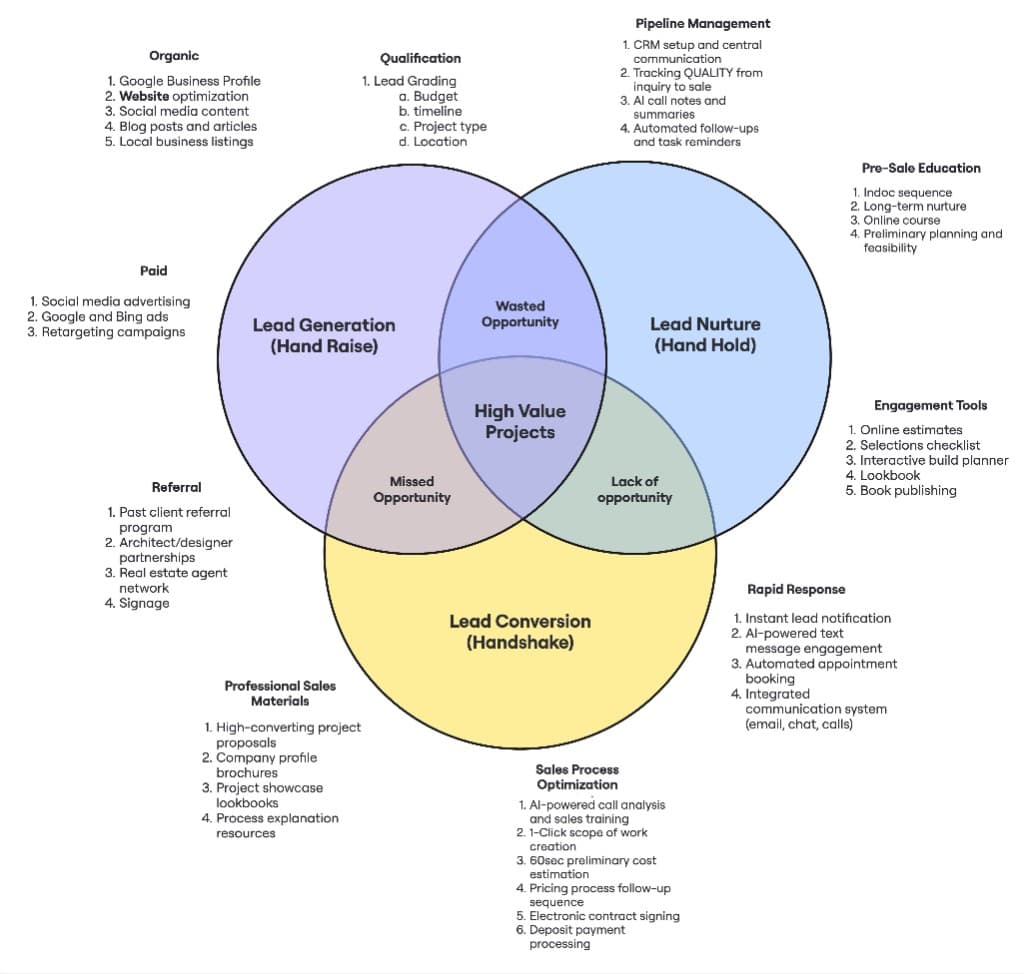
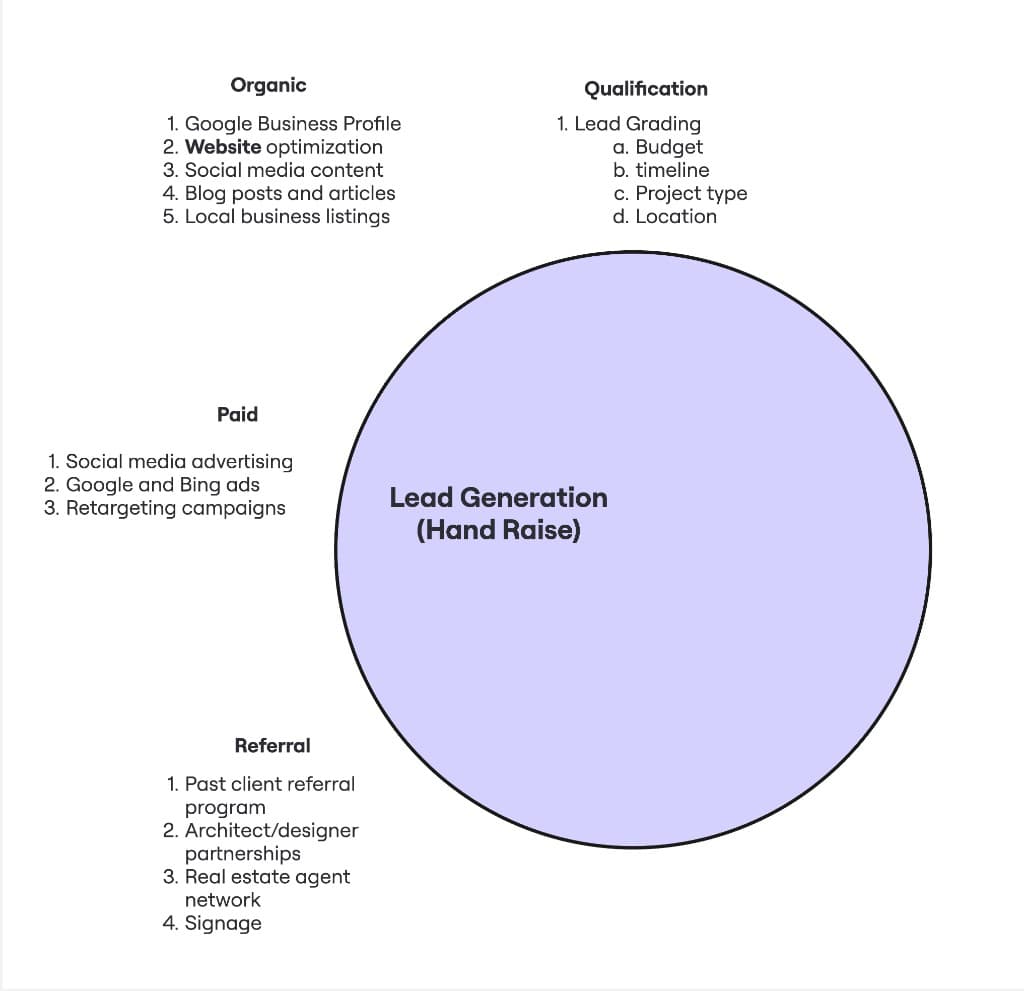
First circle — hand raise
Generation
Right homeowners find you, then get graded before your estimators burn hours.
Open pillar + workshop →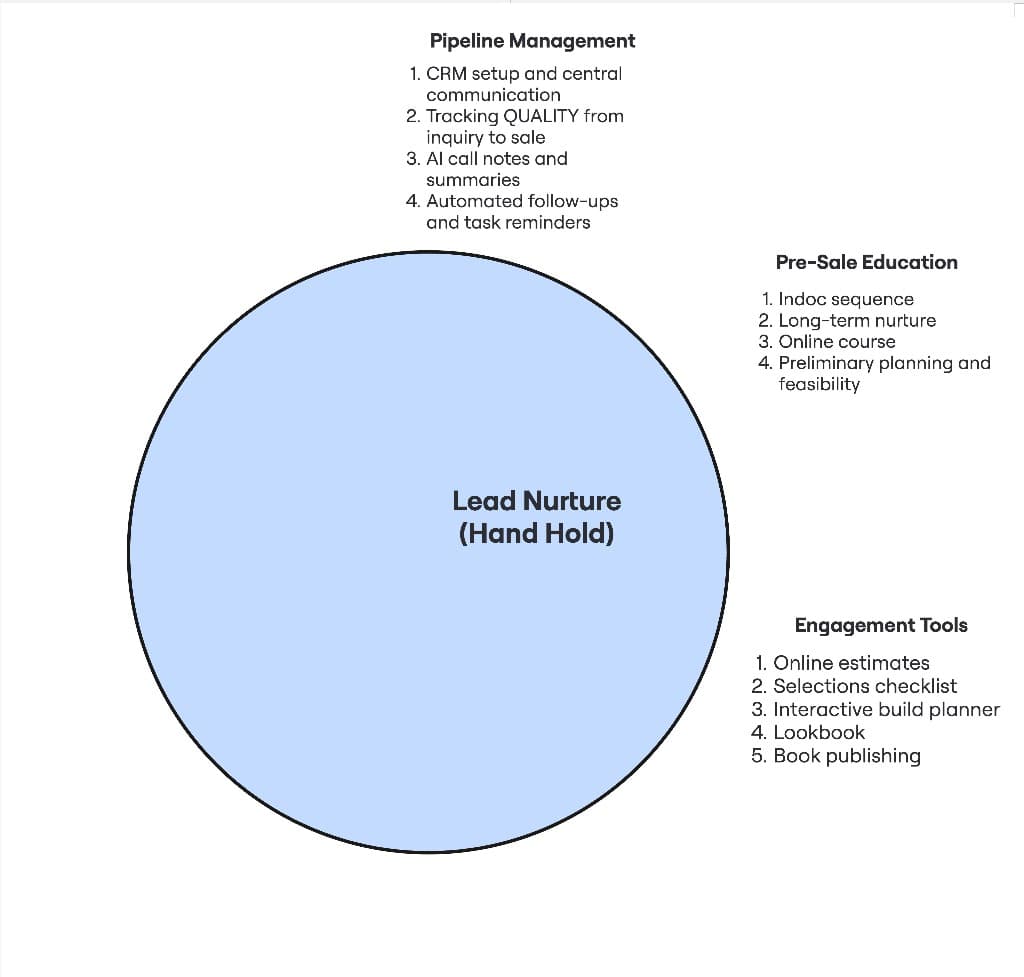
Middle circle — momentum
Nurture
Speed-to-lead, pipeline discipline, and education between interest and signature.
Open pillar + workshop →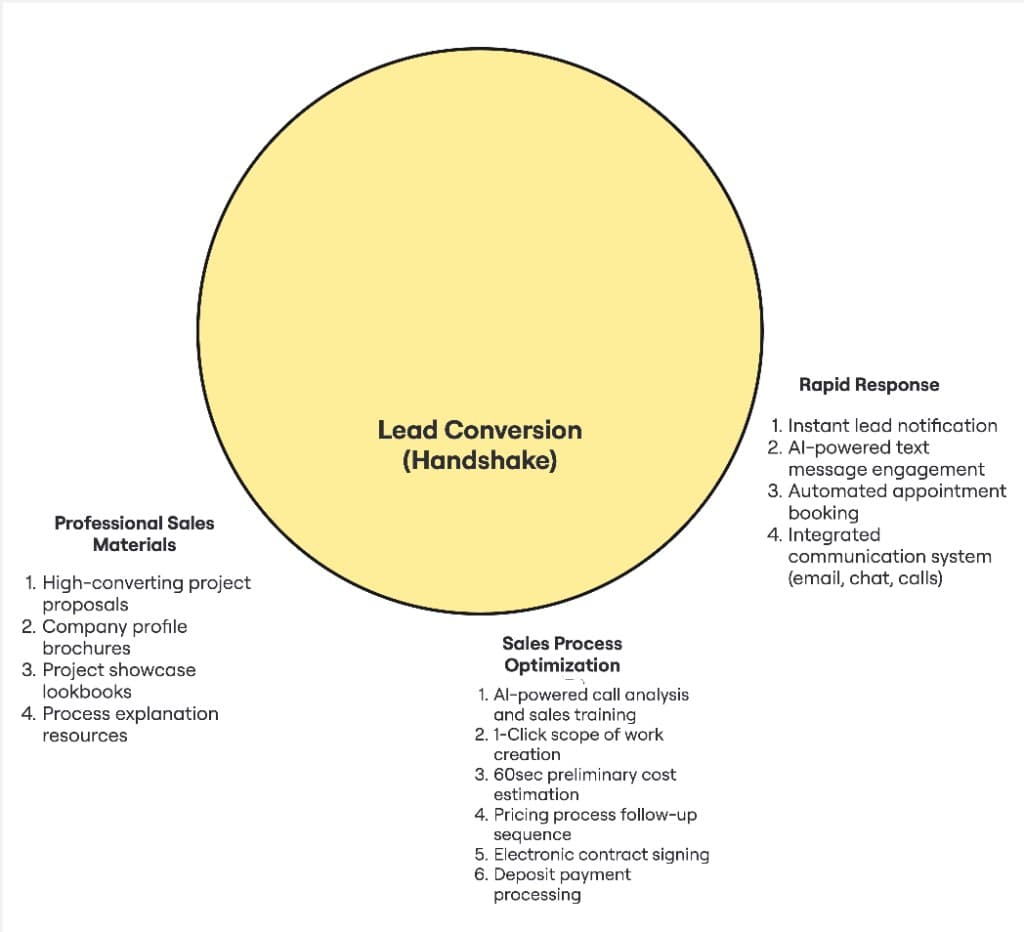 This playbook
Third circle — signed work
Conversion
A repeatable sales process that does not depend on one heroic estimator.
Open pillar + workshop →If you want priorities by revenue stage, the Builder Growth Roadmap maps the same sequence across Stage 1 ($0–$500K) through Stage 5 ($5M+) so you can see what to tighten first at your current size.
01Why Free Quoting Is the Silent Margin Killer
TL;DR
Unpaid tenders vaporise hundreds of principal hours while teaching buyers expertise costs zero.
- Ghosted proposals tally massive opportunity drain annually.
- Free positioning attracts comparator shoppers by default.
- Paid expertise signals premium professionalism immediately.
The economics of free quoting are worse than most builders realise when they look at it honestly. Take a builder doing 10 tenders per year. Average time per tender: 30 hours of principal and estimator time. If only 30% convert — which is generous for most custom builders — they've spent 210 hours of professional time that generated no revenue. At a conservative $150/hour equivalent value, that's $31,500 in unrealised fees, every year, just in the tenders that didn't convert.
But the financial cost is only part of the problem. The opportunity cost is just as significant. Every hour spent on a free tender that doesn't convert is an hour not spent on a project that's already signed, not spent improving systems, not spent on sales conversations with higher-probability prospects. The builder who stops free quoting doesn't just recover the direct cost — they also recover the strategic capacity to work on what actually grows the business.
There's a psychological dimension too. Free quoting trains your market to expect that your expertise has no value before the contract is signed. Homeowners who receive multiple free quotes learn to treat them as a commodity — to look at the final number and choose the cheapest. The builder who charges for early-stage expertise signals immediately that they operate differently, that their input is worth something, and that the relationship they're entering is a professional one with mutual respect for each party's investment.
The shift to paid feasibility is not a luxury available only to premium builders. It's the mechanism that makes a builder premium. You don't charge for prelims because you're premium — you become premium in part because you've made the structural change to charge for your early expertise.
02The Preliminary Agreement Model — What It Is and How It Works
TL;DR
Structured paid scopes deliver bankable clarity—clients fund diligence fairly upfront.
- Deliverables must justify fee seriousness honestly.
- Builders gain filtering plus commitment simultaneously.
- Documentation quality previews eventual delivery standards.
A Preliminary Agreement — also called a Pre-Construction Agreement, Feasibility Study, or Preliminary Budget — is a paid engagement that happens before a contract is signed. It typically costs $3,000–$15,000 depending on the complexity of the project and the depth of the scope work involved.
What does it deliver? A proper preliminary agreement produces something the client genuinely values: a site assessment, a preliminary cost plan with realistic budget ranges, a scope definition that identifies the key decisions and variables, and an honest assessment of what the project will take in terms of timeline, process, and investment. This is expert professional advice. It should be paid for, the same way an architect charges for a concept design, or an engineer charges for a structural assessment.
For the builder, the Preliminary Agreement does three things simultaneously. First, it filters: only homeowners who are genuinely serious and financially capable of the project will invest in a preliminary. Price-shoppers and dreamers self-select out. Second, it creates commitment: a client who has invested $5,000 in a preliminary is far more likely to proceed to contract. They have financial skin in the game. Third, it generates early revenue from the sales process itself — the preliminary is not a cost, it's a service.
The structure of the preliminary scope matters. It should include enough deliverables that the client genuinely feels they received value — a document they can take to a bank, share with their architect, or use to make informed decisions — not just a rough number jotted on a page. The professional quality of the preliminary document is itself a proof point for the quality of the full build.
03Selling the Preliminary — The Exact Conversation
TL;DR
Frame preliminary work as risk-reduction—not toll booths—to neutralise comparison reflex.
- Contrast commodity quotes against investigative partnerships boldly.
- Practice narratives before high-value prospects arrive tense.
- Confidence transmits integrity louder than discount apologies.
Most builders who attempt to introduce paid feasibility lose the sale at the conversation. Not because the model is wrong, but because they frame it as a barrier — "before we can do anything, you need to pay X" — rather than as a benefit: "the best way to protect your investment and your timeline is to start with a proper feasibility."
The framing shift is fundamental. A free quote says: "Give us a few weeks and we'll tell you how much it costs." A preliminary agreement says: "For [price], we'll spend [time] doing a proper site assessment, producing a realistic cost plan with clear ranges, identifying the key variables and risks, and giving you everything you need to make a confident decision — or to take to your bank for financing." One is a number. The other is a professional service.
The objection almost always comes down to: "other builders will quote for free." The right response isn't apologetic — it's direct. "Yes, they will. And I'm sure some of those quotes will come in low, and some of them will miss things that a proper feasibility would have found. We've seen what happens when a custom build gets to slab stage and encounters a site condition that wasn't scoped — it adds cost and time that a proper feasibility would have flagged upfront. The preliminary is how we protect your budget."
Practice the conversation before you need to have it. The first time you introduce paid feasibility to a prospect you're excited about, you don't want to be improvising. Know the framing, know the objections, know your responses. The builders who make this transition successfully are the ones who have internalised the logic so completely that the conversation feels natural, not like they're selling someone something they're not sure of themselves.
04Discovery Call Framework — Qualifying Before You Invest
TL;DR
Budget, timeline, complexity, and site realism gate every downstream investment hour.
- Direct ranges beat vague hope questioning politely.
- Structured warmth prevents rambling pleasantries sans decisions.
- Strong fits earn preliminary invitations immediately.
The discovery call is the most important conversation in the sales process. It determines whether you invest further time in the opportunity or disqualify it early. Most builders treat it as a pleasant getting-to-know-you conversation. It should be both pleasant and structured — a professional qualification process that gathers the specific information needed to decide if this is the right fit.
The discovery call has a clear objective: determine whether this homeowner is a realistic prospect for your business. That means understanding four things: budget (realistic range, not "as cheap as possible"), timeline (actual readiness to start, not "within the next year"), project type and complexity (within your zone of expertise and margin), and site/location (within your working area and acceptable site conditions).
The questions that surface these are straightforward but need to be asked directly. "What's your working budget range for the build?" is a better question than "what are you hoping to spend?" — it signals professionalism and sets the expectation that budget is a real, discussable number. "When are you hoping to start on-site?" combined with "how far along are you with design or planning?" tells you whether the timeline is realistic or aspirational.
The discovery call is also your first opportunity to sell the Preliminary Agreement. By the end of the conversation, if the lead is qualified, the natural next step is: "Based on what you've described, I think a preliminary feasibility makes a lot of sense as the next step. It would give us three to four weeks to do a proper site assessment, run the cost planning, and give you a realistic picture before anyone commits to anything further. The investment is [price]. Would that work for you?" This is a direct, professional close — and it's the most natural transition from a good discovery conversation.
05Sales Process Architecture — Making the System Replicable
TL;DR
Playbooks, templates, and objection libraries transfer genius beyond founder-only calendars.
- Document question sequences plus collateral packets verbatim.
- Train successors using identical frameworks—not vibes.
- Confidence emerges when reps trust prepared choreography.
The most common single point of failure in builder sales is that it all lives in one person's head. The principal knows how to run a great discovery call, how to present a preliminary, how to handle objections, how to close. But if that knowledge isn't documented and systematised, the business can't grow beyond the capacity of that one person. It also can't survive that person having a bad week.
Sales process architecture means documenting every step from first contact to signed contract, building templates and tools for each stage, and creating a system that any competent team member can operate — not just the principal. It includes: discovery call frameworks (the questions to ask, the sequence to follow), preliminary agreement templates (the exact document structure and content), proposal templates (how a contract is presented and why), objection handling guides (the specific objections custom home buyers raise and the responses that address them honestly), and follow-up protocols (what happens after a discovery call, after a preliminary is presented, after a proposal goes out).
Most builders have some version of these tools — they're just not documented, not consistent, and not transferable. A sales conversation that happens differently every time can't be improved systematically. A sales conversation with a defined framework can be refined, trained, and handed to another person.
The byproduct of a documented sales process is confidence. A builder who walks into a discovery call with a clear framework, not just good intentions, behaves differently. They ask the right questions. They listen without panic when an objection comes up. They know what the next step is and ask for it directly. That confidence is palpable to the homeowner and is itself a trust signal.
06Objection Handling for High-Value Custom Builds
TL;DR
Budget blowouts, delays, and trust wounds deserve proactive evidence—not dodge scripts.
- Validate fears before pitching reassurance credibility.
- Use testimonials naming uncomfortable truths solved gracefully.
- Most pushbacks signal missing proof—not permanent rejection.
Custom home buyers have specific, predictable fears. Budget blowout — they've heard stories of builds ending up 30% over the initial quote. Timeline delays — they've read online forums full of homeowners describing projects that ran 6 months over. Trust — they don't know if the builder they're talking to will be as responsive and communicative once the contract is signed as they are in the sales conversation. Decision paralysis — the scale of the decision creates anxiety that manifests as hesitation.
Understanding these fears lets you address them proactively, before the objection is raised. In your preliminary agreement process, you present a realistic cost range — not an optimistic low number designed to win the job — and you explain your contingency approach. In your process documentation, you show how you handle variations and communicate budget updates. In your testimonials and case studies, you feature clients speaking specifically about how you communicated when things came up.
Objection handling is not about having clever responses that make objections disappear. It's about having an honest, direct conversation about real concerns that a reasonable person is right to have. A homeowner who's worried about budget overruns isn't being difficult — they're being prudent. A builder who addresses that concern directly, with evidence and process, builds more trust than one who dismisses it or over-promises.
The most common objections you'll encounter: "we want to get a few quotes first" — address this by distinguishing your process from a comparison; "we're not sure about the budget" — this is a signal to use the preliminary as the tool that clarifies budget; "we've had a bad experience with a builder before" — this one requires patience, evidence, and a genuine understanding of what went wrong before. None of these should end the conversation. All of them are information about what the buyer needs to feel confident.
Who this guide is for
- Builders who are overgiving in sales and undercharging for early expertise.
- Owners who know free quoting is draining time, margin, and energy from the business.
- Teams trying to move toward paid feasibility, prelims, or a stronger discovery qualification process.
Common mistakes builders make
Most of these problems are not caused by effort alone. They come from the wrong sequence, the wrong assumptions, or a missing layer in the system.
- Giving away design, scoping, and pricing work before the buyer has shown any financial commitment. You're investing professional time on speculation, and signalling that your early expertise has no value.
- Treating objections as personal rejection instead of information about what the homeowner needs to feel confident. Every objection is a question that hasn't been asked yet.
- Keeping free quotes to protect win rate, even when the real cost is wasted time and suppressed margin. The win rate on free quotes looks better than the win rate on paid feasibility only if you count everyone who received a quote — including the ones who were never going to sign.
- Running the sales process differently every time, dependent on the principal's feel for the conversation, without documentation or templates. What can't be systemised can't be scaled.
- Presenting proposals without a clear next-step close. 'Take your time and let us know' is not a close. 'When do you want to move forward?' is.
- Mispricing the Preliminary Agreement too low out of fear of losing the prospect. A $500 preliminary signals that the work is simple and the builder isn't confident. A $5,000 preliminary signals the depth of expertise being deployed.
Frequently asked questions
Will a Preliminary Agreement fee scare off good clients?
The opposite. It scares off the wrong clients — price-shoppers who were never going to sign a contract. Serious buyers who are committed to building a $600k+ home understand that proper scoping takes expertise and time. The fee creates psychological commitment: a client who has invested money is far more likely to progress. Multiple Contractor Scale clients have reported that their best, most engaged clients were the most comfortable with the preliminary fee.
How much should I charge for a Preliminary Agreement?
It should reflect the actual professional effort involved — not be a token fee. For a custom home, $3,000–$10,000 is typical depending on site complexity, project scale, and the depth of the scope document produced. For a major renovation, $1,500–$5,000 is common. The amount should make the client feel they received genuine professional value — a document they can take to a bank, use to brief their architect, or use to make an informed go/no-go decision.
What if a competitor offers free quotes?
They're welcome to. Free quoting attracts price-sensitive clients who shop three builders and go with the cheapest. If that's the market you want, free quoting is the right tool. If you build premium projects for homeowners who value expertise and outcome certainty, the preliminary model filters for your ideal client. The builders who worry most about competitors offering free quotes are usually the ones most reluctant to test whether their ideal client actually cares.
How do I transition from free quoting to paid feasibility?
You don't have to flip overnight. Start by introducing the Preliminary as an option for complex or large projects — $800k and above, or anything with site challenges. Build confidence with a few early wins. As you see the quality of client improve and your conversion rate on preliminaries rise, make it your standard process. The transition typically takes 3 to 6 months for most builders to complete.
What if I introduce the Preliminary and the client goes to a competitor?
Some will. That was going to happen anyway — they were always going to compare. The difference is you find out in the first conversation rather than after 30 hours of tendering work. The clients who leave because you charge for preliminary scope were not going to be good clients. The clients who stay are the ones who become $900k signed contracts. The maths are unambiguously in favour of the preliminary model.
What should a discovery call cover?
Budget range, realistic timeline, project type and complexity, site location and any known site conditions, design and planning status (do they have drawings or a designer?), and whether they've spoken to other builders. These questions tell you whether to invest further time and whether the Preliminary Agreement is the right next step to propose. The call should be warm and conversational but structured enough that you leave with clear answers to all five.
How do I handle the 'we want to get a few quotes' response?
Acknowledge it, then reframe: 'Completely understand — that's a sensible approach for a decision this size. What I'd suggest is that before anyone invests the time in a detailed quote, it's worth spending an hour together so I can understand your project properly and you can understand how we work. If at the end of that conversation it makes sense to move forward, we'd do that through a preliminary feasibility — which gives you a real number you can actually bank on, rather than a range that might change when we get into detail.' This is honest, professional, and doesn't fight the instinct — it redirects it.
How do I handle the 'your price is too high' objection?
Don't discount. Instead, explore what's behind it: 'Too high relative to what? Another quote you've received, or what you'd budgeted?' If it's a comparison quote, distinguish the scope: lower quotes almost always miss something — site conditions, specification grade, contingencies, or margin that will come back as a variation. If it's budget-driven, the preliminary is the tool that creates an honest conversation about what the project actually costs and whether the scope can be adjusted to fit the budget.
The client-facing half
Stop explaining feasibility. Hand it over.
A white-label sheet you give the homeowner: what a feasibility study is, why you do not quote for free, the four weeks, what they receive, and the three ways it can end. Every fee, policy and contact detail is a blank you fill in once. Put your own logo on it and send it.
Apply it to your business
Framework first. Then the right next move.
A playbook helps you understand the mechanism. The Builder Growth Assessment uses your answers to suggest a likely starting lane: self-install or, for qualified builders, a Builder Growth Strategy.
- ✓The likely lane behind the growth pressure you reported
- ✓A useful starting point without pretending four answers prove the cause
- ✓A direct answer on fit, timing, and whether the wider system makes sense
Regional context: New Zealand home builder marketing and Australia home builder marketing.
Want the full system map first? Download the Growth System guide.
“The Sales Playbook changed how we price projects. We stopped doing free quotes and sold $15k of Preliminary Agreements in our first month.”
Real client proof
Cameron Jackman
CJS Carpenters