
Home Builder Website Design That Generates Leads, Not Just Looks
How to design and structure a home builder website that converts the right visitors into qualified enquiries — proof architecture, offer design, and qualification built in from the start.
Conversion playbook · About 13 min read · Updated April 2026
What you get from this guide
More Qualified Enquiries
Homeowners who match your project profile take action on your site — not just browse and leave.
Pre-Sold Visitors
Visitors arrive at your discovery call already understanding your value, your process, and your positioning.
Fewer Time-Wasters
Site structure and offer design filter out price-shoppers before they book your time.
The problem this playbook fixes
Most builder websites are digital brochures. They look professional, feature beautiful project photography, and tell you the builder is 'committed to quality.' What they don't do is sell. There's no clear offer, no compelling reason to take action today, no qualification layer, and no structure guiding the visitor from curiosity to commitment. The only people who contact most builder websites are the ones motivated enough to hunt for a phone number. A conversion-engineered website changes that equation entirely — by giving the right visitor a clear path forward and giving the wrong visitor a clear reason not to proceed.
How this fits the Growth System
Conversion is the sales process, qualification, and decisions that protect margin and stop the wrong jobs taking over the calendar. Without it demand and nurture only produce activity, not signed contracts.
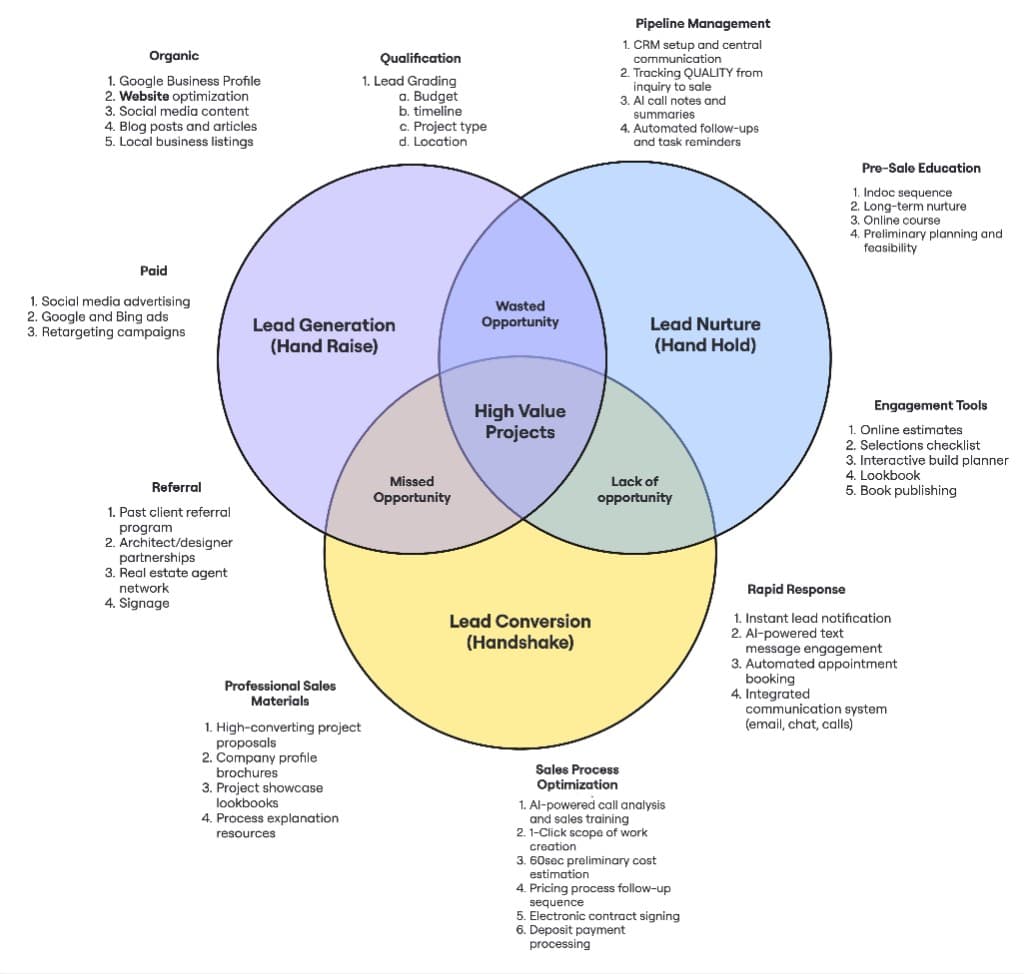
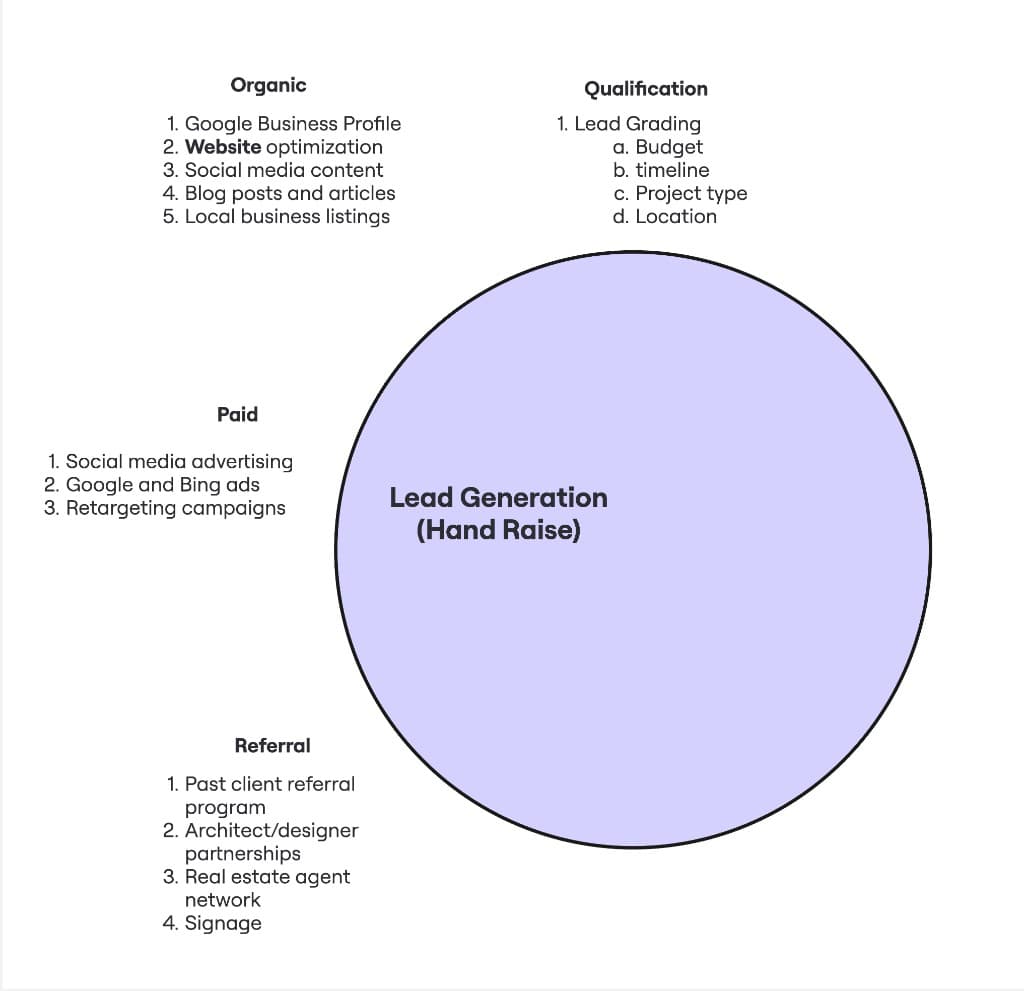
First circle — hand raise
Generation
Right homeowners find you, then get graded before your estimators burn hours.
Open pillar + workshop →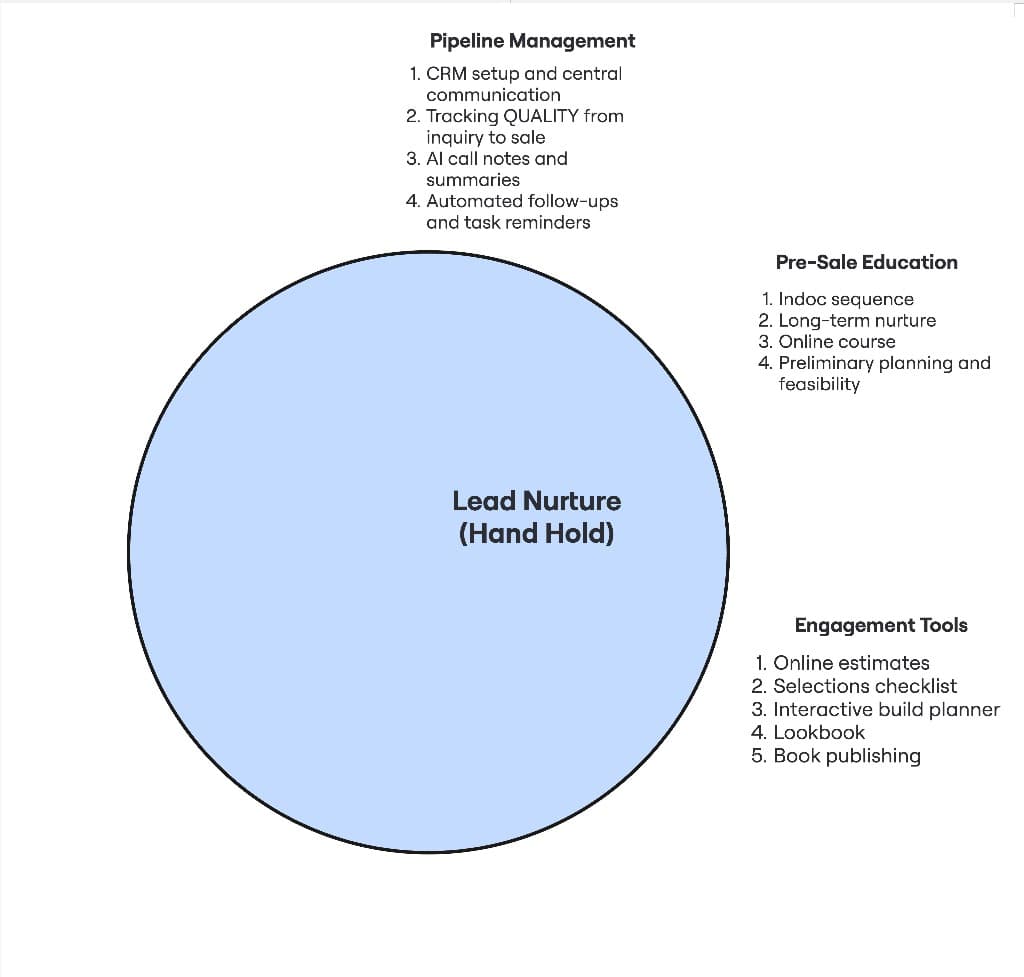
Middle circle — momentum
Nurture
Speed-to-lead, pipeline discipline, and education between interest and signature.
Open pillar + workshop → This playbook
Third circle — signed work
Conversion
A repeatable sales process that does not depend on one heroic estimator.
Open pillar + workshop →If you want priorities by revenue stage, the Builder Growth Roadmap maps the same sequence across Stage 1 ($0–$500K) through Stage 5 ($5M+) so you can see what to tighten first at your current size.
01Why Builder Websites Don't Convert
TL;DR
Absent offers, weak proof sequencing, page sprawl, and mobile friction kill enquiries simultaneously.
- Ambiguous CTAs train homeowners to bounce quietly.
- Risk-heavy purchases demand escalating evidence trails.
- Navigation maze distracts from intentional buyer arcs.
The number one reason builder websites fail to convert is the absence of a clear offer. Most have a "contact us" button. A few have a "get a free quote" form. Neither of these is an offer — they're invitations to start a conversation with no framing, no value exchange, and no qualification. The homeowner has no idea what happens when they click. Will someone call them? When? Is there a commitment involved? It's ambiguous, and ambiguity kills conversion.
The second reason is proof sequence failure. A homeowner considering a $600k–$2M project is making one of the largest financial decisions of their life. They are intensely risk-averse and deeply skeptical. They've heard stories of projects going over budget, timelines blowing out, and builders going silent after the contract is signed. The question running through their mind while they browse your website is: "Can I trust these people?" If your website doesn't answer that question convincingly — with specific case studies, video testimonials, documented projects, and evidence of how you handle challenges — they leave without contacting you.
The third reason is page flow that goes nowhere. Most builder websites are structured like a portfolio: photos, a services list, an about page, a contact form. There's no narrative, no sequence that builds conviction, no escalating commitment. A conversion-engineered website is structured more like a sales conversation: it opens with the problem the homeowner recognises, builds credibility with evidence, presents a specific offer, and makes the next step obvious. Every page has a job and a clear next action.
The fourth reason — often ignored — is mobile performance. More than half of your website traffic is on a mobile phone. If your site loads slowly, has text too small to read without zooming, or has forms that are difficult to fill out on a touchscreen, you're destroying conversion for the majority of your visitors. Beautiful desktop design is irrelevant if the mobile experience is broken.
02The Vesting Offer Model — Your Most Powerful CTA
TL;DR
Paid preliminary scopes filter tourists while funding expert diagnosis upfront.
- Micro-percent project fees buy massive seriousness signals.
- Psychology aligns premium positioning before onsite estimating.
- Site copy explains deliverables—not surprise invoices.
The single highest-leverage change a custom builder can make to their website conversion is replacing "get a free quote" with a paid preliminary engagement as the primary call to action. This is the Vesting Offer model, and it transforms how your website filters and converts leads.
A Vesting Offer — also called a Preliminary Agreement or Pre-Construction Agreement — is a paid first step, typically $3,000–$15,000, where you scope the project properly before committing to a contract. From the website perspective, it changes your CTA from "ask us for something for free" to "invest in getting this right." That framing attracts serious buyers and repels price-shoppers.
The psychology is straightforward. A homeowner serious about building a $900k home has no objection to paying $5,000 for a proper feasibility and design scope — it's less than 0.5% of their project cost, and it directly reduces the risk of budget surprises later. The homeowner who objects to the fee is, almost universally, not ready or not able to commit to the project. The Vesting Offer is a qualification filter built into the sales process itself.
On the website, the Vesting Offer works best when positioned clearly on the homepage and on any page targeting serious buyers. It should explain what's included (site assessment, preliminary cost plan, scope definition), what the investment is (or a range), and what happens after — without making the homeowner feel like they're being charged for information that should be free. The framing is: "this is how serious builders and serious clients begin a project properly." Multiple Contractor Scale clients have stopped free quoting entirely within their first month of introducing this on their website.
03Proof Architecture — Building Trust Before the First Call
TL;DR
Named stories beat praise adjectives when budgets stretch seven figures.
- Video beats blurbs when homeowners narrate specifics.
- Layer proof wherever doubt spikes mid-scroll.
- Train capture questions yielding tangible anecdotes.
Proof is not a nice-to-have for builder websites. It's the primary conversion mechanism. For high-value, high-trust purchases like a custom home build, social proof is more persuasive than any marketing copy you can write. The question isn't whether to include proof — it's how to structure it for maximum impact.
The most powerful forms of proof for builders, in rough order of persuasiveness: video testimonials from named clients speaking specifically about the project experience; detailed case studies with before/after photos, scope description, and outcome; written testimonials with full names, project type, and location (not initials); project galleries with annotated details about the challenges and solutions; and recognition from third parties — awards, certifications, association memberships, media features.
Proof sequence matters as much as proof volume. You don't stack all your testimonials on an About page and call it done. Proof should appear at every point of potential doubt in the buyer's journey. On the homepage: establish credibility immediately. On service pages: provide proof specific to that service. On the FAQ page: use testimonials that address the specific objections being raised. On the enquiry/CTA section: provide the final reassurance that tips the decision.
Specificity is critical. "Great to work with" is not proof. "The team flagged a potential issue with the site drainage before we started framing — saved us $40k in remediation later" is proof. Specific, detailed client stories that describe the reality of the build experience create trust in a way that generic praise never can. Train your clients to give you detailed testimonials. Ask them specific questions. The more specific the proof, the more persuasive it is.
04Page Flow and CTA Hierarchy
TL;DR
Each URL earns one dominant conversion job plus a deliberate exploratory relief valve.
- Mirror homeowner mental checklist top-to-bottom.
- Sticky nav buttons repeat primary commitments everywhere.
- Secondary paths nurture researchers without hijacking funnel.
Every page on your website has one job. The homepage's job is to establish relevance, build initial credibility, and direct visitors toward the next step. A service page's job is to educate on a specific service, address the primary objection about it, and convert interested visitors to enquiries. A portfolio page's job is to demonstrate capability and taste while building trust. When pages try to do too many things at once, they do none of them effectively.
CTA hierarchy means having one primary action and one secondary action on any given page — never three or four competing options. The primary CTA for a custom builder website is typically "Start the Builder Growth Assessment" or "Apply for Your Market Assessment" — a specific, framed engagement that positions the discovery conversation as valuable, not just a sales call. The secondary CTA might be "View Our Projects" or "Download Our Process Guide" — options for visitors who aren't ready to talk yet.
Navigation design affects conversion more than most builders realise. Deep, complex menus give visitors more ways to wander off than to take action. The highest-converting builder websites have clean, simple navigation with a prominent CTA button in the header that's visible on every page. The fewer the distractions between a visitor's first impression and your primary conversion action, the higher your conversion rate.
The homepage structure that converts best for custom builders follows a consistent arc: hook (what we do, who it's for), credibility (proof of results, credentials, social proof), system/process (how we work, what to expect), offer (the Vesting Offer or discovery call), and address objections/FAQ. This order mirrors the internal conversation the homeowner is having as they evaluate you. When the page structure maps to the decision process, conversion rates improve significantly.
05Technical Performance and Core Web Vitals
TL;DR
Heavy galleries punish LCP unless compression and hosting discipline arrive first.
- Vitals failures ding rankings plus perceived craftsmanship.
- Image stacks dominate builder slowdown patterns.
- Real-device QA beats desktop-only design reviews.
Page speed is a conversion problem as much as an SEO problem. Amazon famously quantified that a 100ms increase in load time cost 1% in sales. For high-consideration purchases like custom homes, the relationship between site speed and trust perception is even stronger. A slow website signals an organisation that doesn't pay attention to details — which is exactly the concern a homeowner has about a builder.
Google's Core Web Vitals measure three aspects of load performance: Largest Contentful Paint (how quickly the main content loads), First Input Delay (how quickly the page responds to interaction), and Cumulative Layout Shift (how much the page moves around as it loads). Failing any of these signals is a ranking penalty in organic search and a conversion penalty regardless of where the traffic comes from.
The most common speed killers on builder websites are unoptimised images (photography websites regularly load 3–5MB of images on a single page), blocking JavaScript files that prevent the page from rendering, unminified CSS, and cheap shared hosting. None of these are difficult to fix once identified — they just require the technical attention most web designers don't apply after they've handed the site over.
Mobile experience deserves specific attention. Over half of website traffic arrives on mobile. If your contact form requires zooming, if your buttons are too small to tap accurately, or if navigation is difficult on a phone, you're failing the majority of your visitors. Test every page of your website on a real phone — not a browser emulator — before considering conversion optimisation work complete.
06Measuring Conversion — What Good Looks Like
TL;DR
Instrument GA4 events then judge qualified ratios—not gross form spam.
- Track taps on phone and mailto consistently.
- Homepages landing five-to-ten percent signal tuned journeys.
- Quality beats vanity conversion percentages every quarter.
Most builders have no idea what their website conversion rate is. They know roughly how many leads they get per month, but not what percentage of visitors those leads represent, which pages produced them, or which traffic sources convert at the highest rate. Without this data, every website decision is a guess.
Set up Google Analytics 4 properly before making any other changes. Configure conversion events for every form submission, every phone number click, and every email link click on the site. Connect GA4 to Google Search Console for organic search data and to Google Ads for paid traffic data. This gives you a complete picture of traffic sources, user behaviour, and where conversions are being lost.
Typical conversion benchmarks for builder websites: a well-optimised homepage converts 2–4% of visitors to enquiry. A purpose-built landing page for paid traffic should convert 5–10%. Below these numbers, there's a structural problem worth investigating. Above them, you have a system worth scaling.
The most useful conversion metric for a custom builder isn't conversion rate — it's qualified enquiry rate. Of the leads that come through the website, what percentage match your ideal client profile? A website converting 3% of visitors to enquiries but generating mostly price-shoppers is underperforming a website converting 1.5% where 80% are genuinely qualified. Optimising for quality, not just volume, is the conversion philosophy that actually grows a premium builder business.
Who this guide is for
- Builders getting traffic but not enough serious enquiries from their website.
- Owners tired of websites that look polished but do nothing commercially.
- Businesses ready to turn the website into an active part of the sales process, not just a portfolio.
Common mistakes builders make
Most of these problems are not caused by effort alone. They come from the wrong sequence, the wrong assumptions, or a missing layer in the system.
- Treating the website like a brochure instead of a sales tool. A beautiful portfolio with no offer, no sequence, and no clear next step generates browsing, not enquiries.
- Offering free quotes to everyone as the primary CTA. This filters for price-sensitivity, not project fit. The Vesting Offer model changes who contacts you before they pick up the phone.
- Burying proof in a single testimonials page instead of distributing it at every point of potential doubt throughout the site.
- Ignoring mobile performance while optimising desktop design. More than half of builder website traffic is mobile. A perfect desktop experience with a broken mobile experience is still a broken website.
- Using generic CTA language like 'contact us' or 'get in touch.' Every CTA should be specific about what happens next and why it's worth taking that step.
- Making no measurement setup — no conversion tracking, no analytics goals — and then making website decisions based on gut feel rather than data.
Frequently asked questions
Do I need a completely new website?
Not always. Some websites have a sound structural foundation but underperform on conversion elements — weak offer, no proof sequence, no mobile optimisation. We audit first. If the platform, structure, and technical foundation are salvageable, we work with what's there. If it's fundamentally broken — slow, built on the wrong platform, or impossible to restructure — we'll tell you directly and explain the economics of a rebuild.
What is the Vesting Offer and does it actually work?
The Vesting Offer (or Preliminary Agreement) is a paid first step — typically $3,000–$15,000 — that replaces the free quote. It works because it filters for serious buyers immediately, creates financial commitment, and positions you as a premium operator rather than a commodity. Multiple Contractor Scale clients have stopped free quoting entirely within their first month of introducing it. The homeowners who object to the fee almost never become signed clients anyway.
How do I know if my current website is underperforming?
The clearest signals: the ratio of traffic to enquiries, the ratio of enquiries to qualified conversations, and whether the people contacting you match your ideal client profile. If most website enquiries are price-shoppers or outside your project range, your qualification layer needs work. If you're getting traffic but almost no enquiries, your CTA structure and offer need work. The Builder Growth Assessment can route this as the likely constraint; a qualified Builder Growth Strategy determines whether the website needs deeper review.
Should my website show pricing?
Not specific pricing, but some form of budget guidance. Homeowners who don't know if they can afford what you offer won't contact you — they'll assume they can't and leave. A clear statement like 'we work with homeowners budgeting $600k and above for custom builds' filters out budget mismatches while converting the right clients more confidently.
How important are project photos on a builder website?
Critical — but quality matters more than quantity. 10 exceptional photos with captions explaining the design challenge, build approach, and client outcome are more persuasive than 100 generic construction shots. Project galleries should be treated as case studies, not just portfolios. Every project photo is an opportunity to build trust, demonstrate craft, and tell a specific story.
What CTA converts best for a custom builder?
CTAs that are specific and framed as a value exchange outperform generic 'contact us' buttons consistently. 'Start the Builder Growth Assessment' or 'Apply for Your Territory Assessment' converts better than 'Get a Quote' because it frames the next step as something worth having, not just a sales conversation. The Vesting Offer framing works similarly — 'Invest in a Proper Feasibility' is a more compelling action for a serious buyer than 'request your free quote.'
How long does it take to see results from website conversion improvements?
Conversion rate improvements are typically visible within 2–4 weeks of making structural changes — faster than SEO because you're measuring changes against existing traffic rather than waiting for new traffic to arrive. The most impactful changes (offer structure, proof placement, CTA hierarchy) often show measurable improvement within the first month.
Apply it to your business
Framework first. Then the right next move.
A playbook helps you understand the mechanism. The Builder Growth Assessment uses your answers to suggest a likely starting lane: self-install or, for qualified builders, a Builder Growth Strategy.
- ✓The likely lane behind the growth pressure you reported
- ✓A useful starting point without pretending four answers prove the cause
- ✓A direct answer on fit, timing, and whether the wider system makes sense
Regional context: New Zealand home builder marketing and Australia home builder marketing.
Want the full system map first? Download the Growth System guide.
“Website launched and got a new lead that same day. The same lead is also paying for my first preliminary budget.”
Real client proof
Florin Barbu
Custom builder