
CRM & Lead Automation for Home Builders
Remove the owner from the administration bottleneck — so no lead falls through the cracks, every follow-up happens on time, and your pipeline runs without you.
Nurture playbook · About 13 min read · Updated April 2026
What you get from this guide
Speed-to-Lead
Respond to every enquiry in under 5 minutes, automatically — before competitors even check their phones.
Zero Admin Leakage
Every lead is routed, tagged, and followed up without anyone needing to remember to do it.
Owner Freedom
The pipeline functions when you're on-site, in a meeting, or on leave.
The problem this playbook fixes
The average builder's lead management system is an inbox, a spreadsheet, and good intentions. Leads come in on a Tuesday, you get busy with an on-site problem, and by Thursday the lead is cold and you've lost the window. Follow-up happens when someone remembers — which means it's inconsistent, slow, and deprioritised every time something more urgent appears. The result is a pipeline that feels full of maybes, no clear view of what's actually real, and a nagging feeling that you're losing jobs you should have won. CRM and automation doesn't replace your team — it makes sure the right things happen at the right time without depending on anyone's memory or willpower.
How this fits the Growth System
Nurture is what happens after the first enquiry — so momentum does not die in slow follow-up, admin gaps, or forgotten next steps. Without it good leads cool off before sales ever sees them.
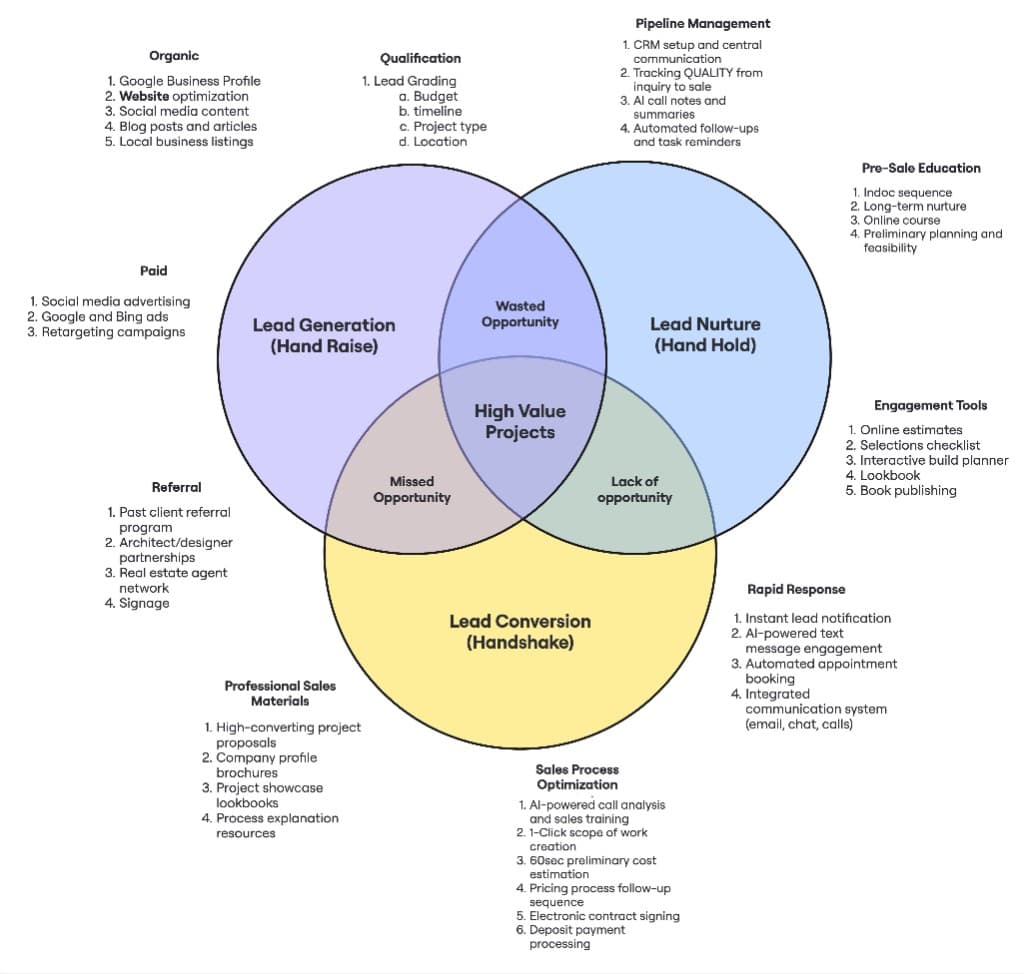
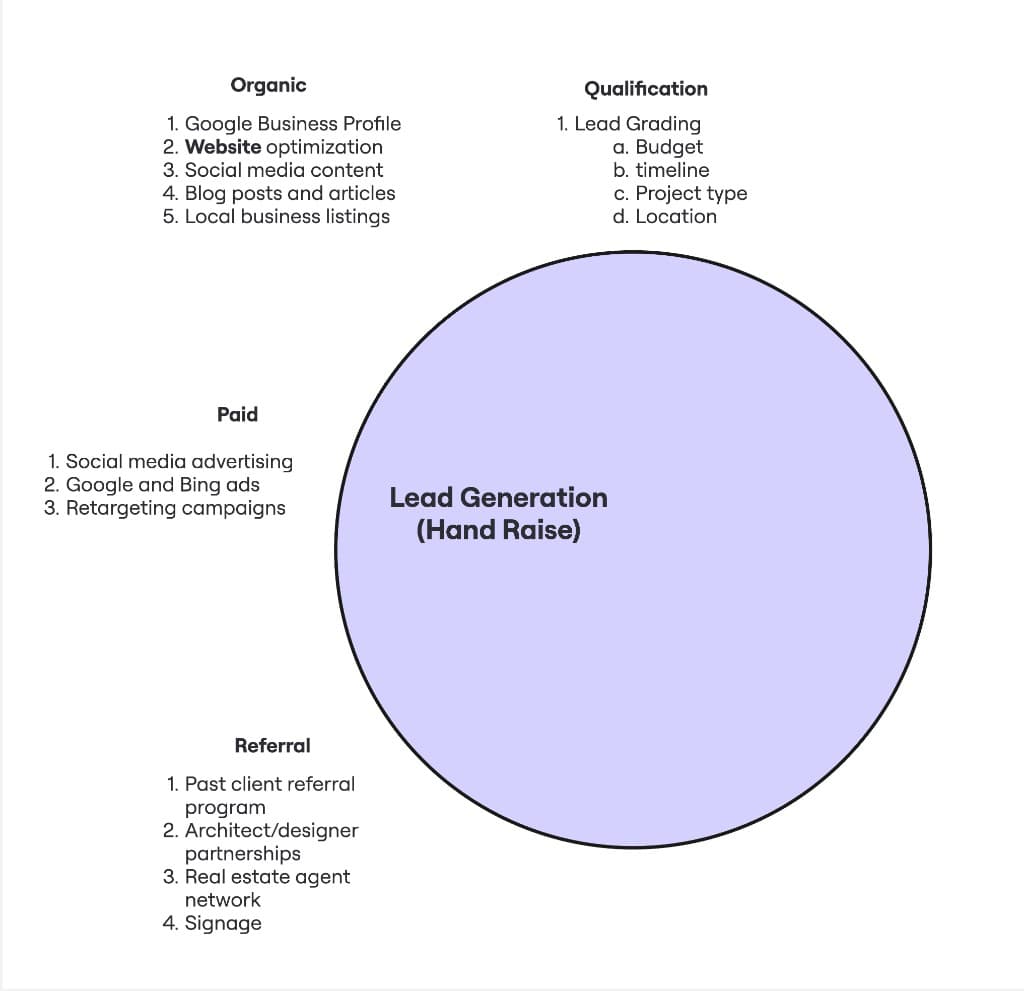
First circle — hand raise
Generation
Right homeowners find you, then get graded before your estimators burn hours.
Open pillar + workshop →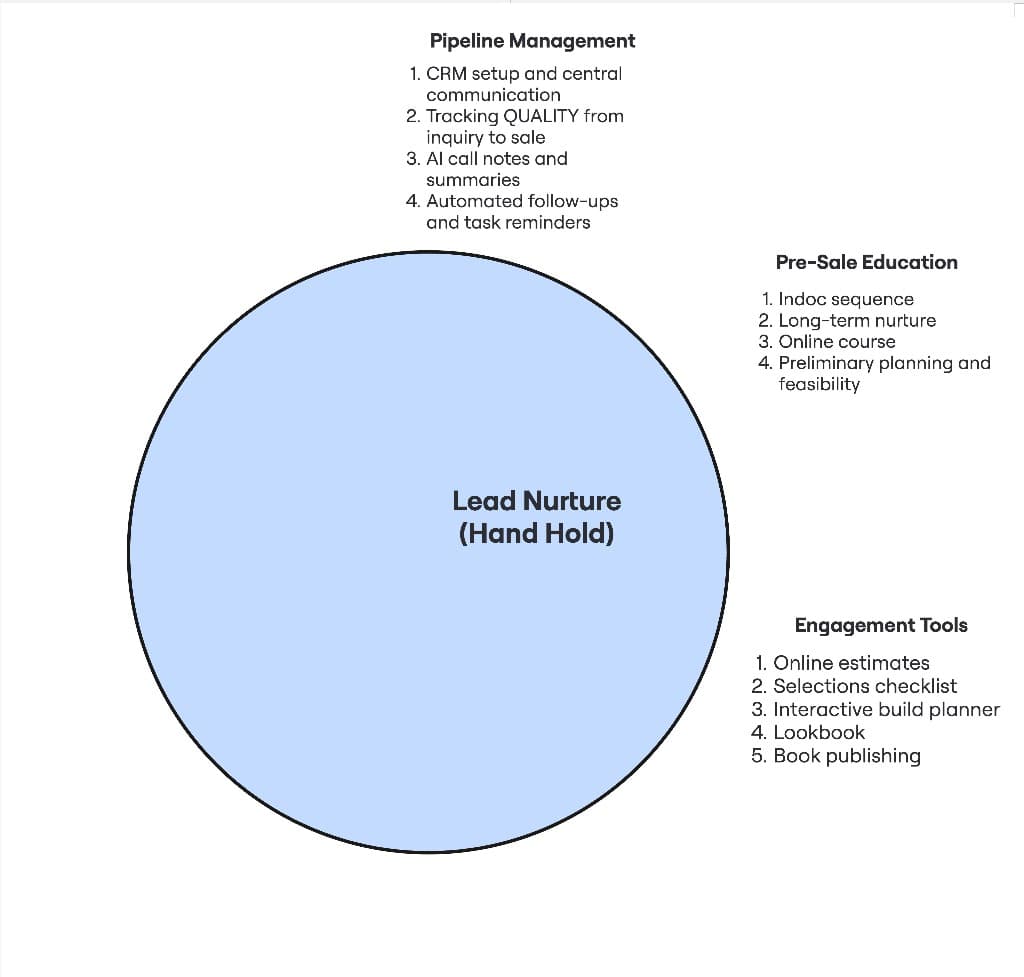 This playbook
Middle circle — momentum
Nurture
Speed-to-lead, pipeline discipline, and education between interest and signature.
Open pillar + workshop →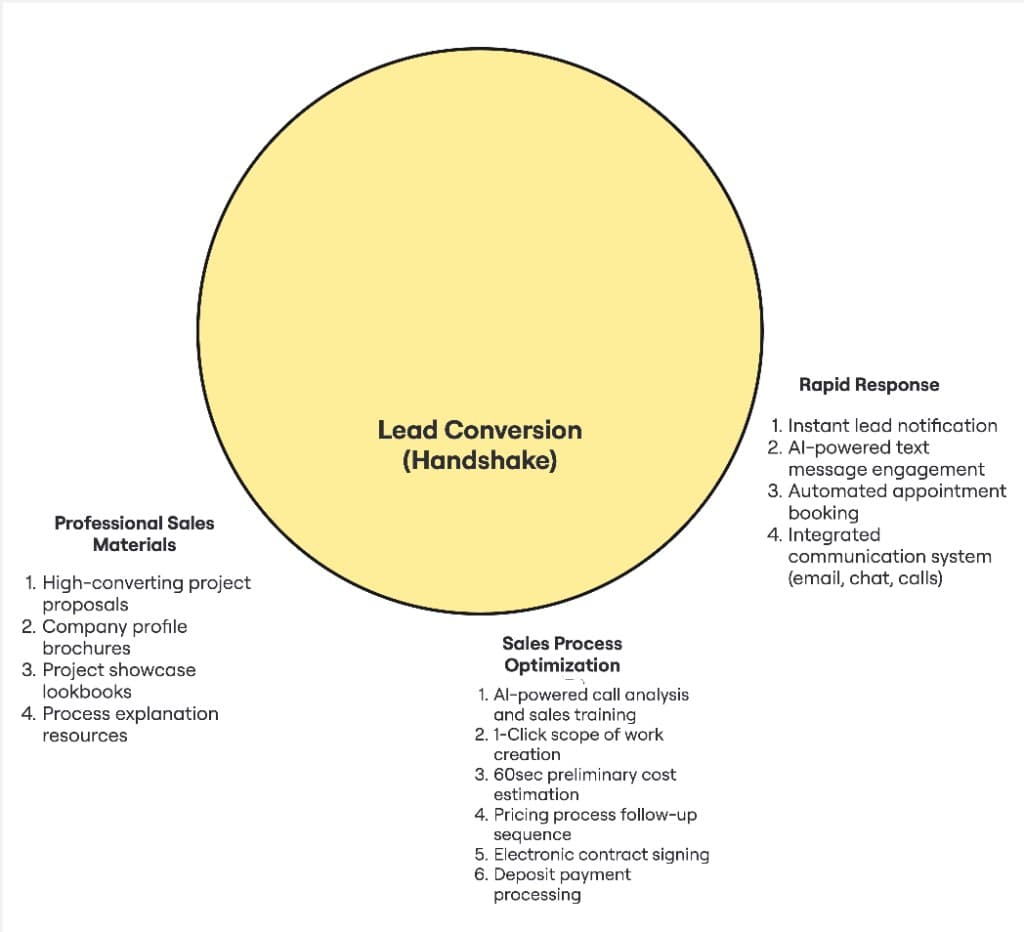
Third circle — signed work
Conversion
A repeatable sales process that does not depend on one heroic estimator.
Open pillar + workshop →If you want priorities by revenue stage, the Builder Growth Roadmap maps the same sequence across Stage 1 ($0–$500K) through Stage 5 ($5M+) so you can see what to tighten first at your current size.
01Where Builder Pipelines Actually Leak
TL;DR
Slow replies, vague next steps, and forgotten long-cycle leads evaporate margin quietly.
- Hour-one responses massively outperform forty-eight-hour norms.
- Calls without booked milestones stall indefinitely.
- Year-long buyers need programmed nurture—not silence.
Most builder businesses lose their best opportunities not to better competitors, but to their own follow-up gaps. The leak points are almost always the same, and almost always invisible until you track them.
The first leak: slow response time. Research consistently shows that the probability of qualifying a web lead drops dramatically within the first hour of submission. After 24 hours, you're chasing a prospect who has already had two or three conversations with competitors. The average builder, busy on-site, doesn't respond to web leads for 24–48 hours. Most of those leads are already gone.
The second leak: no defined next step. A lead submits a form. Someone from the office calls them the next day. There's a pleasant conversation. Nothing is scheduled. The contact goes back into the inbox. Two weeks later someone tries to follow up again. The homeowner has moved on or is no longer responsive. There was never a structured stage with a clear next action.
The third leak: long-cycle leads forgotten entirely. A homeowner who is 12 months from being ready to build contacts you today. You have a conversation, send some info, and six months later they've signed with a competitor because you stopped following up and they assumed you weren't interested. Long-cycle lead management is one of the biggest unrealised opportunities in custom building — most builders have former leads sitting in their inbox right now who would become clients with consistent nurture.
Understanding where the leaks are in your specific pipeline is the first step. A CRM audit — looking at every stage from first contact to signed contract and identifying where leads are stalling — typically reveals 20–40% more recoverable pipeline than the builder thought existed.
02Speed-to-Lead Architecture
TL;DR
Sub-minute SMS plus five-minute human tasks lock engagement windows automatically.
- Triggers fire regardless of principal presence onsite.
- CRM pipes unify web, ads, and social capture instantly.
- After-hours acknowledgement prevents Monday regret spirals.
The 5-minute follow-up is the standard we engineer toward. A lead submits a form at 7:15pm on a Tuesday. Within 60 seconds, they receive an automated SMS: "Hi [name], thanks for reaching out to [Company]. I'm looking forward to learning more about your project — I'll be in touch shortly. In the meantime, here's an overview of how we work with builders: [link]." Within 5 minutes, a task is created in the CRM for a personal follow-up call.
This architecture does three things. First, it occupies the window before competitors respond. A homeowner who's already received a professional, immediate response from you is psychologically less likely to engage deeply with the next builder who calls. Second, it buys you time to make a proper call rather than a rushed reactive one — the automated response manages the expectation gap. Third, it eliminates the human failure mode of forgetting.
The architecture behind this isn't complex. A properly configured CRM (we use Go High Level) can fire SMS acknowledgements, email sequences, and internal task notifications the moment a form is submitted — from your website, from your Google Ads landing pages, from your Facebook lead forms. All from the same system, with the same consistent messaging, regardless of whether anyone in your team is at their desk.
After-hours and weekend leads are where the biggest failures happen. A homeowner researching builders on Sunday evening who submits a form and hears nothing until Monday afternoon has often already called two competitors by the time you respond. Configure your automated acknowledgement to work 24/7, 365 days a year. The personal follow-up can wait until business hours; the acknowledgement cannot.
03CRM Pipeline Logic — Mapping Your Actual Sales Process
TL;DR
Stage transitions—not vibes—should spawn tasks, reminders, and nurture enrollments.
- Mirror real milestones from enquiry through contract.
- Owners per stage stop orphaned leads drifting.
- Long-cycle buckets differ materially from dead disqualifications.
A CRM pipeline should mirror how you actually sell, not how a generic sales template assumes you sell. The stages in your pipeline should reflect the real conversations and decisions that happen between first contact and signed contract — and each stage should have a defined next action and a defined owner.
For most custom builders, the pipeline looks something like: New Enquiry → Qualification Call → Site Visit Scheduled → Site Visit Completed → Proposal Sent → Proposal Follow-Up → Won / Lost / Nurture (long cycle). Each stage has a specific task associated with it. When a lead moves from New Enquiry to Qualification Call, an automation creates a calendar invitation and an SMS reminder. When a Site Visit is Completed, an automation reminds the relevant person to send a follow-up email within 24 hours.
Automation fires at stage transitions. This is the critical design principle. You don't automate the conversation — you automate everything around the conversation. Reminders, follow-ups, task creation, status updates, sequence enrollment — all of these trigger automatically when a stage changes. Your team's job is to have good conversations and move leads forward. The CRM's job is to make sure nothing that should happen after that conversation is forgotten.
The lost/nurture distinction matters enormously. Most CRMs send dead leads to a "closed lost" stage where they're never looked at again. A properly designed pipeline treats a "not ready yet" lead completely differently from a "genuinely not interested" lead. Long-cycle leads go into a nurture stage with an automated 90-day touchpoint sequence. Many of these come back 6–18 months later, and when they do, they've been consistently nurtured while competitors have forgotten they exist.
04Nurture Sequences That Educate Before You Pitch
TL;DR
Low-pressure educational drips keep twelve-to-twenty-four-month buyers warm honestly.
- Mix email plus SMS with spaced educational value.
- Answer silent objections before sales conversations reopen.
- Consistency outweighs sporadic manual check-ins.
Not every lead is ready to buy today. Custom home building involves one of the longest and most complex consumer decisions imaginable — 12 to 24 months of planning, research, and financial preparation is common. A lead who contacts you today might not be ready to move for another year. The question is: will they still be thinking of you when they are ready?
A nurture sequence is a structured series of touchpoints — emails, SMS messages, and occasional personal calls — that keeps you relevant to a prospect over time without requiring manual effort. Done well, a nurture sequence educates the homeowner about the building process, demonstrates your expertise and credibility, addresses the questions and objections they have but haven't asked, and keeps your name top of mind.
The content should be genuinely useful, not marketing. A sequence for a homeowner who enquired about a custom home build might include: a welcome email with a "how the custom home process works" guide, a week-three email about budgeting and the most common cost surprises, a week-eight email about what to look for in a builder contract, a week-sixteen client story email showing a project outcome similar to their stated goals. None of these are sales emails. They're all education. But each one builds trust and keeps the relationship warm.
The mechanism that makes nurture sequences work is timing and consistency. A homeowner who gets a useful email from you every four to six weeks for twelve months, without pressure, without spam, without anything that feels like a sales pitch — that homeowner is very likely to come back to you when they're ready to move. The builders who win long-cycle clients are almost never the ones who worked hardest in the initial conversation. They're the ones who stayed in touch.
05AI-Assisted Follow-Up
TL;DR
Automations qualify logistics while humans own persuasion and negotiation nuance.
- Bots capture budget, suburb, scope instantly overnight.
- Dormant databases revive via personalised outreach cadences.
- Guardrails prevent synthetic tone from replacing leadership calls.
Artificial intelligence in the CRM context isn't about replacing human sales conversations. It's about handling the repetitive, time-sensitive, logistically demanding parts of follow-up that humans consistently fail to do well because of time and attention constraints.
AI-assisted qualification handles the initial screening of new enquiries. When a form is submitted, an AI-powered conversation via SMS or a website chat widget can ask the three or four qualifying questions that determine whether the lead is worth a personal call: project type, estimated budget, preferred timeline, and location. This happens instantly, at 2am if necessary, and produces a qualified or unqualified flag before anyone on your team has spent a minute on the lead.
Re-engagement sequences for dormant leads are another high-value AI application. A CRM with 500 historical leads who went cold can be sent a personalised re-engagement sequence — "we haven't spoken in a while, we thought you might find this [relevant resource] useful, would love to hear how your project thinking has evolved" — that brings back a meaningful percentage as active prospects. Without automation, these leads would sit indefinitely.
The principle is that AI handles consistency and scale; humans handle complexity and relationship. No automated system should be having the conversation that matters — the one where a homeowner is deciding whether to trust you with their project. But every conversation around that conversation — the acknowledgements, reminders, follow-ups, educational sequences, re-engagements — can and should be systematised so your team is focused entirely on the conversations that require their expertise.
06Managing the Long-Cycle Lead
TL;DR
Segment timelines, automate milestone pings, harvest dormant CRM revenue patiently.
- Twelve-month planners need different cadence than ninety-day buyers.
- CRM reminders replace mental calendars principals cannot sustain.
- Reactivation campaigns monetise sunk acquisition costs.
Custom home building is, for most homeowners, a multi-year decision. From first inspiration to first call with a builder is often 18 months. From first call to signed contract can be another 6 to 12 months. Most builders' sales processes are designed for a 4-to-6-week decision cycle — which means they're fundamentally misaligned with how their clients actually buy.
A long-cycle lead management system starts with proper segmentation. Leads who are 12 months out need a different nurture approach than leads who are 3 months out. A homeowner who's "just researching" in January needs to feel remembered and valued in July without being pressured. The content of your nurture sequences, the frequency of touchpoints, and the call to action all need to be calibrated to where the homeowner is in their decision process.
Milestone tracking helps. A homeowner who tells you in March that they expect to be ready to start in October should have a CRM task to follow up in August. If your system relies on someone manually remembering to do this, it won't happen. Automated milestone reminders ensure the right conversation happens at the right time, without your team having to maintain a mental calendar of every prospect's timeline.
The business case for long-cycle lead management is compelling. A custom builder with 100 leads in their CRM who haven't been followed up in over 6 months is carrying dormant revenue that could be activated with a structured re-engagement campaign. Even a 10% reactivation rate on old leads represents significant pipeline created at near-zero acquisition cost — far more efficient than generating new leads from scratch.
Who this guide is for
- Builders who know leads are leaking between first contact and actual follow-up.
- Teams with too much pipeline sitting in inboxes, notes, or one person's head.
- Owners who want better speed-to-lead and more pipeline visibility without adding admin to their own week.
Common mistakes builders make
Most of these problems are not caused by effort alone. They come from the wrong sequence, the wrong assumptions, or a missing layer in the system.
- Relying on memory and goodwill instead of stage logic, ownership, and automation. The things that depend on someone remembering are the things that stop happening the moment the business gets busy.
- Thinking a CRM alone fixes follow-up when the real problem is the process sitting behind it. A CRM is a tool. Without a defined pipeline, stage logic, and automation rules, it's just a contact list.
- Waiting too long to respond to new enquiries, then blaming lead quality when the lead has already gone cold. Response time is under your control. Lead quality is not always.
- Sending dead leads to a closed bucket instead of a long-cycle nurture stage. A homeowner who isn't ready yet is categorically different from one who isn't interested. Treating them the same throws away recoverable pipeline.
- Building automations that feel automated — generic, impersonal, or timed without regard for where the homeowner is in their journey. Bad automation is worse than no automation; it damages trust.
- Building the CRM around what the software defaults to rather than how the business actually sells. Every stage and automation should map to a real step in your sales process.
Frequently asked questions
Which CRM do you recommend for home builders?
We primarily build on Go High Level (GHL) — purpose-built for service businesses with the best combination of pipeline management, SMS automation, email sequences, and landing pages at its price point. It handles every touchpoint from first enquiry to signed contract in one system, which eliminates the integration complexity of stitching together separate tools. We can also integrate with existing CRMs where there's a strong business reason to do so.
Do I need technical skills to run the automation once it's built?
No. We build it so your team can operate it without touching the backend. The daily-use interface — moving leads through stages, checking pipeline, logging call notes — is simple and requires no technical knowledge. We provide training for the relevant people and documentation for ongoing reference. Updates and system changes are handled by us, not you.
What's the ROI on CRM automation for a custom builder?
The primary ROI comes from two sources: recovered leads that would have gone cold without systematic follow-up, and time savings from eliminating manual admin. Most principals recover 5–10 hours per week when qualification and follow-up are no longer manual tasks. The recovered leads are harder to quantify precisely, but a single re-engaged lead that converts to a $600k project pays for years of CRM investment.
How long does it take to set up a CRM and automation system?
A basic pipeline with speed-to-lead automation can be operational within 2–3 weeks. A complete system — pipeline logic, nurture sequences, qualification automations, re-engagement campaigns, and reporting — typically takes 6–8 weeks to build properly. The investment in setup time pays back quickly because the system then runs with minimal ongoing management.
Can I migrate my existing contacts and leads into the new system?
Yes. We migrate contacts, historical lead data, and any notes from existing systems as part of the setup. Clean data migration is important — we don't just dump contact lists, we map existing data to the correct fields and stages in the new system so your pipeline is accurate from day one.
How do I know if a lead is genuinely lost versus just long-cycle?
The clearest signals: has the homeowner explicitly said they're not proceeding, or have they just gone quiet? A homeowner who says 'we've decided to stay in our current house' is genuinely lost. A homeowner who stops responding after a promising conversation is almost always a long-cycle lead who needs nurture, not a closed-lost entry. Default to nurture for any lead that hasn't explicitly said no.
What should a basic builder CRM pipeline look like?
The stages should map to your real sales process. A simple starting framework: New Enquiry → Qualification Call → Site Visit Scheduled → Site Visit Completed → Proposal Sent → Decision → Won / Long Cycle / Lost. Each stage has a defined next action and an automation that fires when the stage changes. The stages and definitions should be refined based on where your deals are actually stalling, not based on what looks clean on a kanban board.
Apply it to your business
Framework first. Then the right next move.
A playbook helps you understand the mechanism. The Builder Growth Assessment uses your answers to suggest a likely starting lane: self-install or, for qualified builders, a Builder Growth Strategy.
- ✓The likely lane behind the growth pressure you reported
- ✓A useful starting point without pretending four answers prove the cause
- ✓A direct answer on fit, timing, and whether the wider system makes sense
Regional context: New Zealand home builder marketing and Australia home builder marketing.
Want the full system map first? Download the Growth System guide.
“Had 5 leads from the new campaign — and the best bit — one of those leads is PAYING me to do a quote and kitchen renovation design.”
Real client proof
Alan Macaulay
Builder, NZ