
Google Ads for Home Builders: A Precision Playbook
Sniper-like targeting for homeowners already searching for your services — capture high-intent leads fast, without burning budget on the wrong clicks.
Demand playbook · About 14 min read · Updated April 2026
What you get from this guide
Immediate Pipeline
High-intent leads in your CRM within days of launch — not months waiting for organic rankings.
Budget Accountability
Every dollar tracked to pipeline value. You know exactly what you're paying per qualified conversation.
Scale With Confidence
Validated campaigns you can increase spend on once the system is proven in your market.
The problem this playbook fixes
Most builders who try Google Ads get burned. They set up a generic campaign, blow $2,000–$3,000 on broad keywords, get calls from people asking about handyman work or fence quotes, and conclude 'Google Ads doesn't work for builders.' The issue isn't the channel — it's the architecture. Google Ads works extraordinarily well when it's built around intent, paired with a proper landing page, and connected to a nurture system that follows up fast. Without all three, you're paying to generate leads that disappear because nothing catches them. The fix isn't more spend. It's better infrastructure.
How this fits the Growth System
Demand is how the right homeowners find you, trust you, and put their hand up before a competitor takes the attention. Without it the next two stages have nothing real to work with.
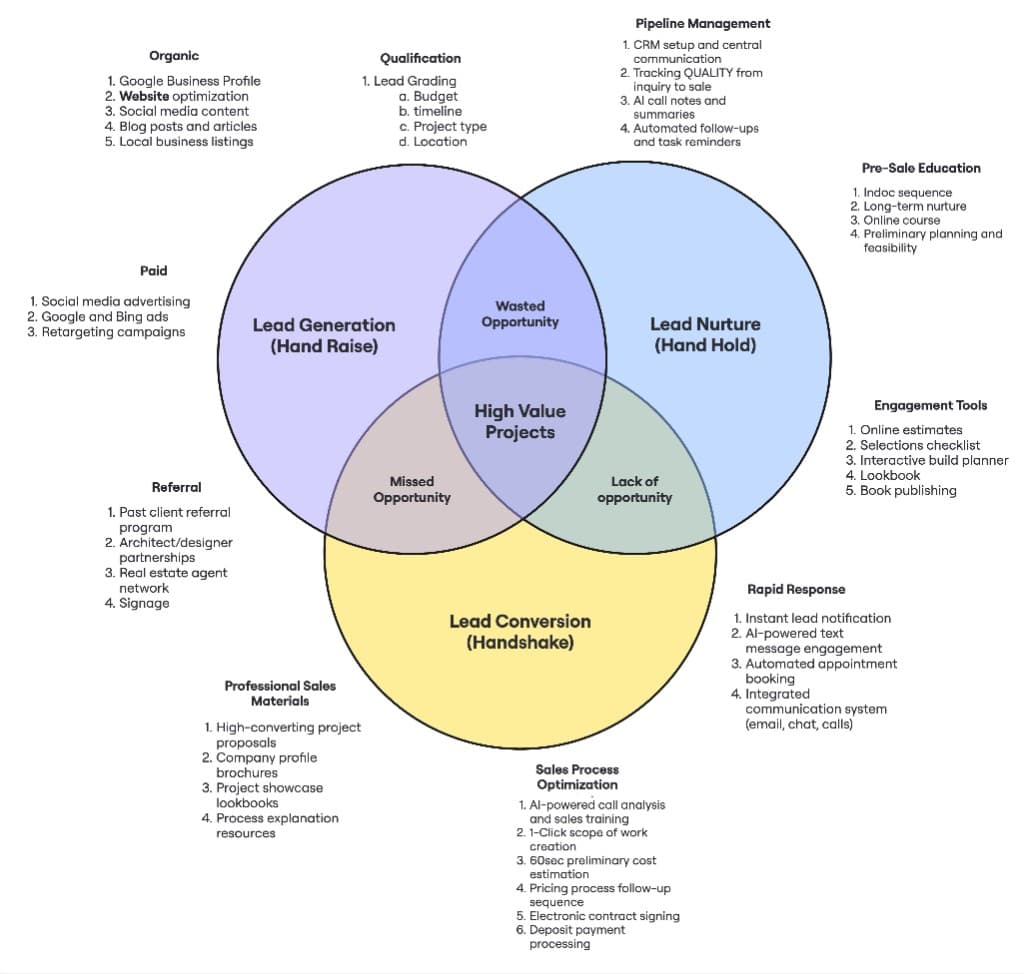
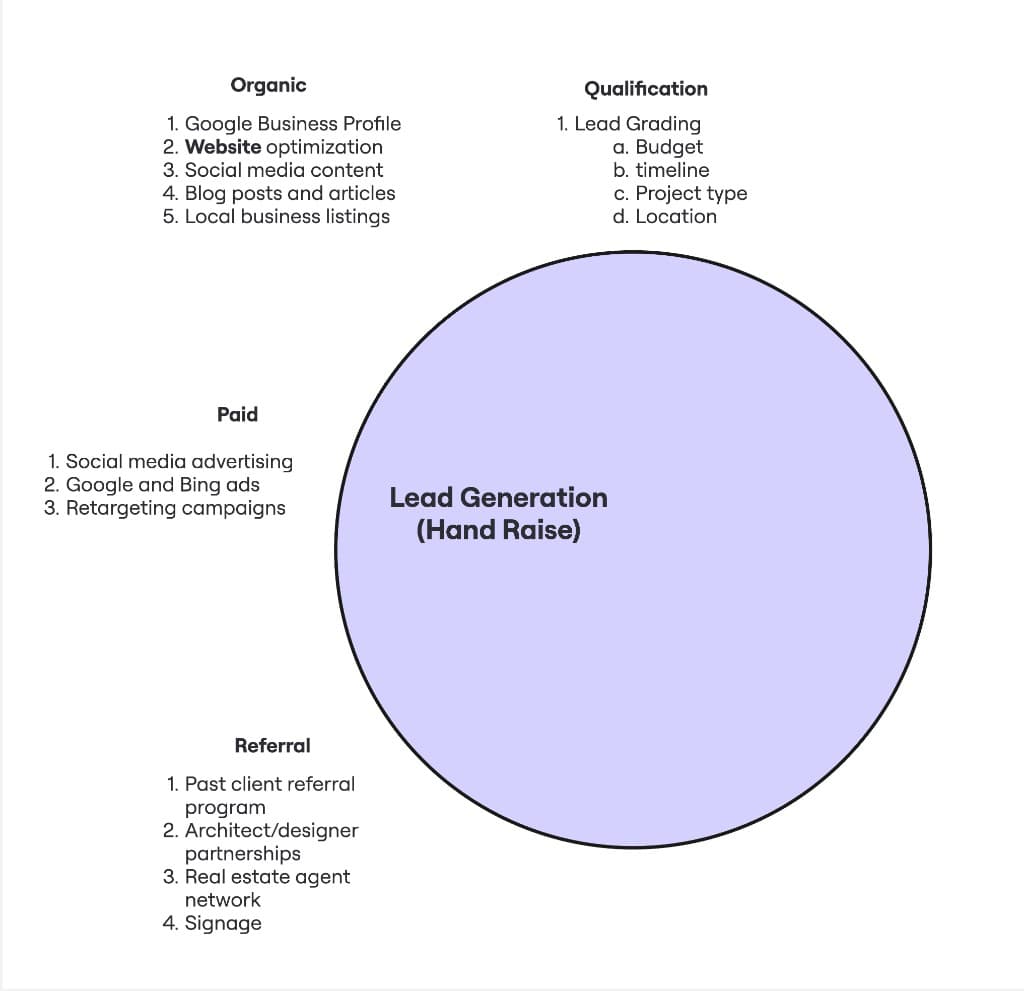 This playbook
First circle — hand raise
Generation
Right homeowners find you, then get graded before your estimators burn hours.
Open pillar + workshop →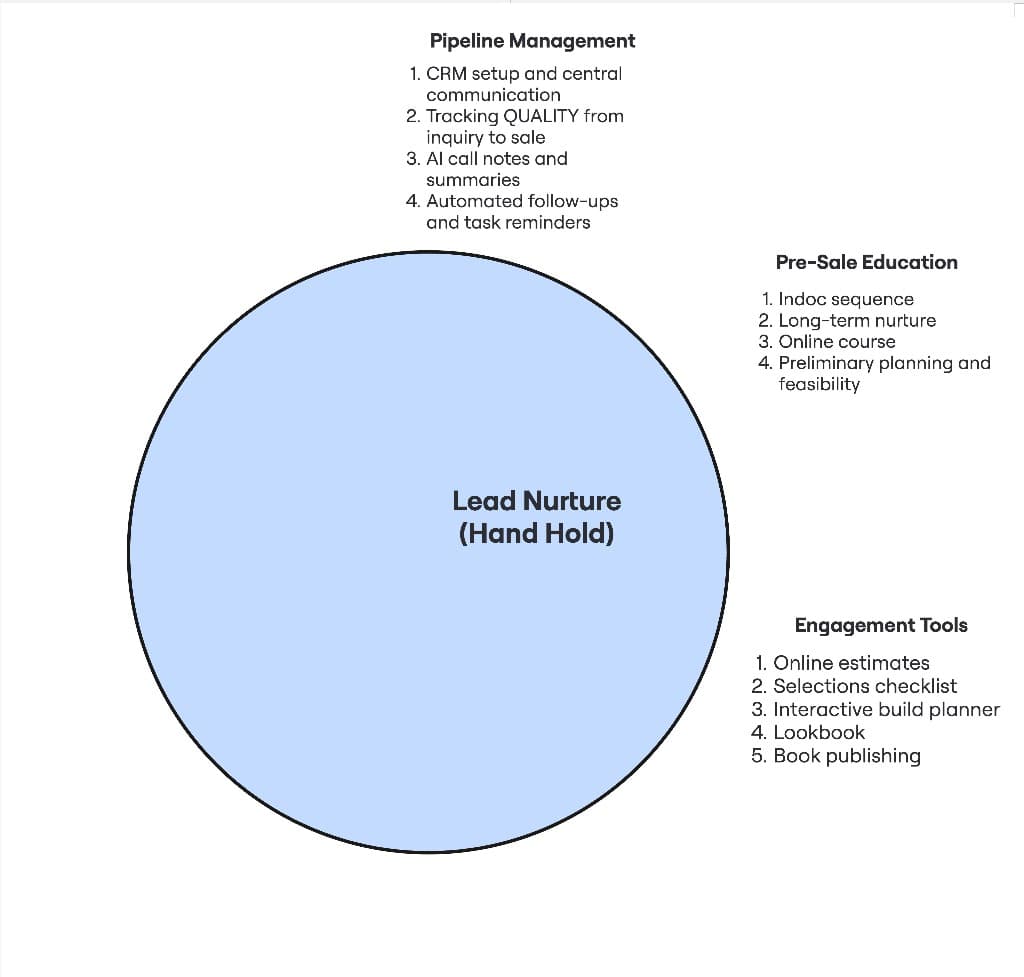
Middle circle — momentum
Nurture
Speed-to-lead, pipeline discipline, and education between interest and signature.
Open pillar + workshop →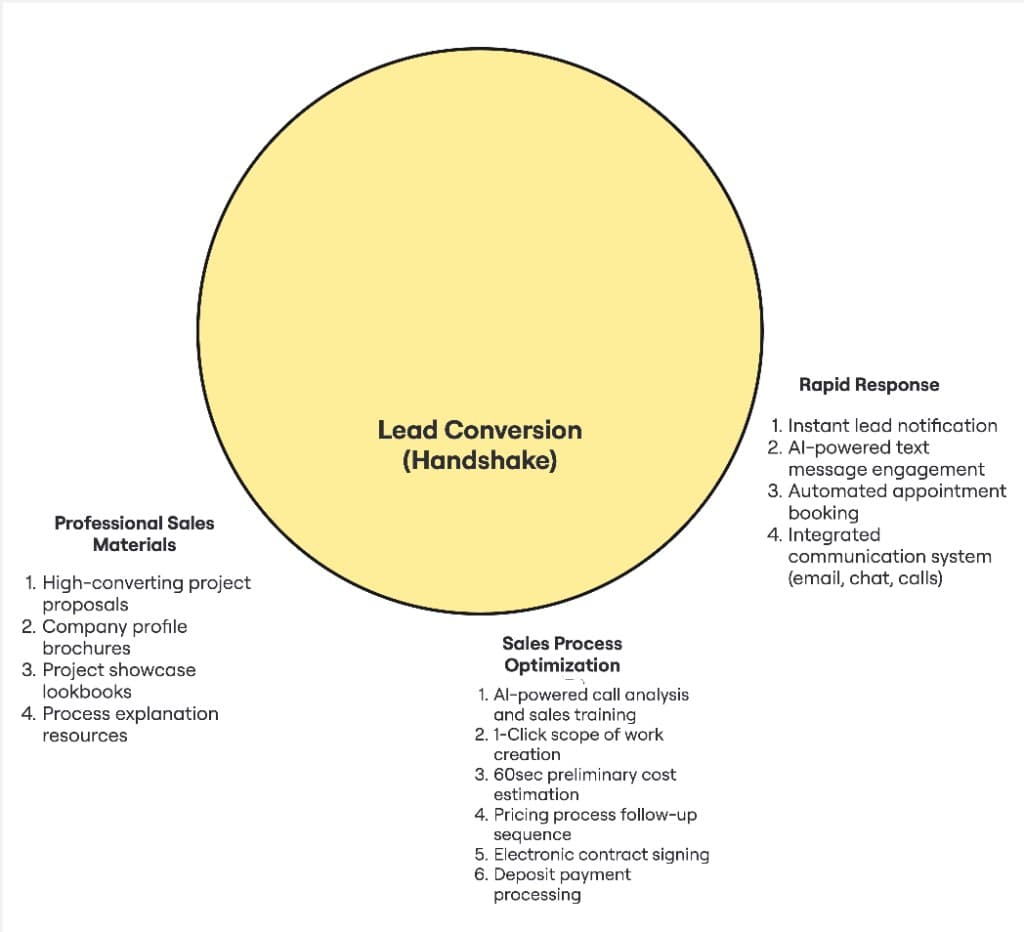
Third circle — signed work
Conversion
A repeatable sales process that does not depend on one heroic estimator.
Open pillar + workshop →If you want priorities by revenue stage, the Builder Growth Roadmap maps the same sequence across Stage 1 ($0–$500K) through Stage 5 ($5M+) so you can see what to tighten first at your current size.
01Why Google Ads Fails for Most Builders
TL;DR
Broad keywords, weak landing pages, and slow follow-up waste budgets—not the channel itself.
- Intent-rich phrases outperform generic builder searches drastically.
- Homepages bleed clicks without conversion sequencing.
- Minutes-old leads decay faster than next-day callbacks recover.
The failure pattern is almost always the same. A builder sets up a campaign targeting "builder near me" or "home builder" — broad, generic terms. The campaign generates clicks from people searching for everything from pool installations to handyman repairs. The budget burns. The calls are useless. The builder concludes that Google Ads is a scam for their industry.
The real problem isn't the platform — it's keyword selection and negative keyword management. Google Ads is a bidding system for attention. If you bid on broad terms, you attract broad intent. If you bid on specific, commercial-intent terms, you attract specific, commercial-intent searchers. The difference between "builder near me" and "custom home builder [city]" is the difference between a $30 lead and a $300 lead — where the $300 lead is actually worth ten times more.
The second failure mode is the landing page. Most builders send ad traffic to their homepage, which was built to look good, not to convert. A homeowner clicking an ad for "luxury custom home builder" lands on a page with a photo of a finished house, a navigation menu, and no clear next step. They leave. The click cost $15 and generated nothing.
The third failure is speed-to-lead. A homeowner searches at 7pm on a Tuesday, fills in a form, and hears nothing until the next business day. They've already moved on to the three other builders who came up in their search. The window to capture an online lead is measured in minutes, not hours. Without automated immediate response, even a perfect campaign generates disappointing results.
02Keyword Architecture That Filters Intent
TL;DR
Commercial phrases plus ruthless negatives define economics before bids scale.
- Phrase match balances volume versus control early.
- Negative libraries exclude kit homes, handyman, noise trades.
- Campaign splits expose renovation versus new-build performance.
The keyword architecture of a Google Ads campaign determines the quality of every lead it generates. This is not a detail — it's the entire campaign strategy. Getting it right is the difference between $300/month wasted and $3,000/month generating qualified conversations.
High-commercial-intent keywords are the core. "Custom home builder [city]," "luxury new build [suburb]," "design and build company near me," "residential construction company [region]" — these are people who have already decided they want a custom build and are actively evaluating builders. Bid on these. They're more expensive per click, but the leads are worth more.
Negative keywords are equally important as the target keywords. A comprehensive negative list excludes searches for commercial construction, kit homes, project homes, handyman work, trade jobs, flat pack furniture, and hundreds of other searches that would otherwise waste your budget. Most builders running DIY campaigns have virtually no negative keyword management. This single omission accounts for the majority of wasted spend.
Match types control how strictly Google interprets your target keywords. Broad match captures too much irrelevant traffic. Exact match limits volume too aggressively. Phrase match — where your keyword appears as a phrase within the search query — is usually the right starting point for builders. As you accumulate data on which exact search terms convert, you can refine toward exact match on your best performers.
Campaign structure matters too. Separate campaigns by service type and geography give you precise budget control and performance visibility. A "custom homes" campaign and a "renovations/extensions" campaign often perform very differently and should be managed separately. What you can't measure, you can't improve.
03Landing Pages Built to Convert, Not Impress
TL;DR
Single-purpose pages that mirror ad promises outperform wandering portfolio journeys.
- Headline parity with ads removes subconscious mismatch.
- Strip navigation until micro-yeses stack.
- Mobile speed thresholds mirror majority click share.
The landing page is where the money is made or lost. After you've paid for the click, the only thing that determines whether it generates a lead is the page the homeowner lands on. Most builder websites fail this test spectacularly — not because they're poorly designed, but because they weren't designed for conversion.
A conversion-optimised landing page has a single purpose: get the right homeowner to raise their hand. Everything on the page should serve that goal. A clear headline that matches what they searched for. Social proof — a testimonial, a project photo, a recognition badge — visible above the fold. A concrete, specific offer (not "contact us" — something with value, like "Book a free 20-minute territory check"). A frictionless form with minimal required fields.
The headline-to-ad message match is critical and frequently missed. If someone clicks an ad for "luxury home builder Brisbane" and lands on a page that talks about "quality building services," there's a disconnect. The brain registers the mismatch as distrust. Every ad group should link to a page whose headline directly reflects what the ad promised. This single change consistently improves conversion rates by 20–40%.
One page, one goal. No navigation menus that let people wander off. No sidebar widgets. No social media links. Every element on the page should push toward one outcome: the enquiry. This sounds extreme but it's how every performance-optimised landing page in any industry is built. Homepage features distract; landing pages focus.
Don't neglect mobile. More than 60% of Google searches happen on mobile devices. If your landing page loads slowly on mobile, has buttons too small to tap, or requires a pinch-and-zoom to read, you're throwing away the majority of your clicks. Test your page on a real phone. If it takes more than 3 seconds to load, fix it before spending another dollar on ads.
04Campaign Structure and Budget Management
TL;DR
Hierarchy clarity lets budgets chase margin-positive pockets—not blended averages hiding waste.
- Separate geography plus offer types for reporting honesty.
- Bid strategies graduate once thirty conversions justify automation.
- Economics tie CPA tolerances to realistic project margins.
A well-structured Google Ads account is easy to read, easy to optimise, and gives you clear visibility into what's working. Most builder accounts are a single campaign with a handful of keywords, no structure, and no way to tell which keywords or ads are driving real business.
Start with a clear campaign hierarchy: campaigns contain ad groups, ad groups contain ads and keywords. Separate campaigns by product type (new builds vs renovations) and by geography (city vs suburbs vs regional). This lets you allocate budget where it's performing, pause what's not, and understand your market without everything lumped together.
Budget setting should be based on economics, not comfort. A custom builder with average project values of $800k can afford a significantly higher cost-per-lead than a renovation business with average jobs of $50k. If your average project is worth $800k with a 15% margin ($120k), a $1,500 cost-per-qualified-lead makes complete sense. Most builders underinvest in Google Ads relative to the project values they're targeting because they're comparing the cost to retail advertising benchmarks that aren't relevant.
Bidding strategy matters. Manual CPC gives you maximum control in the early stages but requires active management. Target CPA (cost per acquisition) works well once you've accumulated enough conversion data — typically 30+ conversions in a 30-day window. Don't start with smart bidding on a new account. Google needs data before it can optimise effectively, and giving it too much autonomy too early leads to unpredictable spend.
Review search term reports weekly in the first month. The search terms report shows you exactly what people typed before clicking your ad. This is where you find the budget-wasting searches you hadn't anticipated, and the high-value search terms you should add as exact match targets. Digging into search terms is the fastest path to improving campaign efficiency early.
05Speed-to-Lead: The Follow-Up Infrastructure
TL;DR
Immediate acknowledgement buys minutes before competitors react—then humans finish properly.
- SMS plus CRM tasks lock expectation windows instantly.
- Weekend silence loses deals before Monday opens.
- Automation carries tone while humans route thoughtfully.
Here's a statistic that should change how you think about ads: the average builder takes 47 hours to follow up on a web lead. The probability of qualifying a lead drops by 400% in the first hour and continues to fall rapidly after that. By the time most builders call back, the homeowner has already had three conversations with competitors.
Speed-to-lead infrastructure is the automation layer that fires the moment a form is submitted. An immediate automated SMS to the lead: "Hi [name], thanks for reaching out. I'm Cameron from Contractor Scale. I'll be in touch shortly — in the meantime, here's a quick overview of how we work: [link]." An email to your team with the lead details and a task to call within 30 minutes. A CRM record created and tagged. All of this before anyone at your company has even seen the notification.
The automated message isn't the close. It's the holding pattern that keeps the lead engaged while you make the actual call. A homeowner who's submitted a form and received an immediate, professional response is far less likely to have already moved on by the time you pick up the phone.
After-hours leads are where the biggest losses happen. A homeowner researching builders at 9pm on a Sunday submits a form. If they don't hear anything until Monday morning, they've often already had a conversation with a competitor who had a 24/7 chat or automated response. Configure your system to acknowledge every lead immediately regardless of when it comes in. The acknowledgement doesn't need to be a call — it needs to confirm their enquiry was received and set an expectation for when they'll hear from you personally.
06Attribution, Reporting, and Knowing When to Scale
TL;DR
Optimise on qualified cost-per-project—not vanity CPC dashboards alone.
- Fire conversions on forms plus tracked calls before spend climbs.
- CRM milestones reveal keywords producing signed contracts.
- Scale only after repeatable CPA proof stabilises.
Most Google Ads reporting is useless. Clicks, impressions, click-through rate — these are input metrics. They tell you about ad performance but nothing about business performance. The number that actually matters is cost per qualified lead, and beyond that, cost per signed project.
Attribution tracks the full journey from click to signed contract. Which keyword generated the lead that became the $900k build? Which ad copy produces the leads with the highest close rate? Which campaign produces the most valuable projects, not just the most leads? Without attribution, you're optimising for the wrong thing. High lead volume at low cost means nothing if the leads aren't converting to signed work.
Set up conversion tracking properly before running a single dollar of ads. Google Ads conversion tracking should fire on form submissions and call connections from the landing page. Import these conversions into Google Analytics and link both to your CRM. When a lead progresses to a discovery call, mark it in the CRM. When they sign a preliminary agreement or contract, mark that too. Over time you build a picture of which traffic sources produce the best business outcomes.
Scaling decisions should be data-driven. When you see a campaign producing qualified conversations at a cost that makes sense relative to your project values, that's the signal to increase budget. Don't scale based on gut feel or urgency — scale based on proven cost-per-qualified-lead metrics. A campaign with 10 leads at $400/lead, where 3 became discoveries and 1 signed, tells you something specific. A campaign with 30 leads at $120/lead where none converted tells you something different. Volume isn't the answer.
Who this guide is for
- Builders who need qualified conversations faster than SEO can realistically deliver.
- Owners with project values high enough for paid search economics to make sense.
- Teams willing to track what happens after the click — not just judge campaigns on lead count.
Common mistakes builders make
Most of these problems are not caused by effort alone. They come from the wrong sequence, the wrong assumptions, or a missing layer in the system.
- Targeting broad builder keywords that attract the wrong search intent. 'Builder near me' generates calls from people looking for handymen, pool companies, and kitchen fitters. Every irrelevant click is money wasted.
- Sending paid traffic to the homepage instead of a purpose-built landing page. The homepage is not a conversion tool. It's a navigation hub.
- Running ads without a negative keyword list. Most wasted ad spend comes from the searches you didn't intend to show for.
- Letting leads sit for hours or days before following up, then blaming lead quality. The quality of follow-up speed is more predictive of conversion than lead quality in most cases.
- Judging campaigns by lead count instead of qualified lead cost and downstream close rate. Volume metrics lead to optimising for cheap, irrelevant clicks.
- Scaling spend before the campaign is proven. Increasing budget on an unvalidated campaign multiplies waste, not results.
Frequently asked questions
How much should a home builder spend on Google Ads?
Budget should be set relative to project value, not as an arbitrary number. A custom builder targeting $500k–$2M projects in a metro area typically starts at $2,000–$5,000/month to generate statistically meaningful data. The economics make sense because one signed project at $600k+ recovers the entire year's ad spend many times over. Underspending produces too little data to optimise effectively.
How quickly will I see leads from Google Ads?
Usually within the first 1–2 weeks of a properly structured campaign. Unlike SEO, paid search is immediate — the moment your ads go live, you're eligible to appear for the searches you're targeting. The first two weeks often produce some leads while also revealing which keywords need refinement and which negative terms to exclude.
Do I need to run both SEO and Google Ads?
They serve different roles in the system. Google Ads gives you immediate, controllable pipeline while SEO is building. SEO builds compounding organic authority that reduces cost-per-lead over time. The strongest builders run both — ads fill the pipeline now, SEO reduces dependence on paid traffic long term. Choosing one over the other creates an avoidable weakness.
What keywords should I target for a custom building business?
Start with high-commercial-intent, service-specific terms: 'custom home builder [city],' 'design and build company [region],' 'luxury home builder near me.' Avoid generic terms like 'builder' or 'construction company' which attract the wrong intent. Layer in suburb-level targeting once you understand which areas produce the best leads.
What's a good cost per lead for a custom home builder?
With project values of $500k–$2M, a cost per qualified lead of $200–$600 is generally acceptable. The key metric is cost per qualified conversation — leads that make it to a discovery call — not cost per form submission. Some form submissions come from unqualified leads, so the total cost needs to be evaluated against qualified pipeline generated, not total lead count.
Can I manage Google Ads myself?
Technically yes, practically rarely worth it. Google Ads requires ongoing keyword management, negative keyword maintenance, landing page testing, bid strategy refinement, and attribution analysis. A builder principal managing their own campaigns is typically running them sub-optimally while also taking time away from the business they're better at. The question is whether the management cost is justified by better results — for most builders with project values above $300k, it almost always is.
What type of ad copy works best for custom builders?
Ad copy that is specific, local, and reflects what the searcher actually wants. 'Custom Home Builder in [City] — One Territory, One Builder | Book a Free Consultation' outperforms generic 'Quality Building Services' every time. Specificity signals relevance. Including a territory exclusivity message or a specific offer increases click-through rate and pre-qualifies intent before they even visit the landing page.
Will Google Ads get me quality building leads, or just more tyre-kickers?
That depends almost entirely on which searches you buy. The intent sits in the query, not the keyword: someone searching a cost or comparison phrase is further along than someone searching a generic service term, even though both can match the same keyword. Buy the first group, exclude the second with a maintained negative list, and qualify on the form before anyone reaches your phone. Builders who skip that get the tyre-kickers and then blame the channel.
Can I control where my ads show and who sees them?
Yes, and this is where a lot of wasted spend hides. You set the service area, so exclude the suburbs you do not want to drive to and the regions you cannot build in. Two things to watch: Google's default location setting also targets people merely showing interest in your area rather than physically in it, and excluding too aggressively can block the market you actually serve. We have found accounts negating the name of their own city.
What is the biggest mistake builders make with Google Ads?
Running broad match without a negative keyword list. It is the fastest way to pay premium rates for job seekers, DIYers, apprentices looking for work, and people pricing a fence when you build houses. The second biggest is judging the account on lead count instead of what those leads became, which hides the fact that the cheap leads are the ones never converting.
Apply it to your business
Framework first. Then the right next move.
A playbook helps you understand the mechanism. The Builder Growth Assessment uses your answers to suggest a likely starting lane: self-install or, for qualified builders, a Builder Growth Strategy.
- ✓The likely lane behind the growth pressure you reported
- ✓A useful starting point without pretending four answers prove the cause
- ✓A direct answer on fit, timing, and whether the wider system makes sense
Regional context: New Zealand home builder marketing and Australia home builder marketing.
Want the full system map first? Download the Growth System guide.
“$3,800 ad spend → $2.5M in house and land packages sold.”
Real client proof
Cameron Diack
Cameron Diack Homes