
The Ultimate Guide to Lead Generation for Home Builders
How to stop competing on price and start generating a pipeline of pre-educated, high-intent homeowners — engineered, not guessed.
Demand playbook · About 12 min read · Updated April 2026
What you get from this guide
Qualified Pipeline
A steady flow of homeowners who match your project type, budget range, and territory — not volume for volume's sake.
Demand You Control
An owned demand engine that doesn't switch off when you stop paying for it or answering your phone.
Territory Exclusivity
One builder per market. The system you build is yours alone — competitors can't buy into it.
The problem this playbook fixes
Most builder lead generation fails because it generates volume instead of value. Buying leads from platforms like Bark, HomeAdvisor, or Houzz puts you in a bidding war — the same lead goes to 5 different builders, forcing you to compete on price rather than value. The result: you spend your weekends doing free quotes for people who just want the lowest number. The deeper problem is structural. Without a dedicated demand layer — a system that consistently puts your name in front of homeowners at the right moment — you're entirely dependent on referrals that arrive when they feel like it and dry up when you need them most. Feast-or-famine isn't a market problem. It's a pipeline engineering problem.
How this fits the Growth System
Demand is how the right homeowners find you, trust you, and put their hand up before a competitor takes the attention. Without it the next two stages have nothing real to work with.
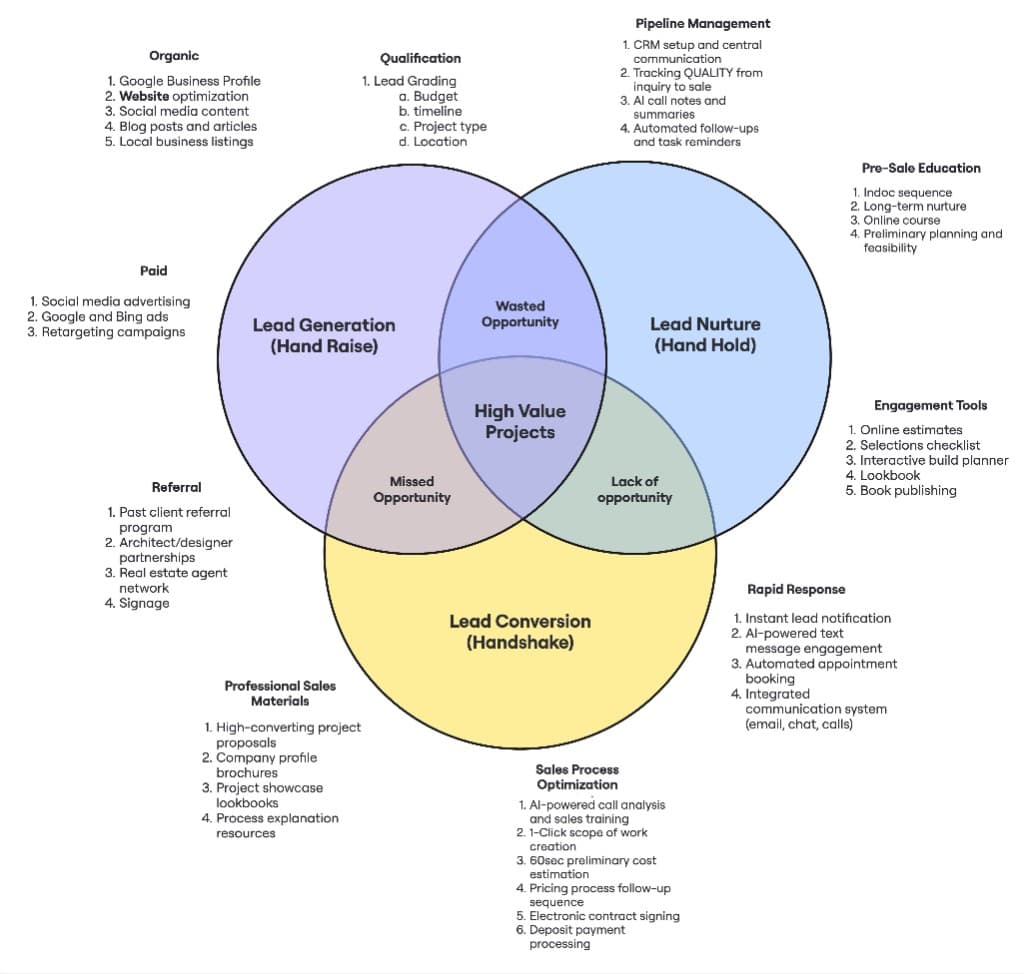
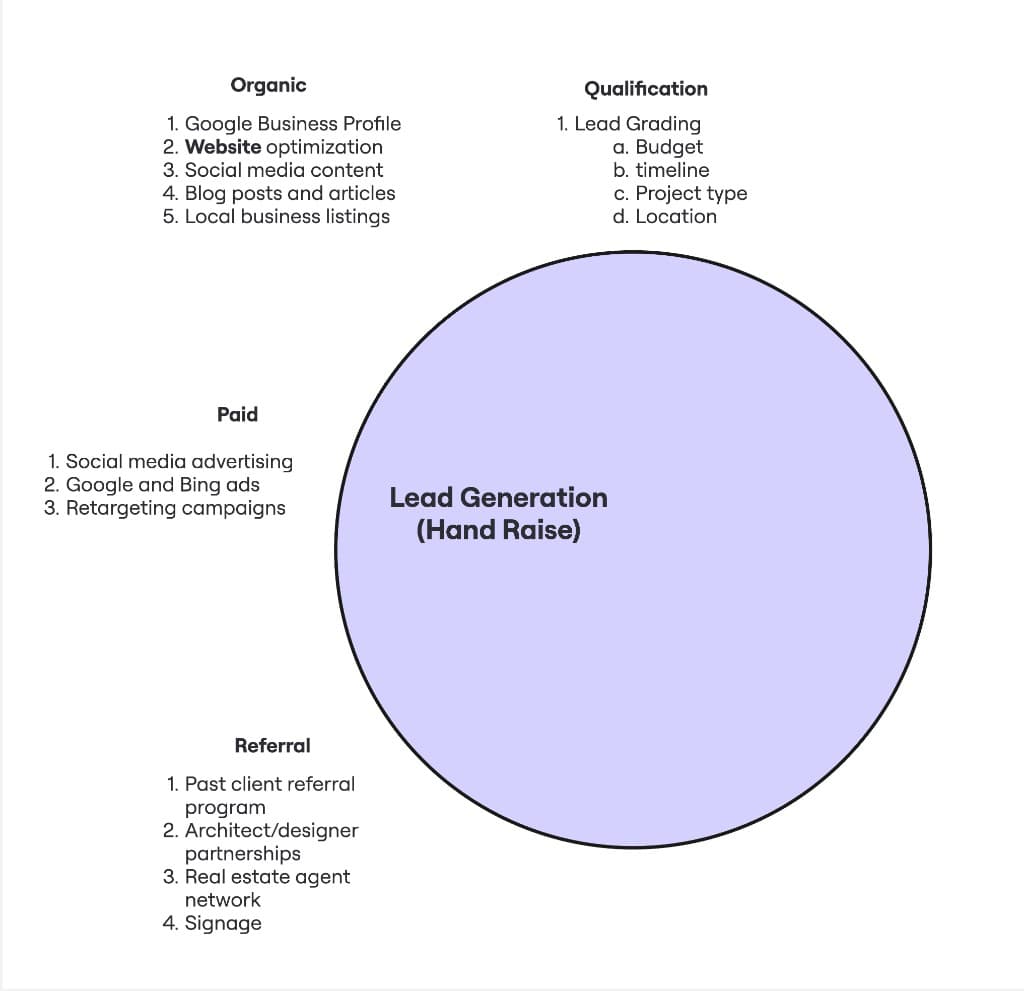 This playbook
First circle — hand raise
Generation
Right homeowners find you, then get graded before your estimators burn hours.
Open pillar + workshop →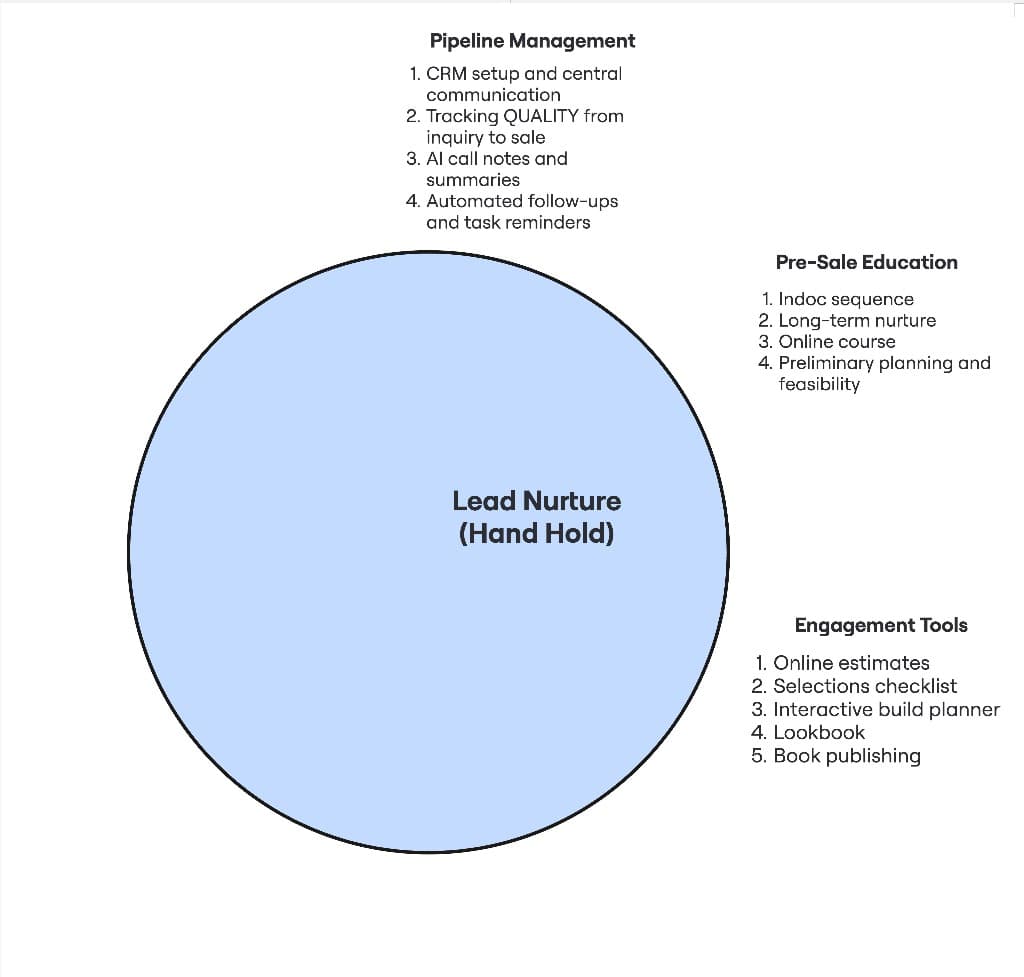
Middle circle — momentum
Nurture
Speed-to-lead, pipeline discipline, and education between interest and signature.
Open pillar + workshop →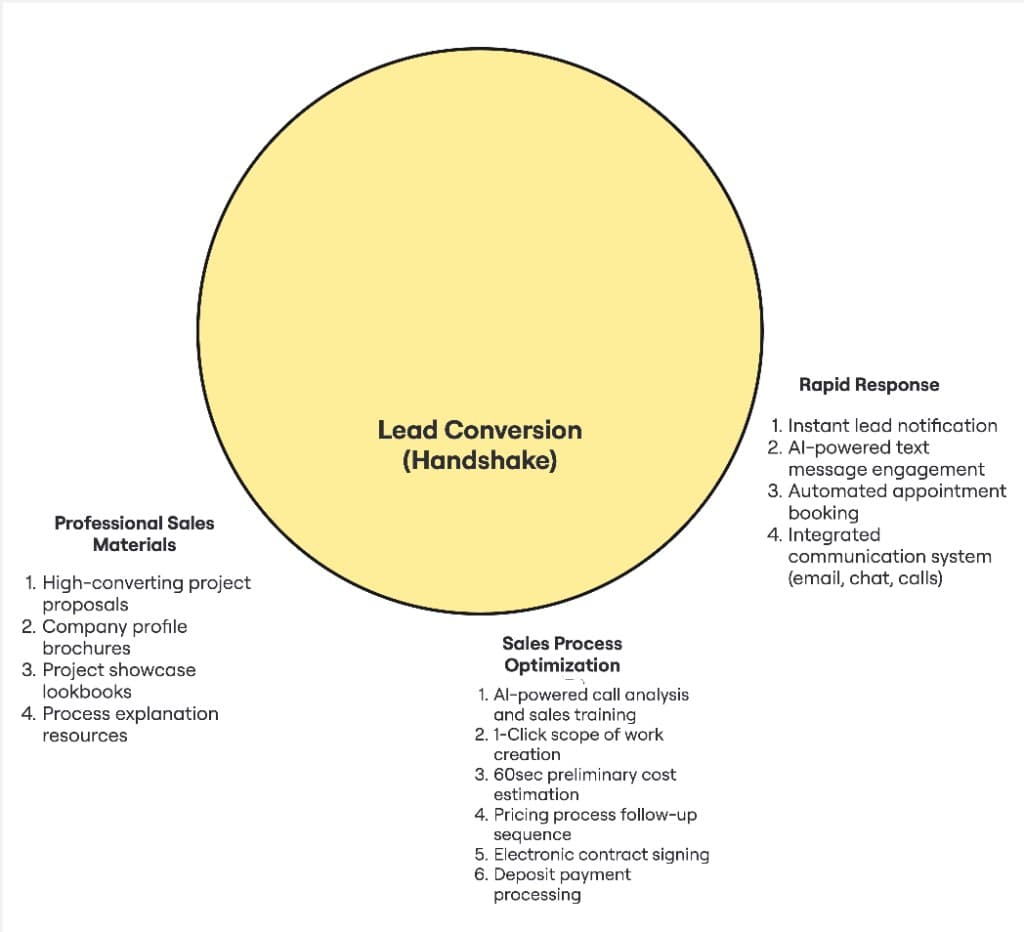
Third circle — signed work
Conversion
A repeatable sales process that does not depend on one heroic estimator.
Open pillar + workshop →If you want priorities by revenue stage, the Builder Growth Roadmap maps the same sequence across Stage 1 ($0–$500K) through Stage 5 ($5M+) so you can see what to tighten first at your current size.
01The Two Types of Lead Generation — Intent vs Demand
TL;DR
You win pipeline when you run intent capture and long-cycle demand together—not only one.
- Google captures homeowners already searching for builders now.
- Social and content build familiarity before the search phase.
- Different timelines mean budgeting both lanes deliberately.
There are exactly two ways to get in front of a homeowner: catch them when they're actively searching, or show up in their world before they start. Both matter. Neither is optional if you want a pipeline that doesn't go quiet every six months.
Intent-based channels — Google Search, Google Ads — capture people already in buying mode. They've decided they want to build or renovate. They're typing "custom home builder [your city]" right now. If you're not ranking or advertising, that lead goes to whoever is. The sale starts before you even know they exist.
Demand generation channels — social media, content, email, community presence — put your name in front of people who aren't searching yet. They're in the dreaming stage. They're saving inspiration boards. In six to eighteen months they'll be serious buyers. The builders who dominate their markets aren't lucky with referrals; they've been showing up in that homeowner's feed for a year.
Understanding the distinction matters because the tactics and timelines are completely different. Intent channels produce leads fast but cost money every month. Demand channels take longer to build but compound in value and create a defensible market position. A builder who engineers both is almost impossible to compete against.
02High Intent Capture — Google Search
TL;DR
Organic ranks slowly then compounds; Ads plug the gap the same week campaigns launch.
- High-intent searches happen whether your site earns page one or not.
- Most competitor sites stay thin—technical fixes earn disproportionate upside.
- Paid fills pipeline while SEO months compound authority.
Google Search is the highest-ROI lead generation channel for most custom builders. When someone searches "custom home builder near me" or "luxury new build [suburb]," they already want what you offer. You don't need to create the desire — you just need to be the one they find.
The challenge is getting there. Google Search results are a competition. Every builder in your area wants page one. Most of them have done nothing to earn it. Their websites are slow, thin on content, technically weak, and never updated. That's your opportunity.
Ranking in organic search takes 3–9 months of consistent effort. But the economics are extraordinary once you're there. A page that ranks for "custom home builder Auckland" or "luxury home builder Dallas" generates leads every single day without paying per click. One signed project typically pays for six to twelve months of SEO investment. Nothing else in your marketing stack compounds like this.
In the meantime, Google Ads fills the gap. You can appear at the top of search results the same day a campaign launches. The full playbook on paid search is covered in the Google Ads guide — but the principle is the same: capture the people already looking, before they find a competitor.
03Demand Generation — Social and Brand Authority
TL;DR
Consistent documented presence beats sporadic portfolio drops when homeowners eventually decide.
- Dream-phase homeowners live on feeds before they type searches.
- Trust stacks across months of process proof—not single viral hits.
- System beats needing full-time creator energy.
Demand generation is the work that happens before a homeowner is searching. It's building the recognition, trust, and familiarity that means when they finally are ready, you're the only builder they're thinking about.
For most builders, social media is the primary demand generation tool. It's where future clients spend time long before they're ready to call. They're watching build progress reels, saving renovation ideas, following people whose homes they admire. The builders who understand this stop treating social as a portfolio and start treating it as a long game.
The 'Hand Raise' strategy works like this: you put out consistent, valuable, authentic content about your work and process. Over time, a portion of your audience develops enough trust and familiarity that when their project becomes real, they come to you pre-sold. They've watched six months of your content. They know your process, your quality standards, your personality. The sales call is almost a formality.
This doesn't require becoming a full-time content creator. It requires a system. A consistent output of project documentation, process insights, and client stories — distributed to the right platforms — is enough to build genuine brand authority in a local market over 12 to 18 months. The builders doing this are making the ones who aren't irrelevant.
04Referral Systems That Actually Scale
TL;DR
Referrals stop being lottery wins when clients, trade partners, and community loops stay deliberate.
- Passive referrals stall whenever calendars compress.
- Past-client rhythm plus partner deals replaces heroic outreach bursts.
- Automations carry nurture without desperation texting.
Referrals are the best leads in any builder's pipeline. They arrive pre-sold, pre-educated, and trusting. But in most businesses, the referral system is entirely passive — it happens when a happy client happens to mention your name. That's leaving serious revenue on the table.
An engineered referral system has three components. Past client activation: a structured follow-up sequence that keeps you in touch with completed clients, gives them easy language to refer you, and makes them feel remembered. Trade partner activation: a formal referral relationship with architects, designers, structural engineers, and real estate agents who regularly encounter clients planning a build. Community presence: the kind of visible expertise and documented track record that makes referrals feel natural and obvious rather than forced.
Most builders have informal versions of all three. The problem is consistency. When you're busy, referral nurture stops. When work slows down, you start calling old clients in a way that feels desperate. Engineering the system means automating the touchpoints so they happen regardless of how busy you are.
A well-maintained referral program can reliably generate 30 to 50 percent of a custom builder's pipeline — without the cost-per-click of paid channels or the time horizon of SEO. It's your cheapest and most efficient lead source. It just needs to be deliberate.
05Lead Qualification Before You Waste Your Time
TL;DR
Budgets, timelines, and fit gates recover principal hours lost on doomed chase-ups.
- Forms plus SMS sequences shrink tyre-kickers before calls.
- Three qualifying lenses decide whether tours merit estimator hours.
- Automation upholds filters during hectic onsite weeks.
Not every enquiry deserves a site visit. Not every site visit deserves an estimate. One of the most common patterns we see in builder businesses is the principal spending 40% of their week with people who were never going to sign a contract.
Pre-qualification is the filter that protects your time. It answers the three questions that determine whether a conversation is worth having: Does this person have a realistic budget for the scope they're describing? Is their timeline actually compatible with your schedule? Is this project type and location in my ideal zone?
The qualification layer can be automated. A well-structured enquiry form on your website captures budget range, timeline, project type, and location before anyone picks up the phone. A short automated SMS or email sequence after submission further filters intent. By the time a real conversation happens, you've already screened out the tire-kickers.
For most builder principals, implementing a qualification layer recovers 5 to 10 hours per week. Not because the volume of enquiries drops — if you're growing, it increases — but because your time is spent only on conversations that have a realistic chance of converting to signed work. That time goes back to the jobs on the ground, where it belongs.
06One Builder. One Territory.
TL;DR
Exclusive territory stacks SEO, ads, content, and referrals behind one builder—not competitors splitting spend.
- Dominance compounds faster than scattered budget slices.
- Proprietary systems cannot be purchased by rivals once locked.
- First mover keeps twelve-plus months of cumulative authority.
The territory model is the foundational constraint that makes everything else in this system work. Every market we enter, we take one primary builder. That means every dollar of strategy, content, media, and infrastructure goes into making one builder the dominant presence in their region — not splitting focus across three competitors.
This matters because dominance compounds. A builder who owns their local search results, has the most consistent content output, runs the most targeted ads, and has the most systematic referral program creates a gap between themselves and competitors that gets harder to close over time. The second-place builder in a market can't overcome that with budget alone.
From your side, it means the system we build is genuinely proprietary. Your competitors can't buy what you have. They can't partner with us. If your territory is still open, that's your window. Once it closes, it stays closed.
The practical implication: moving fast matters. Markets fill. The builder in your city who installs this system first gets the structural advantage. Being second means fighting uphill against an entrenched competitor with 12 months' worth of compounding SEO authority, social credibility, and referral infrastructure. We tell builders this not as a pressure tactic but because it's true — and the builders who've moved on it early confirm it.
Who this guide is for
- Builders who rely too heavily on referrals and have no dependable demand layer underneath.
- Owners who are tired of quoting the wrong work and want more control over lead quality.
- Custom home builders and remodelers ready to build a pipeline they can inspect, measure, and grow.
Common mistakes builders make
Most of these problems are not caused by effort alone. They come from the wrong sequence, the wrong assumptions, or a missing layer in the system.
- Treating all leads as equal instead of defining the job types, budgets, and locations that actually fit the business. The fastest path to wasted time is a pipeline full of enquiries that were never the right fit.
- Buying shared leads from platforms like Bark or HomeAdvisor and calling it a lead generation strategy. Shared leads commoditise you before the first conversation.
- Generating enquiries without any qualification layer — which turns pipeline growth into more admin rather than better work. Volume without filters is just noise.
- Treating referrals as a passive channel instead of engineering follow-up, partner programs, and community presence that make referrals consistent and predictable.
- Conflating social media activity with lead generation strategy. Posting without a demand architecture behind it builds vanity metrics, not pipeline.
- Waiting for the pipeline to run dry before building the demand layer. Lead generation infrastructure takes time to compound. Starting it when you're busy is how you avoid feast-or-famine.
Frequently asked questions
How can lead generation help my home building business?
A properly engineered lead generation system gives you a predictable pipeline of pre-educated prospects. Instead of relying on referrals that arrive unpredictably, you attract homeowners who already understand your value and are ready to have a real conversation about budget and fit. The practical impact: you spend less time on the wrong conversations and more time on work that's actually going to sign.
Can Contractor Scale guarantee there will be an increase in leads?
We don't guarantee vanity metrics — we guarantee a system built to produce qualified pipeline. Results depend on your market, your starting position, and how quickly we can install the infrastructure. Most clients see qualified conversations within 30–60 days of launch. The compounding effects of SEO and content take 3–9 months to fully materialise.
Will Contractor Scale handle all aspects of lead generation for me?
Yes. Our model covers demand generation (paid and organic), the content and social layer, the pre-qualification infrastructure, and the nurture system that keeps leads warm. You handle the discovery calls and site visits — we handle everything that fills the calendar with the right people.
How quickly can I expect to see results?
Paid channels can produce results within the first 2–4 weeks. SEO and organic authority compound over 3–12 months. The system is built for both — quick wins from intent-based paid search and long-term defensibility from organic dominance. We don't choose one over the other; both are part of the install.
What sets you apart from HomeAdvisor or other lead platforms?
We don't sell you shared leads. We build your own demand engine — assets and infrastructure that belong to you and generate leads exclusively for your business. One territory, one primary builder, fully exclusive. You're not competing against our other clients because we don't take other clients in your market.
How do I know if my current lead generation is working?
The clearest signals are: what percentage of your enquiries match your ideal project profile, how many site visits convert to signed work, and how consistent your pipeline is month to month. If any of those feel unpredictable or consistently worse than they should be, there's a structural problem worth fixing.
Should I use paid ads, SEO, or both?
Both, in sequence. Google Ads gives you immediate, controllable volume while SEO is being built. Once SEO is producing reliable organic traffic, you can reduce ad spend or redirect it to newer markets. Running only ads means your pipeline disappears the moment spend stops. Running only SEO means waiting 6–12 months for your first organic lead. The combination is the right answer.
What budget do I need to make lead generation work?
It depends on your market and starting point. A builder targeting $500k–$2M custom homes typically allocates $2,000–$5,000/month combined across ads and system management in the first 6 months, then adjusts based on what's converting. The economics almost always work at this level because one signed project at $500k+ recovers the entire year's marketing budget.
Are all leads worth the same? How should I be grading them?
No, and treating them the same is what quietly destroys margin. Grade on exclusivity and qualification. An exclusive enquiry where you are the only builder being spoken to, with budget and timeline already established, converts at a completely different rate to a shared enquiry where three or four builders are quoting the same job. Architect referrals and past-client referrals sit at the top for the same reason: someone else has already done the qualifying. A more expensive lead that arrives pre-qualified is usually the cheaper lead once you count the hours spent quoting work you were never going to win.
What is the most common lead generation mistake builders make?
Accepting every enquiry regardless of project fit. A builder who works on $800k homes spending three hours quoting a $25k bathroom is losing money twice, on the hours and on the positioning. Set a minimum project value, ask the qualifying questions before the site visit, and refer the rest on politely. The second most common is going quiet during long design phases, where weeks without contact read as disinterest and the prospect quietly moves on.
Apply it to your business
Framework first. Then the right next move.
A playbook helps you understand the mechanism. The Builder Growth Assessment uses your answers to suggest a likely starting lane: self-install or, for qualified builders, a Builder Growth Strategy.
- ✓The likely lane behind the growth pressure you reported
- ✓A useful starting point without pretending four answers prove the cause
- ✓A direct answer on fit, timing, and whether the wider system makes sense
Regional context: New Zealand home builder marketing and Australia home builder marketing.
Want the full system map first? Download the Growth System guide.
“Been a good week. New marketing campaign last week and am fully loaded with 8 qualifying leads to visit.”
Real client proof
Mark Taylor
Custom builder, AU