
Content & Social Authority for Home Builders
How to use documented craftsmanship to build 'Best Known' status in your local market — and make the decision easy for the right homeowners before they ever call.
Nurture playbook · About 13 min read · Updated April 2026
What you get from this guide
Top of Mind
Stay visible to your market between projects, between referrals, and between seasons.
Authority Positioning
Become the recognised, trusted expert builder in your area — not just another name on a list.
Compounding Asset
Content published today generates trust and leads for years — without ongoing cost per click.
The problem this playbook fixes
Most builders either post nothing, or post inconsistently — photo of a pour here, framing shot there, no narrative, no strategy. Social content without a story doesn't build authority. It fills a feed. The builders who dominate their local markets treat content differently: every project is evidence, every milestone is proof, every piece of expertise is published. They are not trying to be social media personalities. They are documenting a standard of work and a depth of knowledge that makes the choice obvious when a homeowner is ready to build. The builders who are doing this now are building a gap that gets harder to close every month.
How this fits the Growth System
Nurture is what happens after the first enquiry — so momentum does not die in slow follow-up, admin gaps, or forgotten next steps. Without it good leads cool off before sales ever sees them.
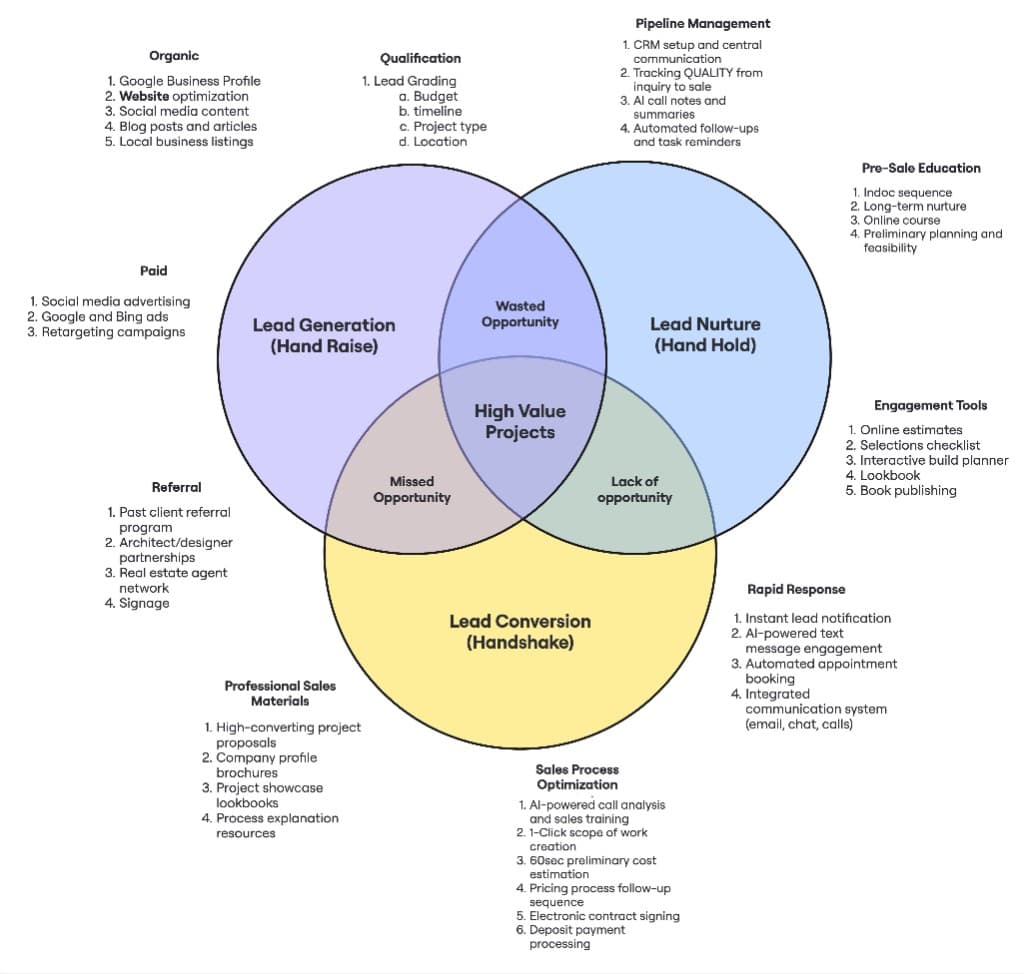
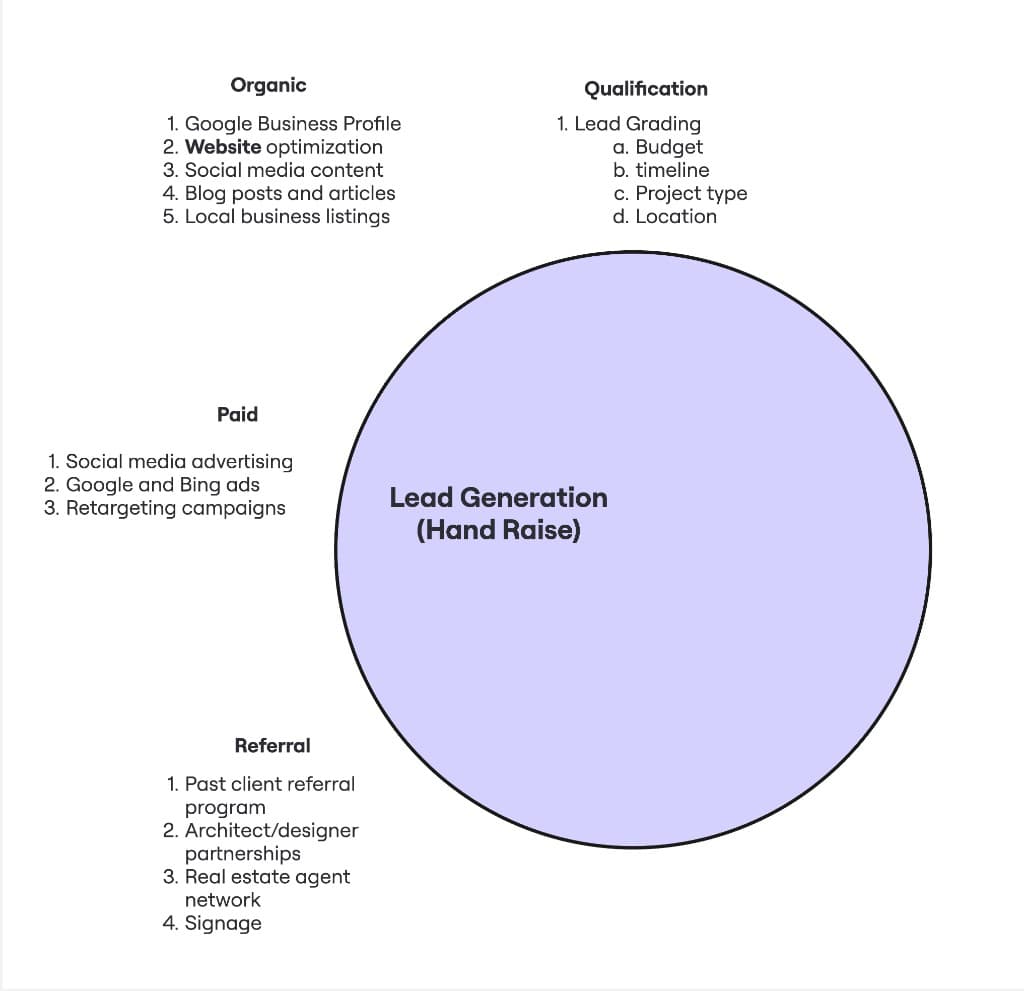
First circle — hand raise
Generation
Right homeowners find you, then get graded before your estimators burn hours.
Open pillar + workshop →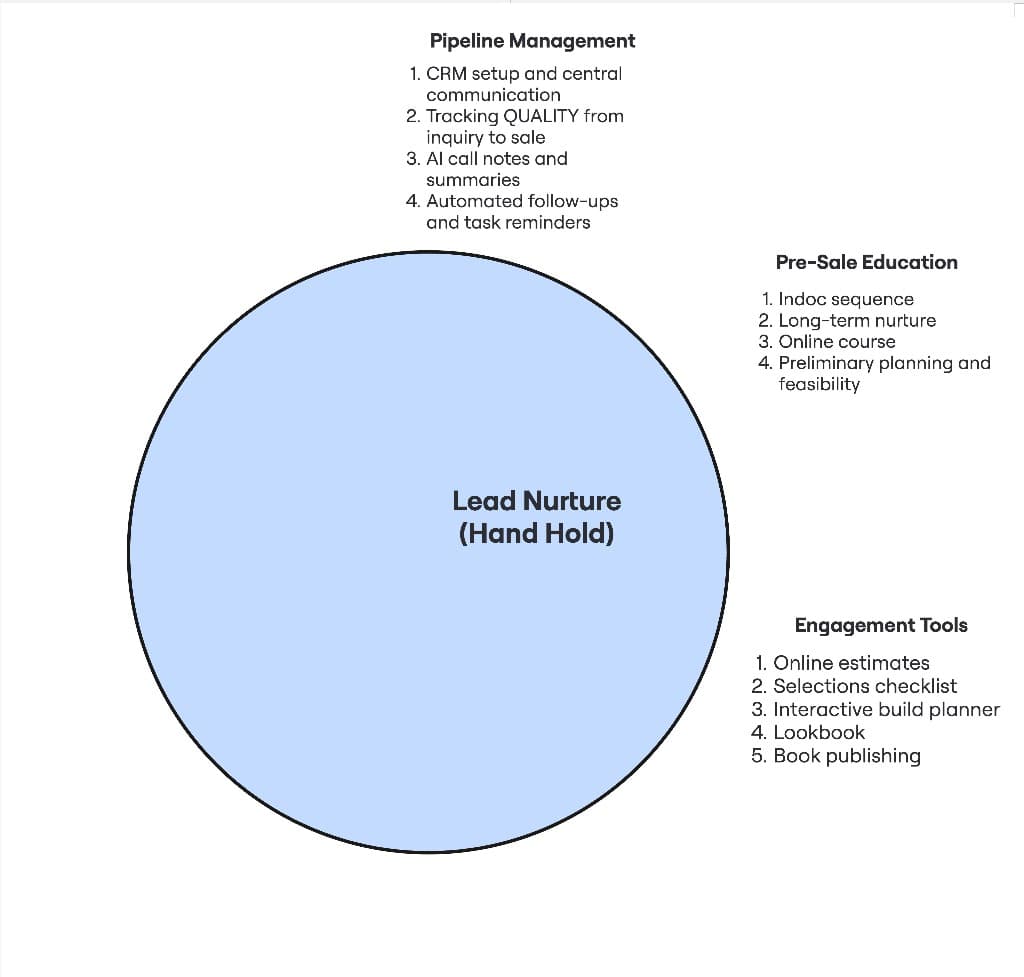 This playbook
Middle circle — momentum
Nurture
Speed-to-lead, pipeline discipline, and education between interest and signature.
Open pillar + workshop →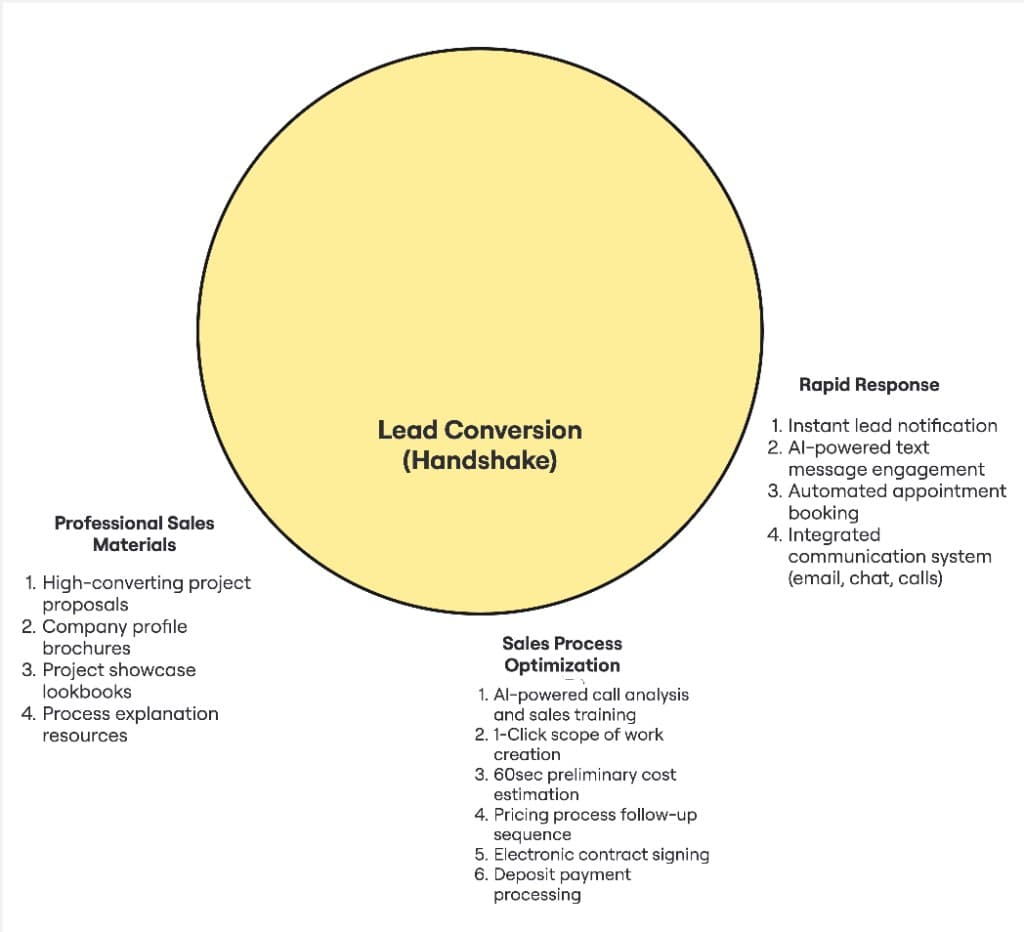
Third circle — signed work
Conversion
A repeatable sales process that does not depend on one heroic estimator.
Open pillar + workshop →If you want priorities by revenue stage, the Builder Growth Roadmap maps the same sequence across Stage 1 ($0–$500K) through Stage 5 ($5M+) so you can see what to tighten first at your current size.
01Why Random Posting Doesn't Build a Business
TL;DR
Spikes without cadence fail familiarity effects serious builds require.
- Likes from trades rarely equal homeowner pipeline.
- Consistency compounds recognition months—not weekends.
- Strategy assigns commercial intent to every capture.
Most builders who try social media do the same thing. They post a photo of a framing job on a Friday, get 12 likes from other tradespeople, and then don't post again for three weeks. When they eventually revisit it, they feel like they've tried social and it doesn't work for their industry.
The problem isn't the industry — it's the strategy. Or rather, the absence of one. Random project photos without context, narrative, or a commercial architecture behind them generate engagement but not pipeline. They make your existing followers feel good but don't convert anyone who didn't already know you.
Social media generates business for builders through two mechanisms, and both require consistency over time. The first is familiarity — the repeated exposure effect that makes your name the one a homeowner thinks of when they're finally ready to build. This takes months of consistent presence. The second is trust signalling — the accumulation of project documentation, process transparency, client stories, and expert commentary that communicates "this is a builder who knows what they're doing and treats clients well." This also takes months.
The builders winning with content aren't the ones posting the most or the fanciest. They're the ones posting consistently with a clear strategy — content that serves a commercial purpose, published on a schedule their audience can anticipate. 3 posts a week over 18 months builds something real. 20 posts one week, nothing for a month, doesn't.
02The Documentation System — Content From Work You Already Do
TL;DR
Assign capture duties onsite—raw authenticity beats studio polish for trades.
- Weekly brief covers video plus annotated photo backlog.
- Editors polish scheduling—not principals guessing captions nightly.
- Phones suffice when explanations stay substantive.
The most practical content strategy for a builder is the simplest: document what's already happening. Every project you're working on right now is content. The footing pour, the framing milestone, the roof inspection, the tile selection meeting, the site walkthrough with the client — all of it is material for building authority and familiarity with your market.
The documentation mindset shifts the content question from "what should I post about?" to "what should I capture today?" Your team is already on site doing the work. The barrier isn't generating content ideas — it's capturing them. A short video walkthrough of a structural detail you're proud of. A photo sequence of a construction phase with a caption explaining why you approach it the way you do. A client comment on a progress inspection, captured on camera. These don't require a production team. They require pointing a phone at the right things.
The practical system looks like this: designate one person (or the principal) as the content capturer on site. Give them a simple weekly brief — one short video walkthrough, two or three photos with brief captions, and any client interaction worth capturing. That raw material gets passed to whoever handles your content (in-house or with our support) for basic editing, captioning, and scheduling. The output is consistent, authentic, and genuinely interesting because it's documenting real work.
Raw authenticity outperforms polished production for trade businesses. A phone-shot video of a builder explaining why they choose a specific waterproofing approach — in their own words, on the job — outperforms a professionally produced video in a studio every time. Homeowners buying a custom build want to see the actual person, the actual work, and the actual process. Production quality matters far less than genuine expertise and authenticity.
03Platform Strategy — Own One Channel, Then Expand
TL;DR
Master one watering hole before diluted mediocrity across six feeds.
- Pick platforms matching demographic reality versus hype cycles.
- YouTube doubles search surfaces traditional feeds ignore.
- Discipline beats theoretical audience reach fantasies.
The most common content mistake builders make isn't posting bad content — it's trying to be on too many platforms at once and doing all of them badly. Facebook, Instagram, YouTube, TikTok, LinkedIn, a blog, a podcast — the list of content platforms is endless. Trying to maintain a presence on all of them is a fast route to burnout and mediocrity on every channel.
The right strategy is the opposite: choose one primary platform, build it properly, achieve genuine traction, then expand. For most custom home builders, the primary platform should be chosen based on where your ideal client actually spends time. Facebook still dominates for community-minded homeowners in the 35–55 demographic — the primary custom home buyer. Local Facebook groups and personal pages reach the exact homeowner profile you're after. Instagram works for highly visual, aspirational content targeted at design-forward homeowners.
YouTube is the most underrated platform for builders. YouTube content ranks in Google search results. A video titled "What it costs to build a custom home in Auckland in 2026" will generate organic search traffic for years. YouTube viewers are high-intent — they've actively searched for educational content, not just scrolled past your post. And the barrier to entry is lower than most builders realise: a well-lit, clear-audio video of you explaining a topic your ideal client cares about performs well without professional production.
The decision rule is simple: where does your ideal client spend time, what type of content does that platform reward, and which of those are you actually going to create consistently? The best platform is the one you'll show up on reliably, not the one with the biggest theoretical audience.
04Authority Content vs Engagement Content
TL;DR
Blend sixty-percent depth proof with forty-percent approachability per calendar.
- Polls spark familiarity yet seldom secure contracts alone.
- Case studies answer silent fear conversations.
- Cadence quality beats unsustainable daily spam bursts.
Not all content has the same commercial purpose. Understanding the difference between content that makes people like you and content that makes people trust you enough to hand over $800k is essential for getting a return from your investment.
Engagement content builds familiarity. Polls asking homeowners to choose between two design options. Behind-the-scenes photos of the team. Progress milestones with a happy caption. This content generates likes, comments, and shares — it keeps you visible and likeable. It's not the reason someone hires you, but it's part of the consistent presence that keeps your name front of mind.
Authority content builds trust. Detailed project case studies with photos, timelines, and honest reflections on challenges. Process explanation videos — "why we approach waterproofing this way," "how we manage variations and budget conversations." Client testimonial videos with the homeowner speaking specifically about what the build experience was like. Expert commentary on industry issues, pricing transparency, timeline management. This content is what moves a homeowner from "I've seen their work" to "I trust these people with my project."
The ratio matters. A content calendar that's all engagement and no authority feels pleasant but doesn't convert. A content calendar that's all authority and no engagement feels like marketing. The mix should lean toward authority for builders targeting high-value custom projects — roughly 60% authority content, 40% engagement content. The goal is to be liked enough to watch and trusted enough to hire.
Consistency over volume is the governing principle. Three high-quality, strategically chosen pieces of content per week, every week for a year, builds something that five posts a day for a month never does. The audience needs to see you repeatedly, across multiple topics, over an extended period before the familiarity and trust accumulate to the level that drives a high-consideration purchase decision. There are no shortcuts to this.
05The 'Best Known Builder' Positioning Strategy
TL;DR
Visibility plus credible proof loops earn uncontested recall locally.
- Architect referrals amplify when content reinforces workmanship publicly.
- Past clients share pride moments extending remarketing pools organically.
- Timeline honesty sets twelve-to-twenty-four-month expectation anchors.
The goal of content and social strategy for a custom builder isn't to have the most followers or the highest engagement rate. It's to become the builder that every homeowner in your territory thinks of first when they're ready to build. This is the 'Best Known' position, and it's the most defensible competitive advantage available to any local service business.
Best Known status is built at the intersection of visibility and credibility. Visibility means your name appears regularly in the places your ideal clients are present — their social feeds, their Google searches, the recommendations of their architects and designers. Credibility means what they see when your name appears confirms that you are the right choice — your work is exceptional, your process is transparent, your clients are genuinely satisfied.
The compounding effect of consistent content is that Best Known status becomes self-reinforcing. Architects and designers recommend you because they see your content and know your work. Past clients share your content because they're proud of what you built them and they want their friends to know who built it. Referrals arrive pre-qualified because the homeowner has already spent months following your content before they picked up the phone.
The timeline is longer than most builders want to hear: genuine Best Known status takes 12 to 24 months of consistent content to establish. But the businesses that have it — the builders whose name comes up every time anyone in their market talks about who to call — are almost entirely immune to the feast-or-famine cycle that plagues their competitors. The investment in that position is one of the most durable competitive moats available to a local builder business.
06Connecting Content to Pipeline — Making Content Commercial
TL;DR
Wire posts into audiences, lead magnets, sequences, and CRM visibility—not vanity dashboards.
- Engagement pixels seed warmer remarketing cohorts cheaply.
- Downloads kick nurture threads automatically.
- CRM reveals consumed topics before discovery calls open.
Every piece of content should have a job in the broader system. Not every post needs a hard call to action — in fact, content that constantly asks for something converts badly and erodes trust. But content that exists with no commercial architecture behind it is a cost centre with no ROI.
The architecture connects content to pipeline through three mechanisms. Remarketing audiences: every person who watches your YouTube video or engages with your Instagram posts is added to a custom audience that you can retarget with paid ads. Someone who watched 60% of your "custom home process" video is a far warmer prospect for a follow-up ad about booking a consultation than a cold audience who's never heard of you.
Conversion touchpoints embedded in content: a useful blog post ends with a genuine CTA — "download the custom home budget planner" or "book a 20-minute territory check." A YouTube video ends with a specific offer rather than a vague "contact us." These conversions don't happen on every view, but they capture the highest-intent viewers at the moment their interest peaks.
Email and SMS sequences activated by content engagement: when someone downloads a resource from your website, they enter a nurture sequence that continues the education and slowly introduces the commercial offer. When someone books a consultation from a social media post, their history of content engagement is visible in the CRM — so the first conversation is informed by what they've already engaged with.
Content that's disconnected from the wider demand and nurture system is hard to justify commercially. Content that's wired into a system — building remarketing audiences, driving email list growth, activating nurture sequences, and generating qualified bookings — is the highest-leverage marketing activity a builder can do. The investment is time and strategy; the return compounds for years.
Who this guide is for
- Builders who know they should be more visible but do not want to become full-time content creators.
- Owners trying to turn project documentation into trust, familiarity, and better-quality enquiries.
- Businesses that want local authority to compound across referrals, search, and paid traffic simultaneously.
Common mistakes builders make
Most of these problems are not caused by effort alone. They come from the wrong sequence, the wrong assumptions, or a missing layer in the system.
- Posting random project photos with no narrative, no positioning, and no commercial architecture. Project photos are a starting point, not a strategy.
- Treating social content as an entertainment channel instead of a trust-building layer in the wider demand system.
- Trying to be on every platform at once instead of owning one channel properly. Mediocrity on five platforms is not better than excellence on one.
- Abandoning content after a few months because 'it's not generating leads yet.' Authority and familiarity accumulate over 12–18 months. Stopping at month three means starting from zero when you come back.
- Valuing engagement metrics (likes, follows) over commercial outcomes. An account with 400 followers and consistent qualified enquiries is more valuable than 10,000 followers and no pipeline impact.
- Creating content in isolation from the rest of the marketing system. Content that doesn't build remarketing audiences, drive email list growth, or connect to CRM nurture sequences is generating goodwill without generating business.
Frequently asked questions
How much time does content and social actually take?
With a documentation system in place, 30–60 minutes per week from the principal is realistic. You capture raw material on-site — short videos, photos, brief voice notes about what you're working on. We handle strategy, editing, captioning, scheduling, and distribution. The principal's time is providing authentic access to the work; everything else is systematised.
Does social media actually generate leads for custom builders?
Directly, rarely. Indirectly, it's one of the most powerful channels in the system. Social content builds the familiarity and trust that makes a homeowner choose you when they're finally ready to move — often after following your content for 6 to 18 months. It also keeps you visible and credible to referral sources: architects, designers, past clients. Measuring its impact requires looking at downstream outcomes, not just direct attribution.
What type of content performs best for builders?
Project documentation wins consistently: build diaries, milestone walkthroughs, before/after reveals. Second best: client testimonial videos where the homeowner speaks specifically about the experience. Third: process explainers that answer the questions buyers have but don't ask — how you manage budget conversations, why you approach a specific detail a particular way, what happens when something unexpected comes up on site. All of these address what buyers are thinking without saying it.
Should I be doing video content?
Yes — it's the highest-trust content format available. Video of a real person on a real job site explaining a real decision is more persuasive than any written copy. It doesn't have to be professionally produced. A phone camera, reasonable lighting, and clear audio is enough. The authenticity matters more than the production value for trade businesses.
Which platform should I focus on first?
Start where your ideal client is most likely to see you. For most custom builders targeting homeowners in the 35–55 demographic, Facebook is still the highest-reach option for organic posts. Instagram works well for visually aspirational content targeting design-forward buyers. YouTube is the most strategically powerful long-term because content ranks in Google search and generates inbound traffic for years. Start with one, build genuine traction, then expand.
How often should I post?
Consistency matters more than frequency. Three posts a week on a single platform, maintained for 12 months, builds more authority and familiarity than daily posting for two months followed by silence. Set a cadence you can sustain without burning out. For most builder businesses, three to four pieces of content per week is the right balance between visibility and sustainability.
What if I'm not comfortable on camera?
Most builders aren't at first. It gets easier with repetition — the fifth video you shoot feels completely different from the first. You can also start with formats that don't require on-camera presence: photo documentation with detailed captions, time-lapse build sequences, screen recordings of planning drawings, client testimonial videos where the client is the face. The transition to on-camera content can happen gradually as comfort builds.
Apply it to your business
Framework first. Then the right next move.
A playbook helps you understand the mechanism. The Builder Growth Assessment uses your answers to suggest a likely starting lane: self-install or, for qualified builders, a Builder Growth Strategy.
- ✓The likely lane behind the growth pressure you reported
- ✓A useful starting point without pretending four answers prove the cause
- ✓A direct answer on fit, timing, and whether the wider system makes sense
Regional context: New Zealand home builder marketing and Australia home builder marketing.
Want the full system map first? Download the Growth System guide.
“Managed to get in 2 x $600k renovation/extension jobs, next door to each other and being built at the same time.”
Real client proof
John Dickson
Builder, NZ