
Lead response and nurture for builders
The middle of the system: what happens after someone raises their hand and before they are ready to decide. This is where speed, qualification, education, and trust keep good opportunities alive.
Most builders do not lose deals because nobody cares. They lose them because the first touch is too slow, follow-up is inconsistent, information is scattered across text and email, and nobody can see which opportunities are real until it is too late. That is not a motivation problem; it is a systems problem.
Lead response and nurture for builders is the layer that contacts new enquiries, qualifies the project, keeps serious prospects warm, educates the ones who need time, and surfaces the ones who are ready — without you re-typing the same story every night after site hours. Automation and AI create speed; human calling creates clarity when the opportunity deserves it.
Watch the system overview first if you have not yet; this workshop zooms into the middle circle only.
Watch: lead nurture workshop
Same model as the overview — we just go deeper on response, pipeline, education, and engagement tools.
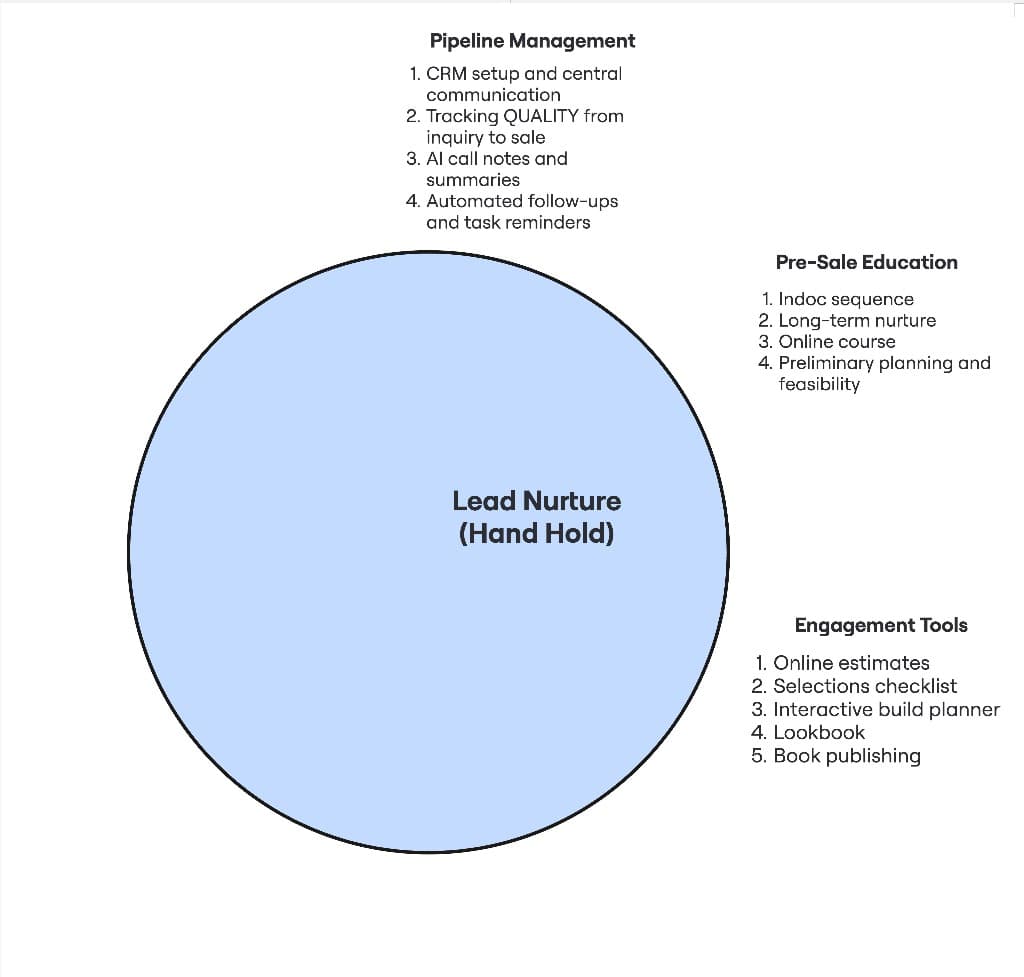
Response: contact before the lead cools off
This is where a lot of good marketing gets blamed for a bad handoff. A homeowner fills out a form, gets distracted, talks to another builder, or decides nobody is serious enough to call back. The response layer makes sure new enquiries get a professional first touch, not just another automated receipt.
- AI first touch and routing — fast acknowledgement, context capture, and the right next step.
- Human calling where it matters — project fit, urgency, budget signals, and qualification before owner time is spent.
- Clean handoff notes — call summaries, next actions, and lead context your team can trust.
Pipeline management: one source of truth
If your CRM is optional, you do not have a pipeline — you have a pile. Central communication means every touchpoint rolls up to something you can trust: who owns the next step, what was promised, and whether this lead still matches your grading criteria. Tracking quality from inquiry to sale — not just ‘did we get more leads’ — is how you stop celebrating activity that never becomes revenue.
- CRM setup and central communication — one place the team actually uses.
- Tracking quality from inquiry to sale — stages, reasons lost, and patterns you can fix.
- AI call notes and summaries — fast handoffs without losing nuance.
- Automated follow-ups and task reminders — so nothing dies quietly in an inbox.
Pre-sale education: lower fear, raise readiness
Custom projects scare people. Budget unknowns, timeline anxiety, and ‘what if we choose the wrong builder’ keep deals stuck in maybe. Education is how you answer those fears before you are standing in their kitchen explaining your entire process for free. Sequences, long-term nurture, and structured planning content turn curiosity into confidence — and confidence into a booked feasibility conversation instead of endless email ping-pong.
- Indoc sequence — what every new inquiry should learn in the first days.
- Long-term nurture — staying useful while they finish financing, design, or life events.
- Online course — scaled teaching for complex buying journeys.
- Preliminary planning and feasibility — structured steps that earn paid depth instead of free quotes.
Engagement tools: help them move forward
Some prospects need more than words — they need something to do. Lightweight tools (estimates, checklists, planners, lookbooks) let them self-qualify and visualize the path. Done well, these shorten sales cycles and reduce scope creep. Done poorly, they become gimmicks. We tie them to how you actually sell, not generic SaaS widgets.
- Online estimates — boundaries and ranges that set expectations early.
- Selections checklist — clarity on decisions that drive cost.
- Interactive build planner — guided thinking before you commit estimating hours.
- Lookbook — proof and aspiration in one place.
- Book publishing — authority asset for long sales cycles.
Mistakes we see on repeat
‘We will just remember.’ Memory does not scale past a handful of jobs. Without a pipeline view, you chase the loudest prospect, not the best one.
Broadcast email with no strategy. Nurture is not noise. Every message should earn the next step or disqualify early.
Tool-first thinking. A new CRM does not fix unclear stages or owners. Process first, software second.
How this connects to the other circles
Nurture without strong lead generation means you are polishing a small, stale list. Nurture without conversion means you educate forever and never ask for the business cleanly. The point of the middle circle is to hand sales a warmer, clearer opportunity — not to add busywork for your admin.
What to do next
For tactics and tooling patterns, read the automation playbook. If you are not sure whether the leak is nurture or something else, the Builder Growth Assessment is the honest place to start.
Put this layer to work
We rarely fix one circle in isolation. If you want an outside read on how this pillar connects to the rest of your system, start with the Builder Growth Assessment.
Want to understand implementation levels first? Review the plans, then come back when you are ready for a fit conversation.