
Lead generation for builders
The first circle — hand raise. Not ‘more leads.’ The right homeowners raising their hand in the right channels, then graded before your estimators get involved.
If you are responsible for a custom home or design-build firm, you have already seen both sides of this problem: either the phone is too quiet, or it is noisy with people who were never going to pay for the work you actually want to build. Lead generation for builders is not a volume game. It is a fit game — geography, project type, budget band, and timeline — then a repeatable way to bring those people in without depending on luck and referrals alone.
This page walks the model we teach in the workshop video below. Keep the system overview in mind: generation is only the first circle. If nurture or conversion is broken, more top-of-funnel traffic will not fix cashflow — it will just waste more of your time.
Watch: lead generation workshop
This session goes deeper on the first circle only — channels, sequencing, and how we think about qualification before a lead ever hits your sales calendar.
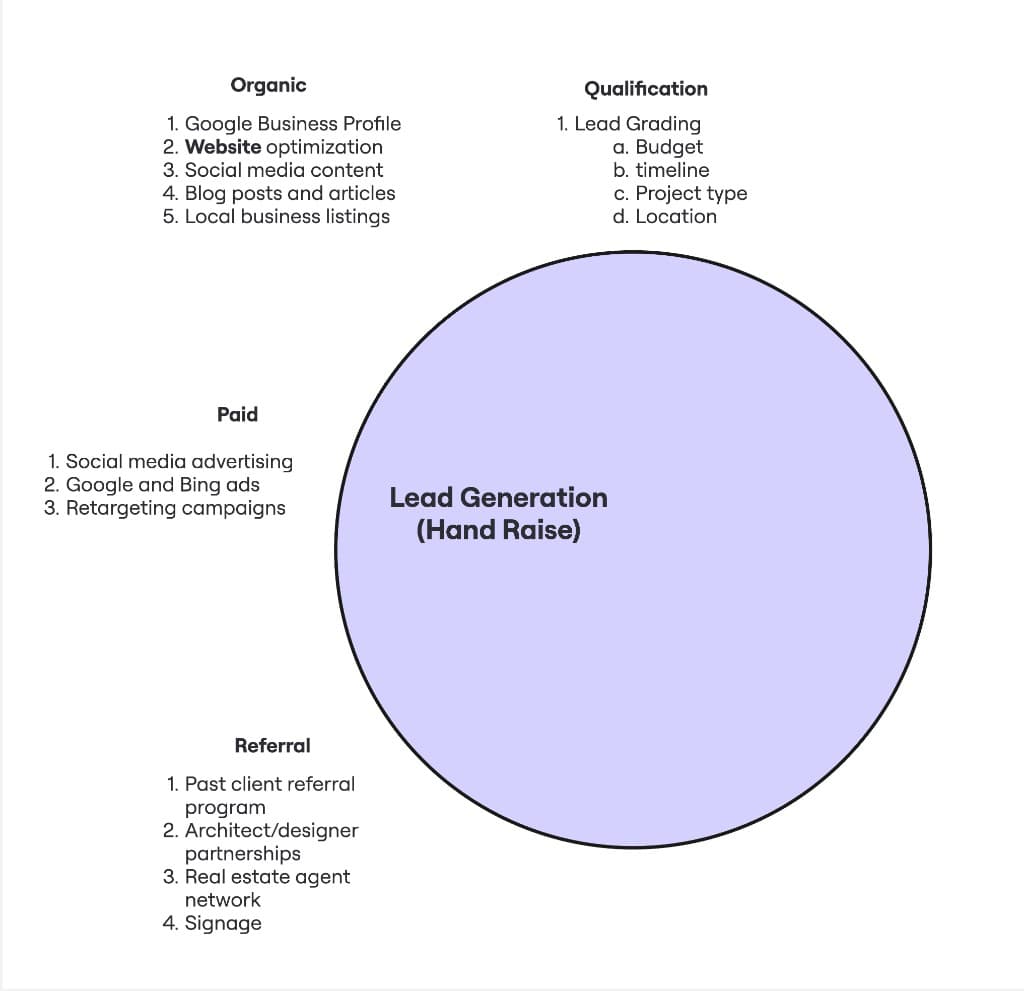
Organic: be findable where trust is formed
For most builders, organic is not ‘blogging for fun.’ It is local proof of competence — showing up when someone searches your craft and your area, and looking like the firm that handles serious work. That usually starts with a strong Google Business Profile, a website that actually explains process and outcomes (not just pretty photos), and content that answers the questions homeowners already ask before they ever call.
- Google Business Profile — the front line of local intent; reviews, categories, photos, and posts that match how you want to be hired.
- Website optimization — speed, clarity, service geography, and pages that support how people really choose a builder.
- Social media content — proof of work, culture, and process; not random engagement bait.
- Blog posts and articles — long-tail education that pulls people researching scope, budget, and timeline.
- Local business listings — consistency across directories so Google (and humans) trust the basics.
Paid: buy speed when organic is not enough
Paid works when you know what a good lead looks like and you have a place for them to land that filters before you are on the phone. Otherwise you rent attention, get clicks, and wonder why nobody books. We use paid to compress time — especially when you are entering a new market, promoting a specific offer, or retargeting people who already showed intent.
- Social media advertising — creative and targeting matched to project type and geography.
- Google and Bing ads — capture high-intent search where homeowners name the problem.
- Retargeting campaigns — follow up with people who visited key pages but did not convert yet.
Referral: engineer word of mouth instead of hoping for it
High-end residential work still runs on relationships — past clients, architects, designers, agents, and people who see your signage on site. Referral is not passive; it is designed touchpoints that make it easy for the right people to send you the right jobs.
- Past client referral program — clear asks, simple rewards, and timing that does not feel desperate.
- Architect and designer partnerships — mutual respect, shared standards, and leads that match your wheelhouse.
- Real estate agent network — where it fits your market and project mix.
- Signage — physical proof on jobs that sell the next one.
Qualification: grading before your team pays the price
None of the channels above matter if every inquiry becomes an emergency site visit and a free novel-length quote. Lead grading is where you protect margin: budget, timeline, project type, and location — simple criteria, consistently applied, before nurture and sales invest deeply.
Get this right and your pipeline gets quieter but heavier — fewer conversations, more of the ones that can actually close. Get it wrong and you will blame ‘the ads’ when the real issue is nobody said no early enough.
Mistakes we see on repeat
Chasing impressions. You can win the attention game and still lose the year if nobody grades or follows up.
Copying another market. What works for tract builders or low-ticket remodels rarely transfers to custom work without rewriting the offer, creative, and qualification.
Skipping qualification to seem ‘responsive.’ Responsiveness to the wrong leads is just expensive politeness.
What to do next
If demand is your bottleneck, read the lead generation playbook. Then move to lead nurture so you know what happens after the hand raise — and lead conversion so you are not building a pile of conversations that never become contracts.
Put this layer to work
We rarely fix one circle in isolation. If you want an outside read on how this pillar connects to the rest of your system, start with the Builder Growth Assessment.
Want to understand implementation levels first? Review the plans, then come back when you are ready for a fit conversation.