
Home Builder Marketing: The Complete Lead-to-Sale Playbook
A practical system for attracting the right homeowners, moving them from enquiry to decision, and measuring marketing by signed work — not clicks alone.
Growth System playbook · About 12 min read · Updated September 2026
What you get from this guide
One connected system
A clear view of how positioning, demand, nurture and conversion work together instead of becoming separate marketing projects.
A pipeline you can inspect
The numbers and decision points needed to find whether demand, response, qualification or sales is constraining growth.
A sensible order of work
A staged plan that fixes urgent pipeline gaps without abandoning the authority and owned assets that compound over time.
The problem this playbook fixes
Most home builder marketing plans are a list of channels: rebuild the website, post on social media, run Google Ads, try SEO, send emails. That creates activity, but it does not create a dependable path from attention to signed work. A campaign can generate enquiries while the pipeline still feels empty because the wrong projects are coming in, response is slow, leads are not nurtured, or the sales process asks for a quote before establishing fit. The useful question is not simply, ‘How do we get more leads?’ It is, ‘Where is the lead-to-sale system losing the right opportunities?’ This playbook gives you a way to answer that question before spending more money on the wrong layer.
How this fits the Growth System
Home builder marketing is not one channel. It is the complete path from market attention to a suitable enquiry, useful follow-up, a clear sales decision, and signed work. This guide maps all three parts before you choose the next tactic.
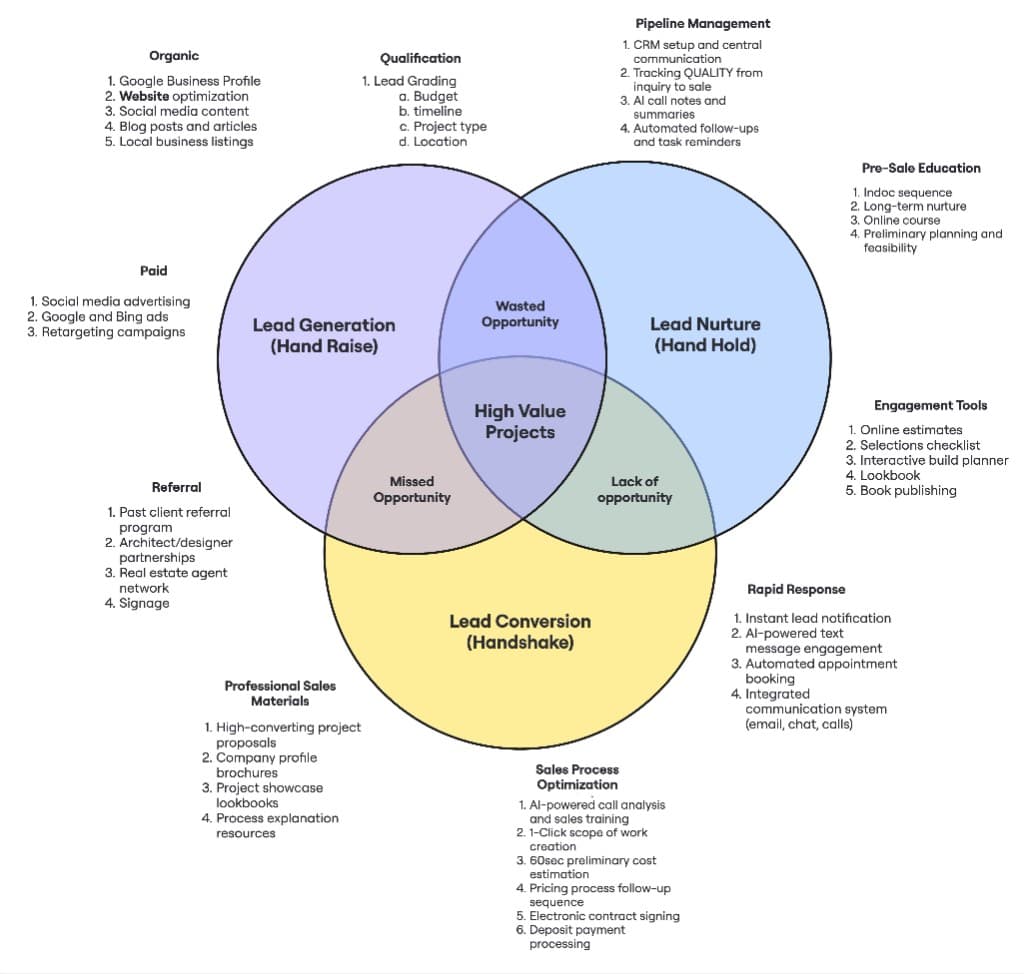
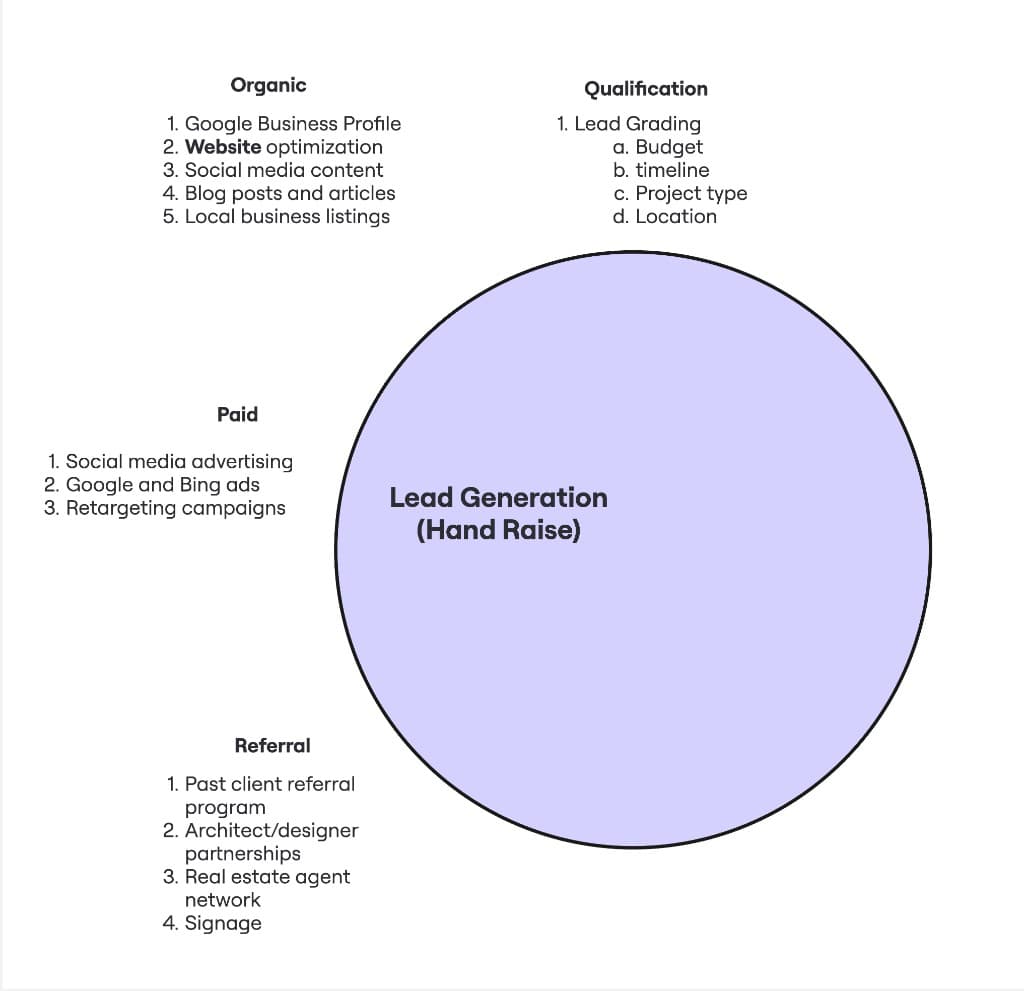
First circle — hand raise
Generation
Right homeowners find you, then get graded before your estimators burn hours.
Open pillar + workshop →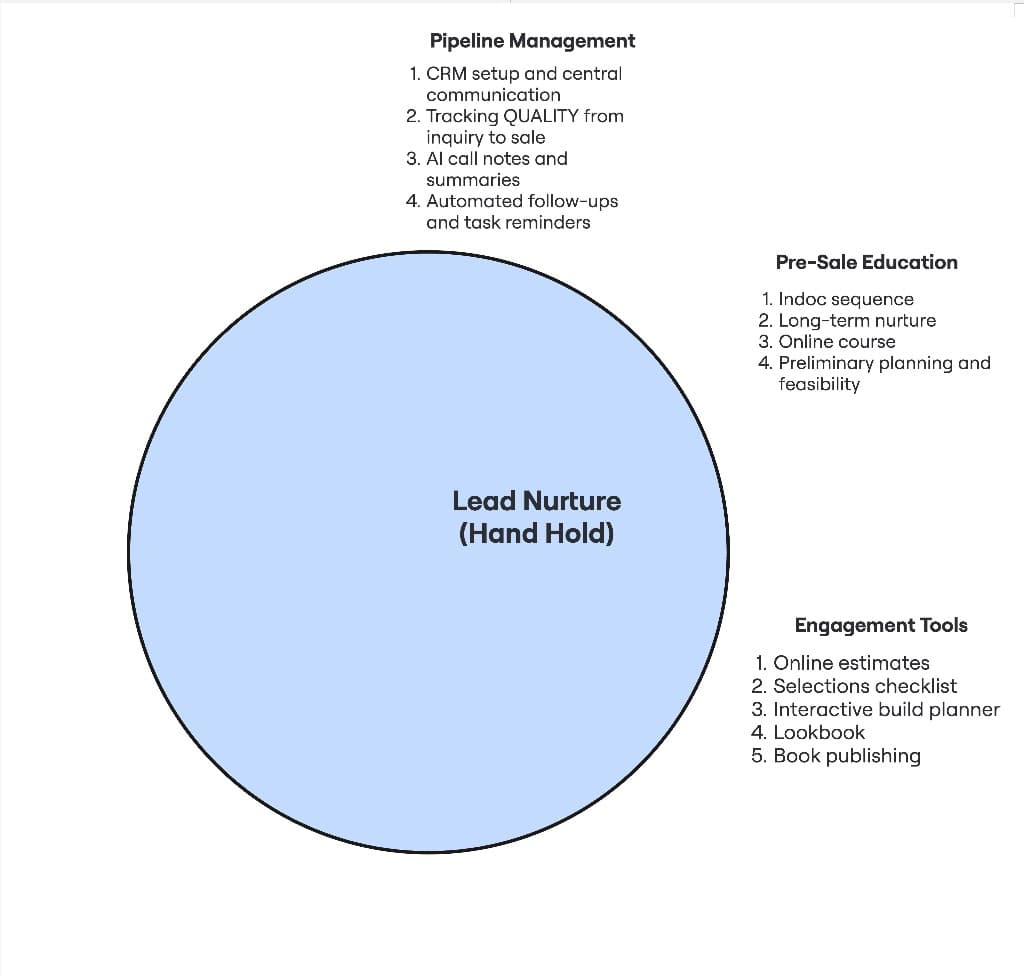
Middle circle — momentum
Nurture
Speed-to-lead, pipeline discipline, and education between interest and signature.
Open pillar + workshop →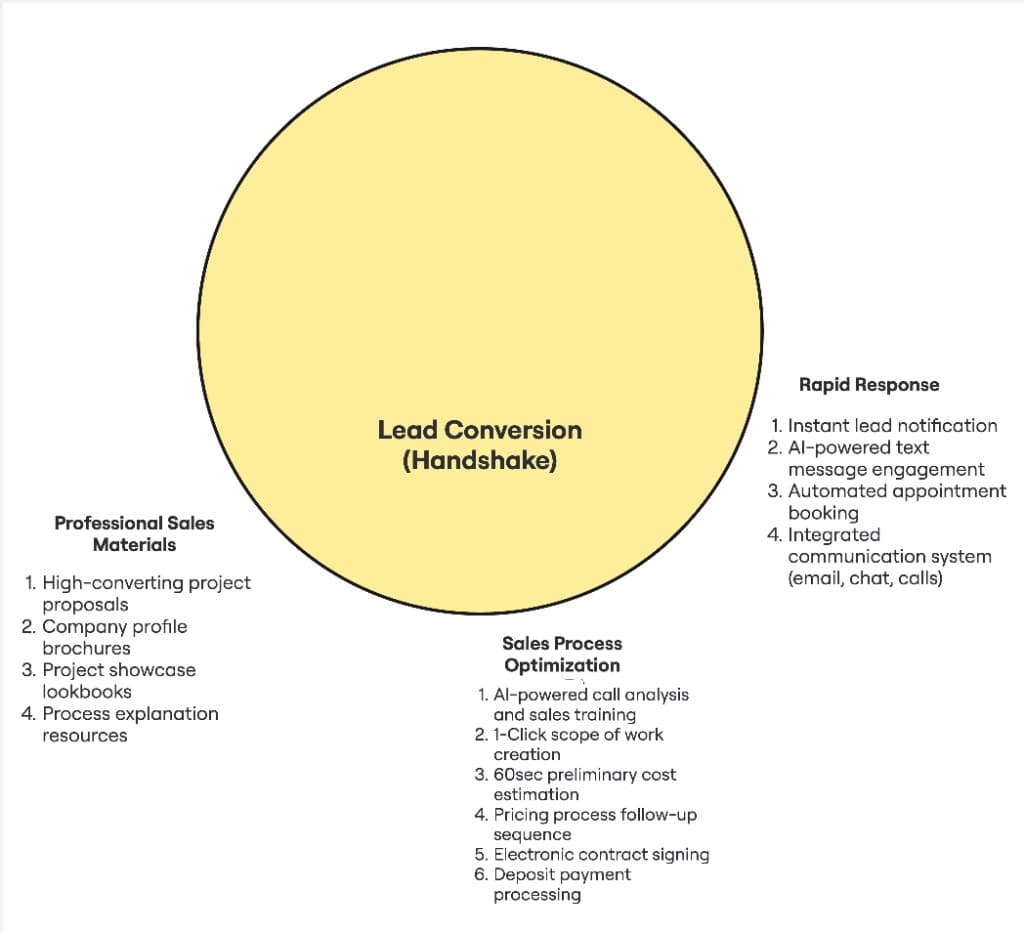
Third circle — signed work
Conversion
A repeatable sales process that does not depend on one heroic estimator.
Open pillar + workshop →If you want priorities by revenue stage, the Builder Growth Roadmap maps the same sequence across Stage 1 ($0–$500K) through Stage 5 ($5M+) so you can see what to tighten first at your current size.
01Start with the pipeline constraint, not the channel
TL;DR
The best next marketing investment depends on where suitable opportunities are currently being lost.
- Low enquiry volume points to a demand problem.
- Plenty of poor-fit enquiries points to positioning or targeting.
- Good leads going quiet points to nurture, response or sales process.
A quiet pipeline does not automatically mean you need more advertising. It means one stage of the path from market attention to signed work is underperforming. Unless you identify that stage, adding traffic can simply push more people into the same leak.
Begin with five numbers for the previous 90 days: suitable enquiries, qualified conversations, site visits or discovery meetings, proposals or preliminary agreements, and signed projects. Add the average time between each stage. This is not a perfect attribution model. It is a practical diagnostic that shows where momentum disappears.
If the business has very few suitable enquiries, work on demand. If enquiries arrive but do not fit your project type, territory or realistic budget range, tighten the offer and targeting. If good prospects wait days for a response, improve speed-to-lead and ownership. If conversations happen but decisions stall, examine the sales path, proof and next step.
Channel decisions become much simpler once the constraint is visible. You can invest where the pipeline is breaking instead of buying another tactic because a competitor appears to be using it.
02Define the work you want before promoting the business
TL;DR
Clear project fit improves targeting, content, qualification and sales at the same time.
- Name the project types and locations the business can serve well.
- Separate preferred work from work you will still accept.
- Use realistic fit criteria without turning preferences into false exclusions.
Home builder marketing becomes vague when the business is presented as available for almost anything. A homeowner cannot tell whether you are the right firm for a complex architectural build, a major renovation, a knockdown rebuild or a smaller alteration. Search engines face the same ambiguity.
Build a project profile before writing campaigns. Document the work types you want more of, the service area, the project complexity you handle well, the capacity you have available, and the signs that a project is likely to become a good commercial fit. Keep preferred work separate from hard exclusions. A missing budget, plan or fixed start date is information to uncover, not an automatic rejection.
This profile should change the whole system. It shapes the service pages and case studies you publish. It determines the search terms and locations you target. It gives enquiry forms useful questions. It also gives the sales team a consistent way to decide which conversations deserve more time.
The objective is not to narrow the market until nothing is left. It is to make the right homeowner recognise themselves quickly while giving the builder enough information to choose the right next step.
03Position the builder around a decision homeowners care about
TL;DR
A strong position explains who the builder is for, what important problem they solve, and why their process is credible.
- Lead with the homeowner's decision, not a generic quality claim.
- Use process, project evidence and local knowledge as proof.
- Keep the same core position across search, ads, website and sales.
Most builders say they offer quality, communication and attention to detail. Those things matter, but they do not create a useful distinction because every credible competitor makes the same claims.
A practical position starts with a specific homeowner and a consequential decision. For example: managing design and construction under one accountable process, making feasibility clear before a large commitment, or delivering complex renovations while protecting the parts of the home that remain. The position should connect the client's risk to a process the builder can demonstrate.
Proof makes the position believable. Show relevant completed projects, explain how early decisions are made, introduce the people responsible, and document the stages a client will experience. Local knowledge matters when planning rules, site conditions, climate or supplier constraints affect the work. Use it where it is real rather than adding place names to generic copy.
Once the position is clear, repeat it consistently. A search result, advert, homepage, case study and first sales conversation should feel like parts of the same business. Consistency reduces the amount of trust each new touchpoint has to rebuild.
04Build demand across search, paid media and relationships
TL;DR
A resilient pipeline combines channels that capture current intent with channels that create future preference.
- Search captures homeowners already investigating a project.
- Paid media can create conversations while owned authority compounds.
- Referrals and professional relationships strengthen trust across both.
Homeowners do not all enter the market at the same point. Some are actively comparing builders. Others are still researching land, design, cost or consent. Your demand mix needs to meet both groups.
Search marketing captures existing intent. Useful service pages, local pages, project case studies and educational resources help the business appear when a homeowner asks a specific question. Google Ads can provide faster visibility for selected commercial searches while organic authority develops. Both work better when the destination clearly matches the query instead of sending every visitor to a general homepage.
Social content and email create familiarity before a formal search begins. The useful material is rarely a stream of finished-project photos alone. Explain decisions, trade-offs, site constraints, planning stages and what clients should expect. This gives future buyers reasons to remember the builder beyond visual taste.
Relationships complete the mix. Past clients, architects, designers, engineers, suppliers and industry groups can introduce opportunities with trust already attached. The goal is not to choose one perfect channel. It is to combine immediate intent capture with authority that compounds and relationships that are deliberately maintained.
05Make the website move people to the right next step
TL;DR
A builder website should help a suitable homeowner understand fit, reduce uncertainty and take one sensible next step.
- Give important services and markets their own clear pages.
- Use project evidence to answer risk, process and fit questions.
- Match the call to action to the visitor's stage of decision.
A portfolio can prove taste and workmanship without helping a homeowner decide what to do next. A lead-to-sale website has a broader job. It explains who the business helps, what work it is equipped to deliver, how the process reduces risk, and what a serious prospect should do next.
Create a clear page for each meaningful service or project category. Add location pages only where the business has a genuine market proposition and useful local knowledge. Connect those commercial pages to detailed case studies and educational resources. This gives visitors depth when they need it and gives search engines a clear map of the business.
Calls to action should match readiness. Someone comparing builders may be ready for a project discussion. Someone testing feasibility may need a guide, assessment or explanation of the preliminary process first. One clear primary action per section is usually stronger than presenting five equal buttons.
Measure meaningful actions separately. A guide download, phone call, assessment and booked consultation do not represent the same intent. Treating all conversions as equal hides whether the website is producing real sales opportunities or only easy micro-actions.
06Engineer follow-up before buying more enquiries
TL;DR
Fast, useful and owned follow-up protects demand that the business has already paid or worked to create.
- Set a clear owner and response standard for every new enquiry.
- Use automation to support human follow-up, not impersonate it.
- Keep long-cycle prospects warm with relevant decision support.
Construction buying cycles are long. A homeowner can be serious while still being months away from drawings, finance, land settlement or a final decision. If every lead is treated as either ready now or lost, the business discards much of the value it has created.
Start with ownership. Every enquiry needs a named person, a response expectation and a recorded next step. A fast acknowledgement matters, but speed without relevance is not enough. Refer to the project details supplied and guide the person toward the next decision that fits their stage.
Automation can confirm receipt, collect missing information, prompt internal follow-up and send useful education. It should not pretend a generic sequence is a personal conversation. Use it to prevent silence and administrative gaps while keeping important judgement with the team.
For longer-cycle opportunities, create a small library around the decisions prospects actually face: feasibility, design readiness, budget alignment, site constraints, builder selection and preliminary agreements. Helpful follow-up keeps the builder present without a stream of ‘just checking in’ messages that add no value.
07Treat conversion as a process, not a personality trait
TL;DR
A documented sales path makes good decisions repeatable and protects senior time, margin and client trust.
- Qualify enough to choose the right next conversation.
- Use paid preliminary work where detailed investigation creates value.
- Track reasons for loss instead of relying on memory.
Many builder sales processes live in the owner's head. That can work while every lead reaches the same experienced person, but it becomes a bottleneck as volume grows. It also makes performance hard to diagnose because each opportunity follows a different path.
Document the stages from first conversation to signed agreement. Define the purpose of each stage, the information required, the decision being made and the next action. Qualification should establish enough about project type, location, readiness, constraints and commercial fit to decide whether more time is justified. It should not become an interrogation or reject promising work because every detail is not yet known.
Detailed estimating, design coordination and feasibility investigation create real value. Where appropriate, a paid preliminary agreement gives that work a defined scope and gives both parties a better basis for the main construction decision. It also separates serious investigation from speculative free quoting.
Record outcomes and loss reasons in a consistent way. ‘Went cold’ is rarely a sufficient explanation. Timing, finance, scope mismatch, competitor choice, lack of trust, slow follow-up and an unclear next step require different fixes. Better sales data improves marketing because it reveals which enquiries actually become suitable work.
08Run marketing on a 90-day operating rhythm
TL;DR
A short operating cycle keeps the team focused while preserving long-term assets that need time to compound.
- Choose one primary constraint and one supporting asset each quarter.
- Review lead quality and stage conversion, not traffic alone.
- Turn real customer questions and project experience into useful content.
A large marketing plan often fails because it creates too many simultaneous projects. The website is half rewritten, campaigns are launched without follow-up, content is published without distribution, and nobody can tell which change affected the pipeline.
Work in 90-day cycles. Choose the primary pipeline constraint and define the observable improvement you expect. Pair it with one compounding asset. For example, a firm might improve paid search and response time for near-term demand while publishing a detailed service page and two supporting case studies for long-term authority.
Review the system monthly. Look at suitable enquiries, stage conversion, response times, sales outcomes and source quality. Use traffic, rankings and cost per lead as diagnostic measures, not final success. A cheaper lead is not an improvement if it creates more estimating work and fewer suitable projects.
Your best content inputs already exist inside the business. Sales calls reveal objections. Phone transcripts reveal the words homeowners use. Project teams know where decisions go wrong. CRM and lead data show patterns that individual anecdotes miss. Anonymise and validate those insights, then turn them into practical resources the market cannot get from a generic marketing summary.
Who this guide is for
- Custom home builders, design-build firms and serious renovation companies that want a more dependable pipeline than referrals alone can provide.
- Builder owners who have tried disconnected tactics and need to see how marketing, follow-up and sales fit together.
- Established firms that want better-fit projects, clearer attribution and stronger authority in their market — not lead volume at any cost.
Common mistakes builders make
Most of these problems are not caused by effort alone. They come from the wrong sequence, the wrong assumptions, or a missing layer in the system.
- Buying more traffic before checking whether suitable enquiries already disappear through slow response, weak qualification or an unclear sales next step.
- Trying to make the homepage rank for every informational and commercial keyword instead of giving distinct search intents a clear page to own.
- Publishing broad advice that could have been written for any industry, with no builder process, project evidence or operational judgement.
- Calling every form submission a lead and optimising cost per lead without checking project fit, sales progression or signed revenue.
- Treating SEO, paid media, social, email and referrals as separate projects with different messages and no shared pipeline model.
- Redirecting older content solely because topics overlap, before preserving any unique search intent, backlinks, evidence or useful passages.
Frequently asked questions
What is home builder marketing?
Home builder marketing is the system used to attract suitable homeowners, build trust, capture enquiries and move those opportunities toward signed work. It includes positioning, search, paid media, content, referrals, website conversion, follow-up and sales measurement. The channels matter, but their connection matters more.
Which marketing channel should a home builder start with?
Start with the current pipeline constraint. If suitable enquiries are scarce, paid search and direct relationship activity can create nearer-term demand while SEO compounds. If good leads already arrive but stall, fix response, nurture or sales before buying more traffic. The 90-day diagnostic in this guide helps identify the right starting point.
How much should a home builder spend on marketing?
There is no useful universal percentage. Work backwards from the type and number of projects required, expected gross margin, current close rate, capacity and sales cycle. Separate fixed system costs from media spend, then set a test budget large enough to produce a meaningful result without relying on one enquiry.
How long does home builder marketing take to work?
The timeline depends on the channel and starting point. Paid campaigns and direct outreach can create conversations sooner. Search authority, content and referral systems usually compound over a longer period. Judge early work by implementation and suitable opportunity signals, then judge the full system by sales progression and signed projects.
Do home builders need both service pages and educational playbooks?
Yes, because they answer different searches. A service page helps someone evaluate an agency or marketing service. A playbook teaches someone how home builder marketing works. They should support each other, but forcing both intents into one page usually weakens relevance and the reader's next step.
How should home builders measure marketing ROI?
Connect source data to suitable enquiries, qualified conversations, proposals or preliminary agreements, signed projects and gross margin where possible. Report total pipeline and lag separately from immediate leads because construction sales cycles are long. Traffic, rankings, click-through rate and cost per lead are diagnostic measures, not the final return.
Apply it to your business
Framework first. Then the right next move.
A playbook helps you understand the mechanism. The Builder Growth Assessment uses your answers to suggest a likely starting lane: self-install or, for qualified builders, a Builder Growth Strategy.
- ✓The likely lane behind the growth pressure you reported
- ✓A useful starting point without pretending four answers prove the cause
- ✓A direct answer on fit, timing, and whether the wider system makes sense
Regional context: New Zealand home builder marketing and Australia home builder marketing.
Want the full system map first? Download the Growth System guide.
Related playbooks