
CRM & Lead Follow-Up for Home Builders
Give each enquiry an owner, a clear next step and the right follow-up. Work through Cameron's three-stage nurture process and the 3R method, with messages your team can adapt.
Watch the workshop below, or jump to the written walkthrough and work through the steps.
Cameron Upton · Full workshop
How to Automate Lead Follow-Up for Your Construction Business
Someone can be a good fit and still be months away from building. Plans, pricing and approvals take time. In this workshop I separate the first response, the early follow-up and the longer education process. The aim is to keep a useful conversation moving, with an owner and an agreed next step.
Nurture playbook · About 17 min read · Updated October 2026
Teaching by Cameron Upton, Contractor Scale founder and trade-qualified engineer turned strategist.
Written guide adapted by Contractor Scale from Cameron’s recorded explanations and source-backed editorial guidance. Suggested scripts and worked examples are labelled; they are not transcript quotations. See the original teaching and evidence.
What you get from this guide
Clear Response Ownership
Know who will respond, who covers them and what the homeowner has been promised.
Useful Follow-Up
Separate reaching a new enquiry from educating a prospect and staying in touch until they are ready.
A Visible Next Action
Record the project context, readiness milestone and next action so another team member can pick up the conversation.
The problem this playbook fixes
A homeowner enquires while you're on site. You make a call, leave a message and get pulled into another job. Later, someone else asks where that enquiry went. The answer is somewhere between your phone, your inbox and your memory. Getting more enquiries adds to that problem unless someone owns the response and records what happens next. This guide turns Cameron's lead-nurture workshop into a practical CRM process, then uses his 3R method to reconnect with past prospects and clients. Start with the conversations and decisions. Automate the repeatable work around them.
How this fits the Growth System
Nurture is what happens after the first enquiry — so momentum does not die in slow follow-up, admin gaps, or forgotten next steps. Without it good leads cool off before sales ever sees them.
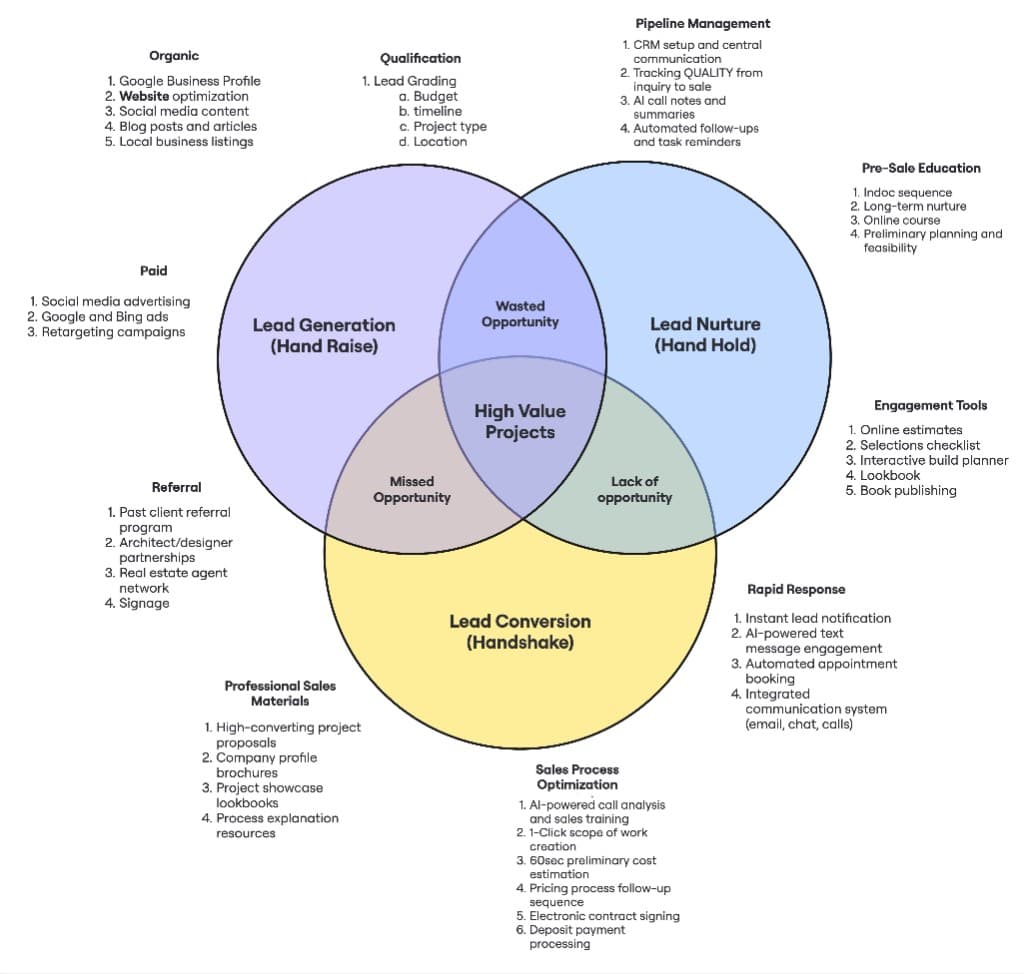
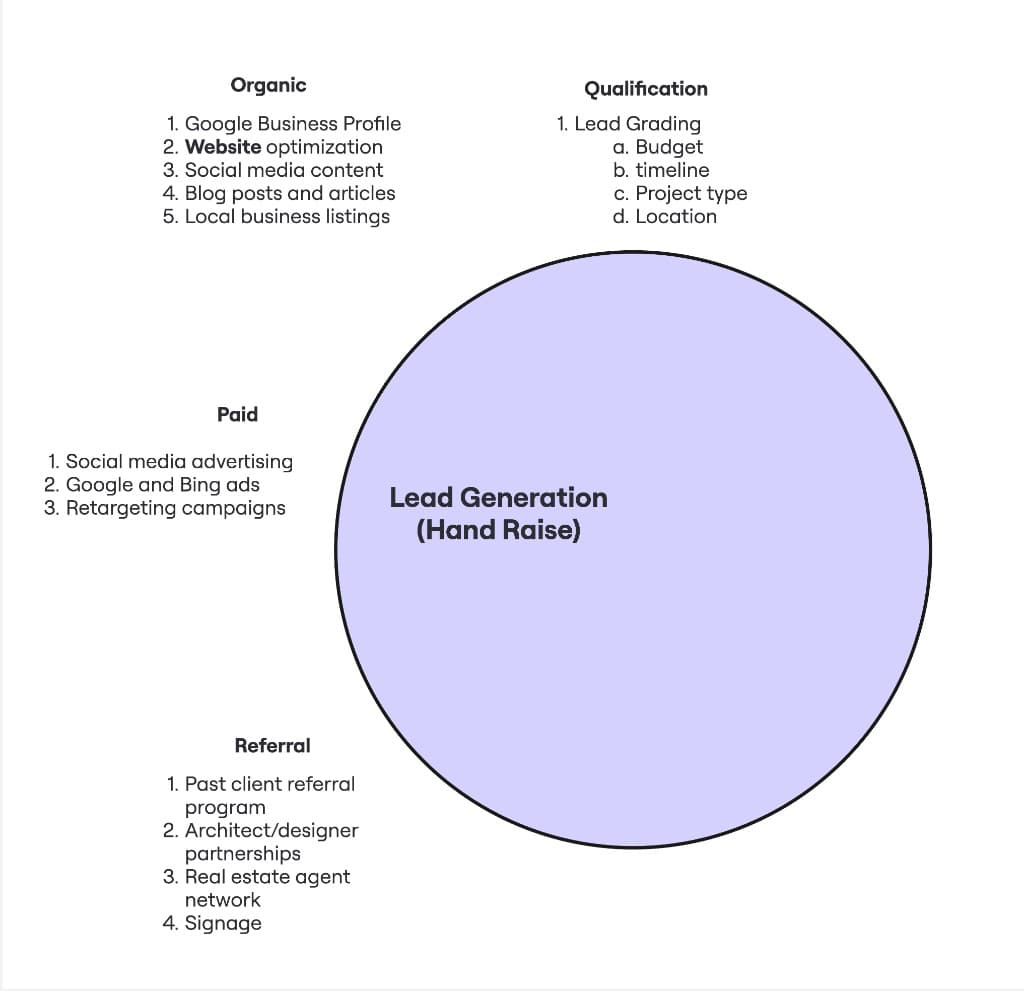
First circle — hand raise
Generation
Right homeowners find you, then get graded before your estimators burn hours.
Open pillar + workshop →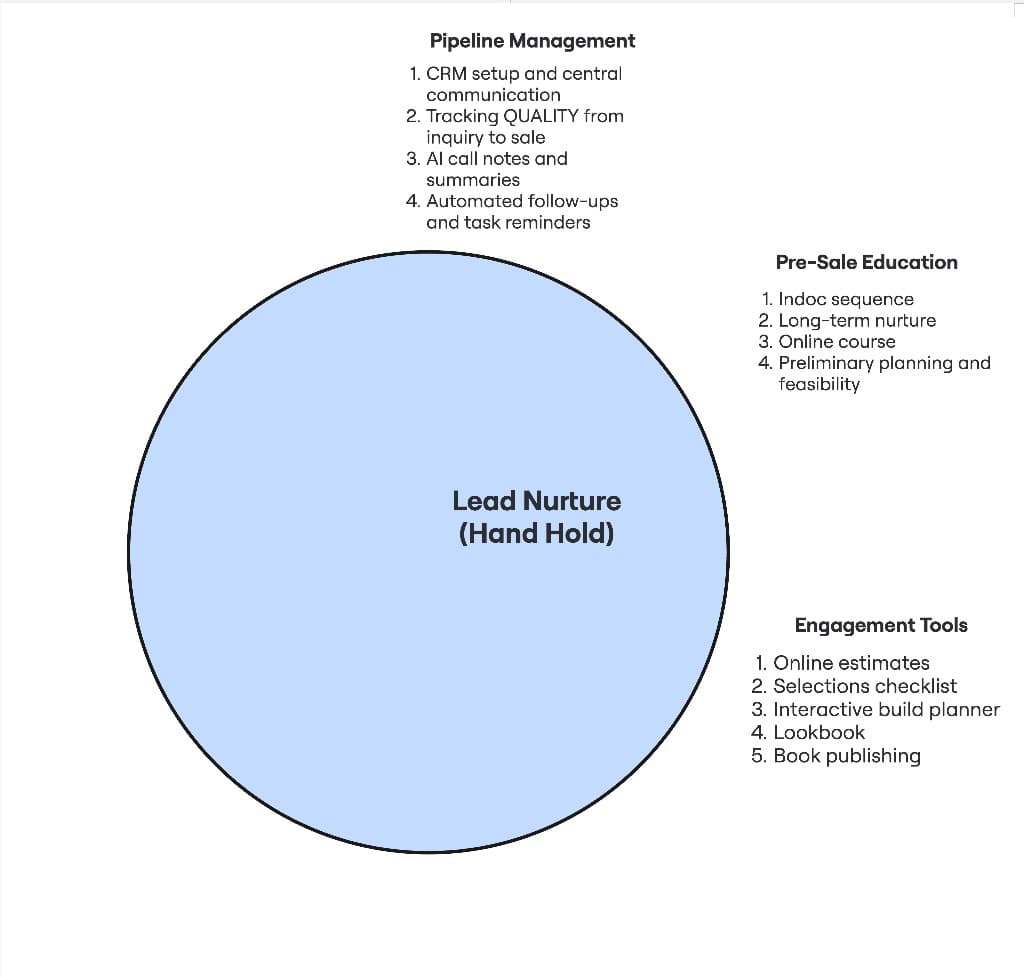 This playbook
Middle circle — momentum
Nurture
Speed-to-lead, pipeline discipline, and education between interest and signature.
Open pillar + workshop →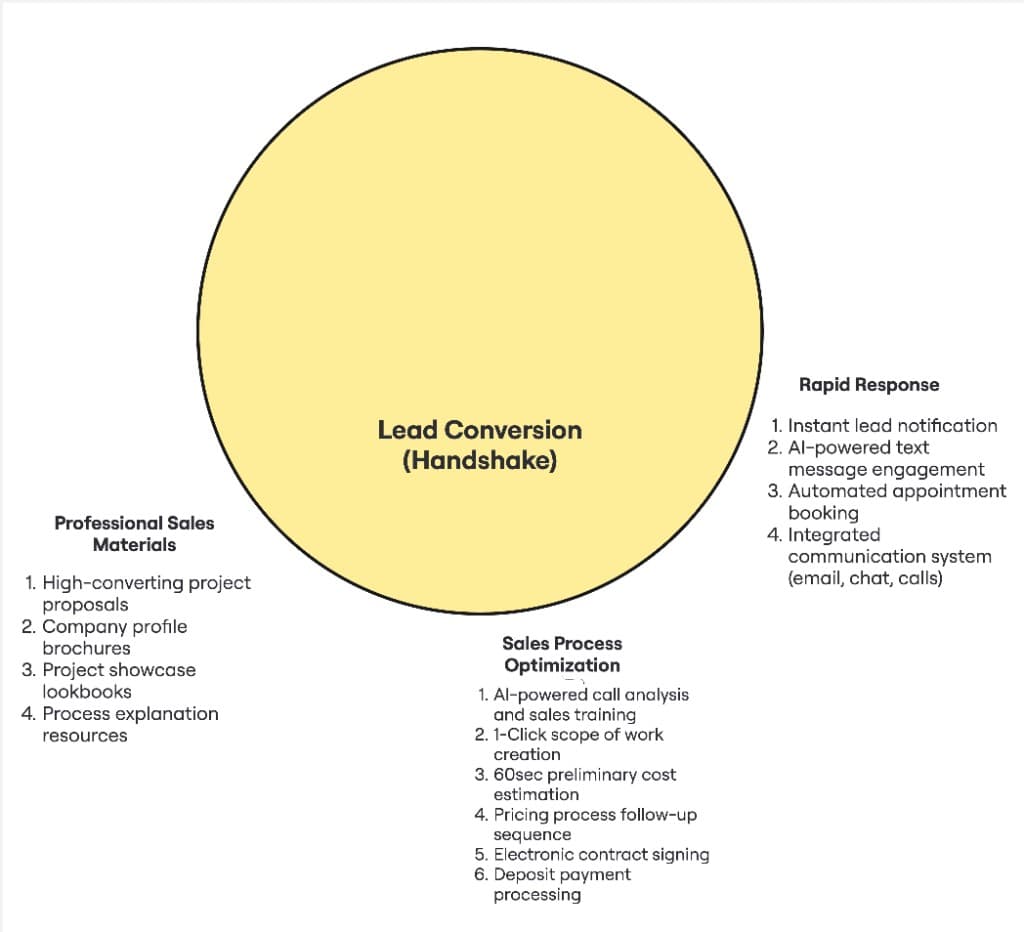
Third circle — signed work
Conversion
A repeatable sales process that does not depend on one heroic estimator.
Open pillar + workshop →If you want priorities by revenue stage, the Builder Growth Roadmap maps the same sequence across Stage 1 ($0–$500K) through Stage 5 ($5M+) so you can see what to tighten first at your current size.
Choosing software first? Read the home builder CRM guide: sales versus project management to compare HighLevel with construction platforms and test the sales process your team needs. Then use this playbook to organise response, follow-up and operating responsibilities.
01Give Every Enquiry an Owner and a Usable Record
TL;DR
A useful CRM shows who owns the conversation, what is known and what needs to happen next.
- One contact record and one current response owner.
- Sales follow-up and project delivery have different jobs.
A CRM is a customer relationship management system: the shared record of conversations before someone becomes a client. It should show your team where each enquiry is.
Start with the enquiry paths you actually use: website forms, paid ads, phone calls, email and referrals. Name the response owner for each path and the person who covers them on site, in meetings or away. Decide when the team will check new enquiries and what an after-hours acknowledgement can truthfully promise.
Keep a minimum record: contact details, enquiry source and date, project type, location, stage, last conversation, owner and next action. Add contact preferences and instructions to stop. Record facts separately from assumptions. “Plans expected after the architect meeting” is useful; “probably not serious” lacks context.
Cameron demonstrates a CRM and an inbox fallback. Starting small, use labelled enquiry folders, shared notes and dated tasks. Check someone else can find the history. Move beyond that when volume makes it hard to manage.
Your sales record covers enquiry through the sales process. Estimating and project-management tools cover their own work. At contract signing, hand over scope, client details and commitments. Check your existing tools' capabilities before buying another system.
02Separate the Three Stages of Follow-Up
TL;DR
Reaching someone, explaining your business and keeping in touch require different messages and decisions.
- Initial contact: learn about the project and agree a conversation.
- Long-term nurture: stay useful around the buyer's readiness.
Cameron separates hot-lead follow-up, a “30-day pitch” and long-term nurture. A single sequence asking everyone to book a meeting misses the distinction.
Initial contact means your team is trying to reach someone who enquired. Understand the project and agree a time to talk. A missed call does not establish whether the project fits.
Early education helps a homeowner comparing builders or discussing plans understand your business. Explain the next step, a real service difference and evidence that helps them assess it. The workshop's 30-day pitch label is not a mandatory duration.
Long-term nurture applies when continued contact is appropriate but the project is not ready. The next conversation might depend on revised plans, a property decision or timing. Record the reason and agreed checkpoint.
Write the entry condition, goal and exit condition for each stage. A reply should reach the owner. An agreed meeting should change the follow-up. A request to stop should end it. A suitable buyer waiting on plans should not keep receiving messages that assume a site meeting is already the next step.
03Make the First Response Lead to a Real Conversation
TL;DR
Acknowledge the enquiry, ask about the project and agree when a responsible person will call.
- Save a simple first message before building automation.
- A booked call needs an owner who will actually make it.
Cameron's starting exercise is to save a first-response message in your phone. Choose a response target your team can deliver and monitor it. An automatic acknowledgement and a personal call are separate events.
Adaptable first-message example: “Hi [first name], it's [your name] from [company]. Thanks for your enquiry about [project]. Tell me a bit more about what you're looking to do.” Use their supplied contact channel. If the form answers that question, ask the next useful one.
Adaptable call-time question: “Thanks, that helps. When would suit for a call about the project?” Confirm day, time, caller and number. Put it in the caller's task list or calendar. Someone still needs to make the call.
For an after-hours acknowledgement, explain when someone will respond. Avoid “I'll call shortly” when nobody is available. A reminder can confirm an agreed call, but it should not invent a booking or send the homeowner to a meeting link you never discussed.
If you miss them, record the attempt and choose a sensible next attempt based on their preference and the enquiry context. Busy people miss calls. Keep a review point and a stopping rule rather than retry indefinitely. If they reply, stop the unanswered-enquiry messages and let the owner continue the conversation.
04Record Fit, Readiness and the Next Action Separately
TL;DR
A suitable project that is not ready needs a readiness checkpoint, while unknown information needs a conversation.
- Define accepted work, preferred work and actual exclusions.
- Every active next action needs a person and a date or trigger.
Cameron describes three call outcomes: unsuitable, suitable and ready, or suitable and not ready. Add “not yet reached” to your record so silence never becomes a false qualification decision.
Write what your business accepts, prefers and genuinely excludes. A preferred value or style does not exclude everything else. Ask about project type, area, scope, plans, timing and budget where relevant. Missing budget, finance or plans is information to resolve, not rejection grounds.
For a suitable, ready enquiry, agree the next step your business actually uses: a further call, site meeting or scoped feasibility discussion. For a suitable project waiting on something, name that milestone and agree when to reconnect. For an explicit exclusion, explain it politely and close the sales pursuit. Record requests to stop separately from project fit.
Use this next-action record: owner; action; due date or milestone; reason; material promised; homeowner's agreed expectation; completion note. “Follow up later” fails that test. “Alex to call after the architect meeting on 22 October, asking whether the revised extension plans are ready” gives another person something to do.
Update the record after the conversation. Sending a promised project example is a task, not sales progress. Check any AI summary against the conversation before using its suggested status or task.
Qualify the project and agree the next sales step — Use the sales walkthrough when a response becomes a discovery or planning conversation.
05Write Early Follow-Up Around Real Differences
TL;DR
Teach the homeowner something useful about your process, backed by material your business can actually show.
- Choose one real difference and explain its buyer benefit.
- Write as a person continuing a conversation.
List your real business differences before drafting, as Cameron does in the workshop. “Quality workmanship” gives a homeowner little to assess. Explain who they speak with, how you clarify scope or what happens before pricing.
Adaptable email example. Subject: “What happens before we price your extension”. “Hi [first name], you mentioned [specific planning question]. Before we put a price around a project, we [actual process]. That helps us clarify [relevant decision] with you. I've attached [your own useful example or guide]. If [next milestone] changes, reply and let me know. [Your name].” Replace the fields with facts and send it only where the topic fits.
Build messages answering real call questions, one topic per email. An actual project can explain a scope decision; a verified review can show what a client valued. Preserve the context. Do not manufacture testimonials or attach irrelevant projects.
Adaptable drafting prompt: “Draft one short email from [named team member] to a homeowner asking about [question]. Use only these supplied business facts and this verified project example. Explain one useful decision. Ask for one relevant reply. Flag missing facts; do not invent inclusions, prices, guarantees or results.”
Check the draft's facts, links and attachments. The personal sign-off belongs to the reply owner.
06Keep Long-Term Nurture Useful
TL;DR
Use teach, show, share and give to stay relevant while respecting the person's project and contact preference.
- Teach a decision, show relevant work, share the people and give help.
- Change the plan when the homeowner replies or circumstances change.
Cameron's four nurture themes are teach, show, share and give. They help you avoid sending only project photos or meeting requests. Here, we apply them to email follow-up.
Teach: explain a decision a homeowner will face, using your actual process. For an extension enquiry, that might be the information your team needs to discuss scope. Show: share a relevant project and explain the challenge and outcome, not just the finished image. Share: introduce the person they would deal with and how the team works. Give: offer a useful resource or invite a question.
Adaptable check-in example: “Hi [first name], last time we spoke you were waiting on [milestone]. Has anything changed? If you're still working through it, I can send [relevant resource]. If you'd prefer I leave it with you, just let me know. [Your name].”
Choose topics and timing around the person. Someone awaiting plans has different questions from someone comparing a proposal. Keep agreed checkpoints visible; educational emails do not replace the promised call.
Before enrolling someone, check continued contact is appropriate and respect their preference. The owner handles replies and changing circumstances. Contractor Scale Growth includes short-cycle follow-up; Scale includes full long-cycle nurture. The workshop does not expand those scopes.
07Revisit Past Prospects as a Separate List
TL;DR
Reopen the last project conversation with context rather than treat old prospects as completed clients.
- Separate past clients from people who only enquired.
- Ask what changed and record the answer.
The 3R recording calls for two lists: past clients and past leads or prospects. Someone who enquired but never hired you should not receive thanks for a completed project.
Use prospects you have spoken with. Read the notes, remove duplicates and check whether the project was completed elsewhere, declined or stopped. Select a manageable group with a reason to reconnect. An old record is not proof of an active opportunity.
Adaptable call opening: “Hi [first name], it's [your name] from [company]. We spoke about [project] when you were [last known stage]. Have you got a moment? I wanted to see whether the project has moved forward or your plans have changed.” Then listen. If it is still relevant, ask what they need next and agree a practical action.
Adaptable email alternative: “Hi [first name], we spoke about [project] when you were waiting on [milestone]. Is that still on the cards? If so, where have you got to? If the plans have changed, let me know and I'll update my notes. [Your name].”
Record active discussion, later checkpoint, completed elsewhere, no longer proceeding or no response. None proves a won contract. A reply starts a human conversation, rather than an old sequence with outdated assumptions.
08Use the 3R Method with Past Clients
TL;DR
Check the relationship first, then discuss repeat work, an honest review and a welcome introduction where appropriate.
- Repeat work: ask how the completed project is working for them.
- Referrals: ask for a warm introduction rather than a cold name.
Cameron's three Rs are repeat work, reviews and referrals. Start through someone the client knows, after reading the project notes. If they raise an unresolved issue, get it to the right person before continuing the promotional conversation.
Adaptable past-client call: “Hi [first name], it's [your name] from [company]. How is [the extension or completed project] working for you? Is there anything else you'd like us to look at?” Discuss whether any new work fits your services.
Adaptable review invitation: “Would you be comfortable sharing an honest review of your experience? I can send the link.” Send the correct review link if they want it. Record that it was sent, check whether they already reviewed and avoid repeated automated asks. They write their experience; you do not write a favourable account for them.
Adaptable referral question: “Do you know anyone considering [work you actually accept] who would welcome a conversation with us?” If they do, ask whether a shared email or text introduction would suit. Give them a choice rather than press for another name.
Adaptable warm-introduction wording for them to edit: “Hi [friend], meet [builder's name] from [company]. They worked with us on [project]. You mentioned [relevant plans], so I thought I'd introduce you if you'd like to chat.” Let the introduced person decide whether to engage, then record the conversation and next step.
09Test the Automation Around the Conversation
TL;DR
Automate defined actions with clear stopping rules, then prove the relevant paths work in your actual setup.
- Start with capture, ownership, tasks and reviewed messages.
- Test replies, bookings, duplicate enquiries and stop requests.
Choose what to automate: records, owner notifications, acknowledgements, agreed-call reminders or approved education. Write each action's trigger, required information, owner and stop condition.
Use test records before applying the process to real contacts. Submit an enquiry through each active path and confirm it reaches the right person. Reply to the acknowledgement and check who sees it. Book a call and confirm the earlier chasing messages stop. Ask to stop and verify later messages are suppressed. Send a duplicate enquiry and check whether it creates conflicting tasks or sequences.
Test the hand-off: can the owner's cover see the conversation and act? Who notices failed messages? Does a changed call time update the task and reminder? A successful first message proves only that path.
The workshop demonstrates AI-assisted conversations and tasks. Before using a current feature for call follow-up, prove that it can access the actual recorded call or notes. A calendar event marked complete does not establish what was discussed. Check a sample summary and saved task against the source, and keep outgoing drafts under the agreed human approval process.
Keep fit decisions and unusual situations with a responsible person. An unknown budget or imperfect summary should not become an automatic refusal.
How response and nurture are implemented — See where owners, shared history and follow-up sit in the wider system.
10Work Through One Enquiry and Review the Outcomes
TL;DR
Test the full path with a realistic scenario, then measure conversations and completed commitments separately from messages sent.
- Review missing owners, overdue actions and waiting milestones.
- Track progress through your sales process without calling activity a sale.
Hypothetical worked example: Riley enquires about an extension on Tuesday evening. The record captures source and project details. An acknowledgement explains response timing. Alex owns the call; their cover sees the same record.
Riley is discussing revised plans with an architect next week. Alex agrees a call and records the conversation. The project and location fit. Budget is unknown. Riley is suitable but not ready for the next sales step.
Alex agrees to send an extension example and reconnect after the architect meeting on 22 October. Those are separate tasks. Initial chase messages stop. At the checkpoint, Alex asks what changed. If ready, they agree the next sales step; if delayed, a new checkpoint. If Riley wants contact to stop, it stops. This is an illustration, not a client result.
Review unowned enquiries, missed calls, unsent promises, overdue actions and passed readiness milestones. Look for unread replies and stopped contacts still receiving messages.
Measure receipt-to-first-attempt time separately from automatic acknowledgement time. Count two-way conversations, agreed meetings, meetings held, proposals and signed work separately. Keep the enquiry source so you can connect progress back to where it began. Messages sent and tasks created show activity; completed commitments and later sales outcomes tell you more about whether the process is useful.
Who this guide is for
- Custom-home builders and renovators managing enquiries around site work, estimating and client meetings.
- Teams whose contact notes, promised calls and later follow-ups sit in separate inboxes or one person's head.
- Owners who want to hand over response and follow-up with enough context for someone else to do it properly.
Common mistakes builders make
Most of these problems are not caused by effort alone. They come from the wrong sequence, the wrong assumptions, or a missing layer in the system.
- Buying a CRM before deciding who responds, what the stages mean and how the team will use it.
- Counting an automatic acknowledgement as a personal conversation, or a calendar booking as a completed call.
- Treating a missed call, missing budget or unfinished plans as proof that the project is unsuitable.
- Giving suitable waiting prospects a generic nurture label without the readiness milestone or promised next action.
- Sending the same chase messages after a reply, meeting or request to stop.
- Mixing past clients and past prospects, then using messages that imply work or a relationship that never happened.
- Using AI summaries or drafts without checking the source, business facts and human approval required for outgoing messages.
- Calling reactivated contacts or messages sent a sales result before an actual conversation or signed project exists.
Frequently asked questions
What should a builder CRM pipeline look like?
Use stages that match your real sales decisions. A starting point is new enquiry, trying to contact, conversation agreed, next sales step, proposal and decision, with suitable waiting prospects tracked separately. Each active record needs an owner, the last conversation and a dated next action. Adapt the stages to your services rather than copy a software template or assume every enquiry needs a site visit.
Do I need a CRM before I can improve follow-up?
You can start with saved messages, labelled enquiry folders, shared notes and dated reminders. Cameron demonstrates that fallback in the workshop. It needs a clear owner and enough context for someone else to cover the conversation. A CRM becomes useful when separate records, multiple team members or repeated follow-up make that arrangement hard to manage. Software does not replace the response process.
How quickly should we call a new enquiry?
Set a prompt response target your team can reliably deliver, with named cover and a truthful after-hours message. Record when you first tried to reach the person and when you actually spoke. A quick automatic acknowledgement can explain the next step, but it is not a completed human follow-up. The best time for the conversation may be the time the homeowner agrees with you.
How do I tell a waiting prospect from a lost opportunity?
Use what the person has actually told you. A suitable project awaiting plans or a timing decision can have a readiness checkpoint and agreed follow-up. Someone who has explicitly declined, completed the work elsewhere or asked to stop needs a different outcome recorded. An unanswered call or missing budget leaves information unknown. Do not treat silence as either a guaranteed future client or permission for endless messages.
What is the 3R follow-up method?
The three Rs are repeat work, reviews and referrals. With a past client, check how the project is working, ask whether they need anything else, invite an honest review and discuss a warm introduction where welcome. Keep past prospects in a separate list and reopen their project conversation with context. They have not completed work with you, so the past-client message does not fit them.
Can AI handle lead follow-up for a builder?
AI can assist with defined tasks when its access and output have been verified in your actual setup. Test whether it sees the relevant conversation, preserves the homeowner's meaning and saves a usable task or draft. Keep a human responsible for qualification, unusual situations, opt-outs and approved outgoing communication. A historical workshop demonstration does not prove a current feature or expand the follow-up scope included in your plan.
Original teaching and evidence
Use the recordings to hear the explanation in Cameron’s own words. Historical fees, software screens and examples belong to their original context; choose your process and terms for the work you actually deliver.
- The three follow-up stages
3:41–4:27: Cameron separates initial contact, early company education and long-term nurture. The recording's 30-day label is a teaching example, not a universal schedule.
- A CRM or an inbox that keeps the history
11:00–14:02: visual stages, contact history and a simple inbox fallback for tracking follow-up attempts.
- Ask about the project and agree when to call
17:31–21:27: save a first message, learn about the project and confirm a call time. Software demonstrations and response-rate claims are historical.
- Suitable and ready, or suitable and waiting
22:22–23:37: distinguish the next sales step from longer-term follow-up. The written guide also keeps unreached contacts and missing information separate.
- Write from your actual business context
23:56–37:26: business differences, source material and personal email drafting. The written examples are adaptations, not verbatim scripts or client-result claims.
- Teach, show, share and give
37:34–43:29: useful long-term communication, applied to email here. The recording's social commentary is not an organic-social course.
- Track attempts, conversations and promised actions
47:50–52:12: inspect contact activity and later tasks. Example timings and AI capabilities are not current benchmarks or independently verified product promises.
- The 3R method and its two lists
1:53–3:34: repeat work, reviews and referrals, with past clients distinct from past prospects. Read the last conversation before adapting an approach.
- Ask for a warm introduction
4:05–5:38: a shared text or email introduction adds context to a referral. The written guide leaves the client and introduced person free to choose whether to engage.
Put the process in context
See where this fits in your building business
The Builder OS Map sets out 157 workflows, from marketing through handover and warranty. Use it to locate the process in this guide and see where an owner, hand-off or next step needs to be clearer.
Get the free Builder OS MapRegional implementation context: New Zealand home builder marketing and Australia home builder marketing.