
Builders and Contractors: How Instant Estimates Can Increase Your Lead Conversion

An early estimate can help a homeowner understand whether their scope and budget are in the same range. It needs clear assumptions and a path to proper investigation. Our builder sales and feasibility guide explains how to separate an initial range from paid planning and a fully priced proposal.
Use the request to start a conversation about the project. A form completion does not establish budget, timing or fit. Paid planning is a separate scoped service when investigation is warranted.
Introduction to Instant Estimates
An instant estimate provides an early range from the information a homeowner supplies. It can help start a conversation, but it cannot replace site investigation, design detail or a properly scoped proposal.
Definition and purpose
An early estimate gives a homeowner information before a full pricing exercise. For the builder, the useful part is a request with project context and a clear next step.
An automated range uses submitted project information and preset assumptions. Explain those assumptions and what has not been investigated. Avoid presenting the output as a fixed quote.
Assign someone to review the request, clarify missing information and explain the next step. Measure whether the process produces suitable conversations and signed work before expanding it.
Direct enquiries and third-party lead platforms
Third-party lead platforms and a form on your own website are different routes into the business. Compare each route’s current terms, costs and actual enquiry quality rather than assuming one is better.
On your own website, you can explain your accepted work, show relevant projects and describe the estimate’s limits before the homeowner submits. The form still needs a reliable response process.
A direct enquiry gives your team a conversation to manage. It does not prevent the homeowner from speaking with other builders. Follow up around the project and the agreed next step.
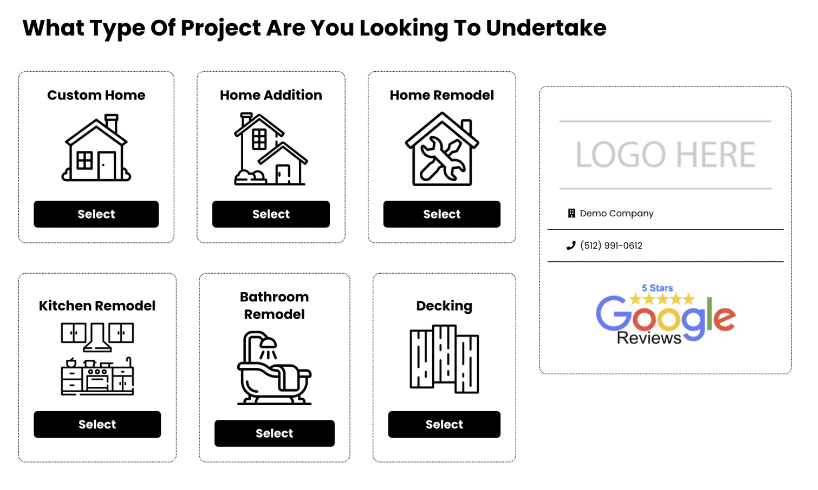
Historical demonstration screenshot with sample company details and US labels. It illustrates an early estimate; it is not a finished Contractor Scale asset or an AU/NZ pricing template.
Benefits of Instant Estimates
The useful benefit is earlier project information. The homeowner can assess an initial range, and your team can clarify whether the work fits. Neither the request nor the estimate proves purchase readiness.
Collects project information for qualification
An estimate request shows that someone wants pricing information. Ask what they are planning and what they need help deciding before treating the request as a qualified opportunity.
The submitted details can support qualification, but they do not complete it. Confirm project type, location, timing and scope. Keep unanswered questions neutral until a conversation resolves them.
Best for: Builders who can provide a useful initial range and own the follow-up conversation.
Pros:
- Captures project details to clarify fit and timing
- Saves time and resources by focusing on warm leads
- Provides valuable data for refining marketing strategies
Cons:
- May deter potential customers preferring human interaction
- Requires accurate, up-to-date pricing information
- Could limit opportunities for upselling or customisation
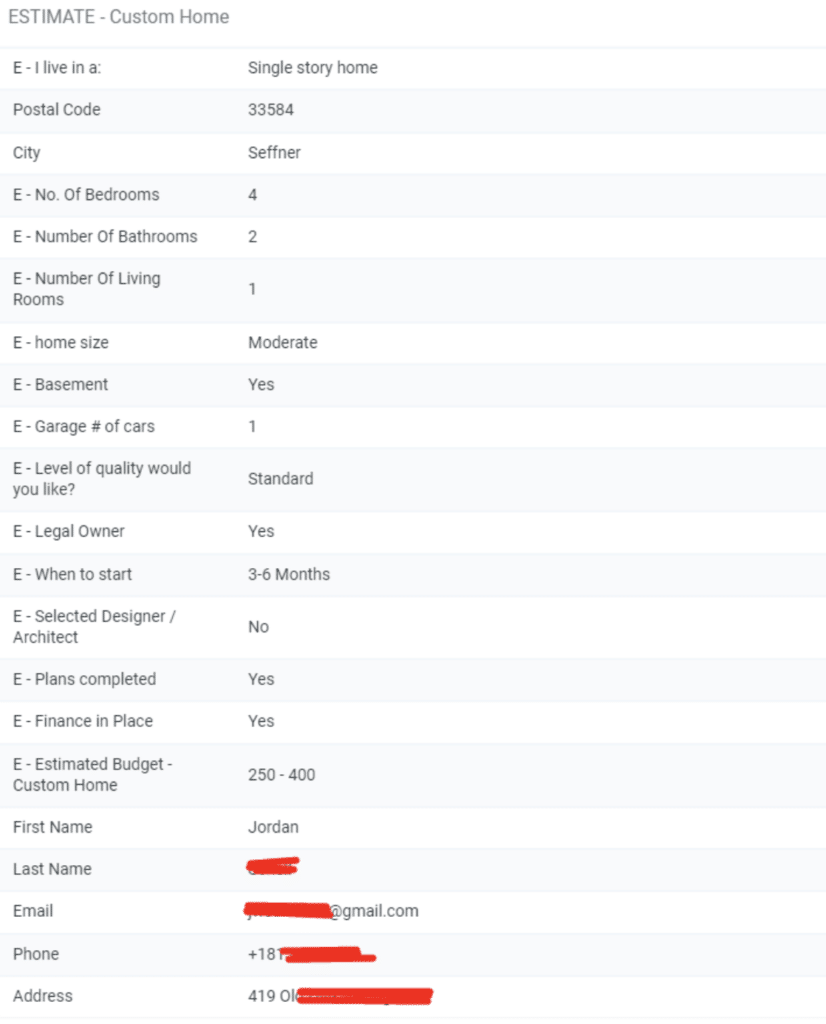
Starts a conversation about scope and budget
A homeowner may be researching costs well before they are ready to build. Use the range to discuss scope and trade-offs. An early-stage enquiry can still fit the business and need longer-term follow-up.
Creates a direct enquiry path
A form on your own website sends the enquiry to your team. Confirm who receives it, how it is saved and who replies. A direct request does not mean the homeowner has chosen your business.
Give the homeowner a copy of the assumptions and an explanation of the next step. Record the conversation and any agreed action so the enquiry does not depend on someone remembering to chase it.
Best for: Builders with a clearly scoped estimate offer and a reliable enquiry handoff.
Pros:
- Sends a direct enquiry to your team
- Builds trust and positions you as responsive and professional
- Allows for personalised follow-ups and tailored content to nurture leads effectively
Cons:
- May require investment in technology for instant estimates
- Could overwhelm you if not prepared for a sudden influx of leads
- Might attract price-shoppers focused solely on quick quotes rather than quality service
Impact on Lead Conversion
Check the conversion outcome rather than assuming an uplift. Compare estimate requests with your other enquiry paths using suitable conversations, planning engagements and signed projects.
Measure conversion at each stage
A quick range may help answer an early question. It may also attract people who are only comparing prices. Review both the volume and suitability of the enquiries before deciding whether the approach works.
An estimate request is an enquiry, not a sale. Track which requests become suitable conversations, planning engagements and signed projects. Lead totals and pipeline value alone do not prove a return on marketing spend.
An early range can help with these parts of the conversation:
- They satisfy your customer’s desire for immediate information
- They showcase your efficiency and technological savvy
- They reduce friction in the sales process
- They allow for quick comparison shopping
- They build trust by demonstrating transparency

Lead Pipeline Management
Use pipeline stages that reflect actual actions and agreements. A new enquiry, qualified conversation, site visit and planning engagement are different events. Record the owner and next step at each stage.
Possible stages: enquiry, fit conversation, agreed visit and scoped planning
Choose stages that match your sales process. Paid planning belongs in the pipeline only when the project requires a defined investigation and the homeowner accepts the scope and fee.
To maximise your lead conversion, tailor your approach at each stage:
- New leads: Capture attention with personalised cold outreach and content marketing
- Qualified leads: Nurture with targeted information and build trust through educational resources
- Site visit agreements: Showcase your expertise and establish rapport during face-to-face interactions
- Paid quotes: Demonstrate value and differentiate yourself from competitors
Visualisation of lead flow and progression
A simple pipeline view helps your team see the next action and any stalled enquiries. Keep stages consistent so the view reflects what has actually happened.
Start by mapping out each stage of your lead journey, from initial contact to closed deal. Use tools like flowcharts or CRM software to create a clear, easy-to-understand visual. This helps you and your team track lead progress and spot bottlenecks or drop-off points.
Colour-code your visualisation to quickly identify lead status at a glance. For example, use green for hot leads, yellow for warm prospects, and red for those needing more nurturing. This visual cue system allows you to prioritise your efforts and allocate resources effectively.
Include the date, owner and next action at each stage. Compare completed cohorts to identify where enquiries stall. Use that evidence to choose a change and check its result.
Historical campaign examples
The Contractor Scale Growth System connects demand, response and sales conversion. An early estimate can be one entry point when it suits the builder’s offer. The following historical examples describe reported opportunities, not guaranteed signed work or a current software inclusion.
The earlier Wellington, New Zealand, example described enquiries progressing through qualification, site visits and preliminary-budget work. Keep those stages separate when reviewing a pipeline. Each should record an actual conversation or agreement.
The earlier account of Custom Builder Rob in Tampa, Florida, described a pipeline of opportunities. An opportunity value is a forecast, not signed work or money received. Use confirmed outcomes to judge the campaign.
The earlier Nick in Melbourne, AU, example concerned home additions. Review such a pipeline against the actual scope and progress of each enquiry. Do not treat all forecast project values as revenue or credit them to one tool.
John Dickson’s original Texas account described won renovation/extension work. Separately, the current Diack Homes case study reports two house-and-land packages sold through a Meta-led campaign. These are specific campaign outcomes; they do not establish an instant-estimate conversion rate or a typical return.
Creating a Stable Business Flow
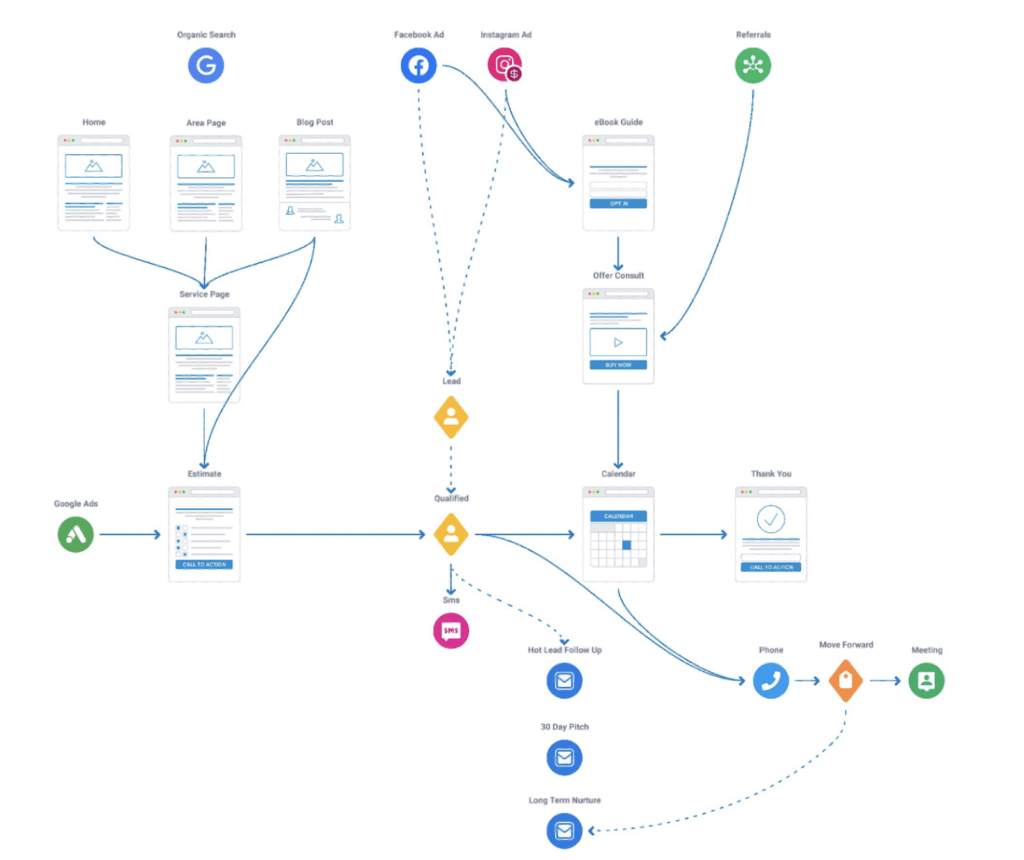
To create a stable business flow, you need to concentrate on two key elements: consistent lead generation and steady progression through your sales pipeline. Begin by implementing effective lead generation strategies like content creation, email campaigns, and paid advertising to keep a steady stream of potential clients coming in. Then, make sure your sales team is equipped to guide these leads through each stage of the pipeline efficiently, converting them into loyal customers and repeat business.
Consistent lead generation
Plan lead generation around the work already booked and your team’s capacity to respond. No channel guarantees a continuous stream of qualified prospects. Review source and project fit together.
To achieve consistent lead generation, consider these key methods:
- Content creation: Develop informative articles and videos that showcase your expertise
- Email campaigns: Nurture leads with personalised, value-driven messages
- Website optimisation: Improve your online visibility to attract more potential clients
- Paid advertising: Invest in targeted ads on platforms like Google and Facebook
- Networking: Build relationships with industry influencers and complementary businesses
Steady progression through sales pipeline
Once you have consistent lead generation, the next step is ensuring a steady progression through your sales pipeline. You’ve worked hard to attract potential clients; now it’s time to nurture them effectively.
Define the stage before comparing conversion rates: visitor to enquiry, enquiry to meeting, and meeting to signed project are different measures. Use completed cohorts and your own records; no single percentage diagnoses the problem.
Don’t forget the power of networking. Building relationships with industry influencers and complementary businesses can open doors to new opportunities. And while you’re focusing on new leads, keep optimising your website. It’s your digital storefront, after all.
Qualifying Serious Buyers
Paid preliminary work can be appropriate when a project needs investigation before reliable pricing. Define the work, fee and output. A homeowner who has not accepted that step is not automatically a poor-fit enquiry.
Concept of “Preliminary Budget” or paid quotes
Offer paid planning when there is meaningful work to scope. Explain the investigation and what the homeowner receives, then confirm acceptance. Keep this separate from an automated initial range.
Here’s how a paid quote system can benefit your business:
- Demonstrates the value of your expertise
- Sets a defined scope for planning work
- Clarifies the next investigation and decision
- Allows for more accurate project scoping
- Builds trust with potential clients
A planning fee pays for an agreed piece of work. It does not guarantee the building contract or make an early range a final price. Confirm the deliverables, limits and any credit in writing.
How to discuss the next planning step
Clarify what the homeowner needs to decide and what investigation is required. If paid planning fits that need, explain its scope. If they are earlier in the process, agree an appropriate follow-up instead.
Set any planning fee against the work being delivered. Confirm the amount and any credit before the homeowner commits. Willingness to pay is one decision, not proof of overall project fit.
A higher fee does not prove a better enquiry. Review whether the project matches your accepted work, whether the proposed next step is useful, and whether the homeowner understands it.
A homeowner may need more information before agreeing to paid planning. Record the unanswered question and the next contact. Do not infer a lack of seriousness from missing plans, an unknown budget or an early timeline.
Frequently Asked Questions
Accuracy depends on the inputs, assumptions and current pricing data. Treat the result as an initial range until site conditions, design and scope are investigated. Show what is included and excluded so the homeowner knows what the number means.
Choose software against the actual workflow, then check its current features and limits. PlanSwift, Clear Estimates, Buildertrend are starting points for that review, not verified recommendations for a homeowner-facing instant-estimate system. Test the assumptions, enquiry capture and handoff before using the output with a client.
A range can be tailored only where the inputs and pricing assumptions support that project type. Test representative scopes and identify cases that require manual review. A generic calculator should not imply it covers every residential, commercial or specialist project.
An early number can become the homeowner’s price expectation. Explain the assumptions, exclusions and investigation still needed before discussing a firm proposal. Update the range when the scope changes.
An automated range can miss site constraints, design detail and changing costs. Those gaps can lead to price expectations your final proposal cannot meet. Make the limits visible and use human review for scopes the calculation cannot handle.
Conclusion
An early range is useful when it answers a real homeowner question and leads into a reliable sales process. Define its limits, test the enquiry handoff and measure suitable conversations and signed projects. Keep the range, paid investigation and final proposal distinct.