
Construction Lead Generation: Which Systems Actually Work? The Ultimate Guide

Construction lead generation has become the biggest headache for builders across New Zealand. You pour thousands into marketing efforts that promise the world but deliver nothing. Meanwhile, your project pipeline sits empty while competitors seem to have endless work lined up.
Here’s the harsh reality: 73% of home builders and remodelers fail at lead qualification processes. They waste money chasing the wrong prospects through the wrong channels. The residential construction market represents a global value of $2.4 trillion, yet most builders struggle to capture their fair share.
Why? Because you’re using generic contractor marketing approaches that don’t work for home builder lead generation. Plumbers and electricians need different strategies than custom home builders. A kitchen remodeler operates differently from a commercial contractor. Yet most marketing companies treat all trades the same.
This creates three critical problems:
- Unqualified leads flood your pipeline – You spend hours quoting $25,000 bathroom remodels when your minimum project size is $75,000
- Generic messaging attracts price shoppers – Your marketing speaks to everyone, so it connects with no one
- Inconsistent results drain your resources – One month you’re booked solid, the next you’re scrambling for work
The solution isn’t more leads. You need qualified construction leads that match your project minimums and profit margins.
Before we continue: this guide won’t help custom home builders or remodelers who want quick fixes, aren’t willing to track metrics, or expect high-value project leads without proper follow-up systems. If that’s you, save your time.
This guide provides an honest systems evaluation for custom home builders and remodelling companies. You’ll discover which contractor marketing systems actually work (and which ones waste your money). More importantly, you’ll learn how to generate high-value project leads worth $50,000+ for remodels and $200,000+ for custom homes.
You’ll walk away with a clear roadmap for building predictable customer acquisition cost (CAC) models and sustainable growth systems tailored to your industry’s specific needs.
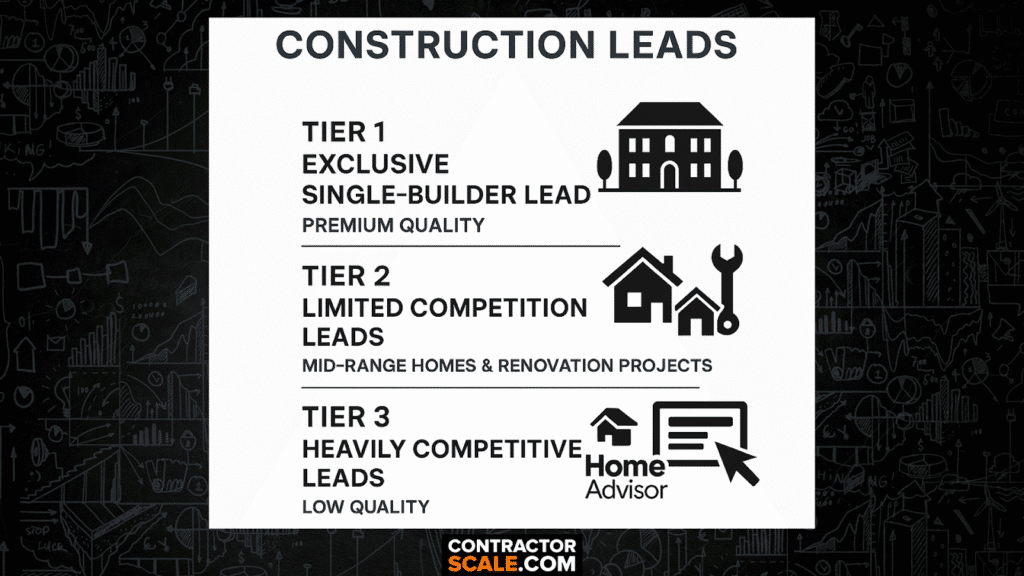
Lead Quality Framework and Classification
Most builders treat all leads the same. This kills your profit margins and wastes your time. A $15,000 bathroom renovation inquiry deserves different treatment than a $300,000 custom home project. Here’s how to classify leads correctly.
The Builder & Remodeler Lead Hierarchy
Tier 1 – Exclusive Qualified Leads
These are single-builder contacts where you face no competition. The prospect has been pre-screened for budget verification ($100,000+ for custom homes, $50,000+ for remodels) and timeline readiness. Conversion rates range from 70-90% because you’re not bidding against three other contractors.
Architect referrals for custom home projects represent premium Tier 1 leads. The architect has already qualified the client’s budget and timeline. Past client referrals for additions or secondary homes carry similar weight because satisfied customers pre-sell your capabilities. Designer partnerships for high-end kitchen remodels work the same way. Direct website inquiries from targeted home builder lead generation campaigns also qualify when proper screening occurs upfront.
These leads cost more to generate but deliver exponentially higher returns. A $500 cost for a Tier 1 custom home lead makes financial sense when it converts to a $250,000 project. The exclusive nature eliminates pricing competition and positions you as the recommended expert.
Tier 2 – Semi-Exclusive Leads
Limited competition exists, but you’re one of only 2-3 builders being considered. Basic qualification has occurred, typically for mid-range projects ($30,000-$75,000 remodels, $150,000-$250,000 custom homes). Conversion rates drop to 35-55% due to competitive dynamics.
Qualified referrals from trade partners fall into this category. Your electrician refers a kitchen remodel client, but they’re also considering another builder. Home show leads with serious interest qualify as Tier 2 when attendees collect information from multiple builders. Remodeling company leads from targeted social media campaigns often land here because prospects research several options before deciding.
Regional directory inquiries and local SEO for contractors results typically generate Tier 2 leads. You appear alongside 2-3 competitors, but the homeowner has specific project requirements that limit their options.
Tier 3 – Shared Platform Leads
Multi-builder competition with minimal screening characterises these leads. You’re competing against 4-6 other contractors, often primarily on price. Conversion rates plummet to 5-20% because qualification is minimal and competition is fierce.
HomeAdvisor and Thumbtack leads epitomise this category. The platform collects basic project information but doesn’t verify budgets or screen for serious intent. General contractor directory listings generate similar results. Broad Google Ads campaigns without proper qualification attract price shoppers and unqualified prospects.
These leads cost less upfront but require significant time investment for poor returns. Spending 2 hours quoting a Tier 3 lead that converts 10% of the time means you need 10 quotes to win one project. The winning project often comes at reduced margins due to price competition.
Smart builders focus 80% of their marketing budget on generating Tier 1 and Tier 2 leads while using Tier 3 leads only to fill capacity gaps during slow periods.
Builder-Specific Economic Impact Analysis
True Cost Metrics
Most builders calculate customer acquisition cost (CAC) wrong. You need three key measurements:
- Cost per qualified lead – What you pay to generate each Tier 1 lead that matches your project minimums
- Conversion cost – Total marketing spend divided by signed contracts over 12 months
- Lifetime customer value – Average project value plus referrals and repeat business over 5-10 years
For custom home builders, a $500 lead cost makes sense if it generates a $200,000 project. The same $500 lead cost destroys profitability on a $15,000 bathroom remodel. Custom home lead costs typically range from $200-$800 for qualified prospects. Remodeling company leads cost $50-$300 depending on project size and market competition.
Profitability Killers for Builders
Three hidden costs drain your profits faster than obvious marketing expenses:
- Time wasted on unqualified prospects – Spending 4 hours quoting a $25,000 kitchen renovation when your minimum project size is $50,000
- Design phase dropouts – Custom home leads who disappear after initial consultations, wasting your design time and follow-up efforts
- Permit delays – Projects that stall during approval processes, tying up your project pipeline management resources
- Wrong-fit client pursuit – Luxury custom builders chasing $100,000 renovation projects compete on price instead of value
- Capacity mismanagement – Volume remodelers pursuing $200,000 whole-home renovations without complex project management systems
ROI Benchmarks by Builder Type
Different builder types require different lead economics:
- Custom home builders – Target $200-$800 cost per qualified lead with 40-60% consultation-to-contract conversion rates
- Kitchen/bath remodelers – Target $50-$200 cost per qualified lead with 25-40% conversion rates
- Whole-home renovators – Target $300-$600 cost per qualified lead with 35-50% conversion rates
- Luxury custom builders – Accept higher lead costs ($500-$1,000) for $300,000+ project values
- Volume remodelers – Focus on lower lead costs ($25-$100) with streamlined conversion processes
These benchmarks assume proper lead qualification processes. Without qualification, conversion rates drop significantly while lead costs remain constant.
When to Avoid Lead Generation Entirely
Sometimes lead generation makes no business sense:
- Market saturation for luxury builds – When your area has 12 custom builders competing for 5 annual luxury projects
- Seasonal capacity constraints – Don’t generate leads during your busiest construction months when you lack bandwidth for consultations
- Permitting backlogs – If permit delays push project start dates 6+ months out, leads lose interest
- Cash flow constraints – When you need deposits from signed contracts to fund marketing efforts
- Team capacity limitations – Adding leads without sales or project management capacity creates chaos
- Economic uncertainty – During market downturns when homeowners delay major construction projects
The goal isn’t more leads. You want predictable conversion rate optimisation that fills your pipeline with profitable projects matching your capabilities and capacity.
Digital Lead Generation Systems Analysis
Digital marketing offers the fastest path to qualified construction leads, but most builders approach it wrong. They copy strategies from other industries or use generic contractor approaches. Here’s what actually works for custom home builders and remodelers.
Search Engine Optimisation (Builder & Remodeler-Focused)
Local SEO for contractors determines whether homeowners find you or your competitors when searching for builders. Most builders focus on generic terms like “construction company” instead of buyer-specific searches like “custom home builder near me” or “kitchen remodeling company.”
Local dominance requires three components:
- Google My Business optimisation with consistent business information, regular updates, and review management
- Location-based content targeting specific suburbs and project types
- Citation consistency across online directories with matching NAP (name, address, phone) data
Your GMB profile appears in local map results, where most homeowners start their search. A custom home builder in Auckland needs different content than a bathroom remodeler in Wellington.
Content strategy separates successful builders from struggling ones. Custom home builders need project galleries showcasing completed builds, design process education explaining how custom homes work, and neighbourhood-specific content. Remodelers require before/after transformation showcases, material selection guides, and renovation process timelines.
Technical infrastructure essentials:
- Project portfolio optimisation with fast-loading image galleries
- Mobile-first design for homeowner research behaviour
- Site speed optimisation affecting user experience and search rankings
- Schema markup for construction projects and reviews
When SEO isn’t right for you: New custom home builders without completed projects to showcase face an uphill battle. SEO requires 6-12 months to show results, making it unsuitable for urgent project pipeline needs. Limited portfolio content also restricts SEO effectiveness since visual proof drives builder selection.
Paid Search Advertising (Builder & Remodeler PPC)
Construction company digital marketing through paid search offers immediate visibility, but campaign architecture determines success or failure. Custom home builders need separate ad groups for “custom home builders,” “luxury home construction,” and location-specific terms. Kitchen remodelers require distinct campaigns for “kitchen renovations,” “bathroom remodels,” and “home additions.”
Negative keyword strategy saves thousands in wasted spend:
- Exclude handyman-related searches: “repair,” “fix,” “maintenance,” “emergency”
- Add budget qualifiers: “cheap,” “budget,” “affordable” for premium markets
- Block competitor brand names to avoid paying for brand confusion
- Filter DIY terms: “how to,” “tutorial,” “tips,” “guide”
Landing page conversion rate optimisation varies by project type. Custom home consultations require different messaging than remodeling estimates. Custom builders should emphasise design process, timeline clarity, and portfolio quality. Remodelers need before/after photos, material options, and timeline expectations.
Budget management requires realistic expectations. Competitive custom home markets require budgets of $ 5,000 or more per month to achieve meaningful results. Smaller remodeling markets might succeed with $2,000-3,000 monthly spend. Insufficient budgets create sporadic visibility and inconsistent results.
When PPC fails for builders: Generic contractor messaging that doesn’t differentiate between trades kills conversion rates. Homeowners researching custom homes think differently from those seeking bathroom repairs. Budget constraints also limit PPC effectiveness in competitive markets.
Google Ads work better for home builder lead generation because homeowners actively search for builders. Facebook Ads excel for remodeling inspiration and brand awareness, but require longer nurturing periods. A $200,000 custom home buyer might research for 6-18 months before contacting builders.
Social Media Lead Generation for Builders & Remodelers
Platform selection depends on your target market and project type. Instagram showcases custom home builds through progress photos and finished project galleries. Facebook works better for remodeling transformations and community engagement. Pinterest drives design inspiration traffic but rarely generates immediate leads.
Content framework differs by builder type:
- Custom builders: Construction progress videos, architectural design showcases, client testimonial videos
- Remodelers: Dramatic before/after reveals, material selection guides, quick renovation tips
- Both: Project walkthroughs, client success stories, design trend education
Video marketing drives the highest engagement for both builder types. Home tours of completed custom builds generate massive interest from potential clients. Time-lapse remodeling videos showing dramatic transformations capture attention and demonstrate capability.
When social media wastes builder time: Commercial construction focus doesn’t align with consumer social media behaviour. Older demographics prefer direct contact over social engagement. Immediate lead needs don’t match social media’s longer relationship-building timeline.
Residential construction marketing through social media requires consistency and patience. Results compound over time as your content library grows and audience engagement increases. The key is positioning yourself as the go-to educational resource for homeowners considering major construction projects.
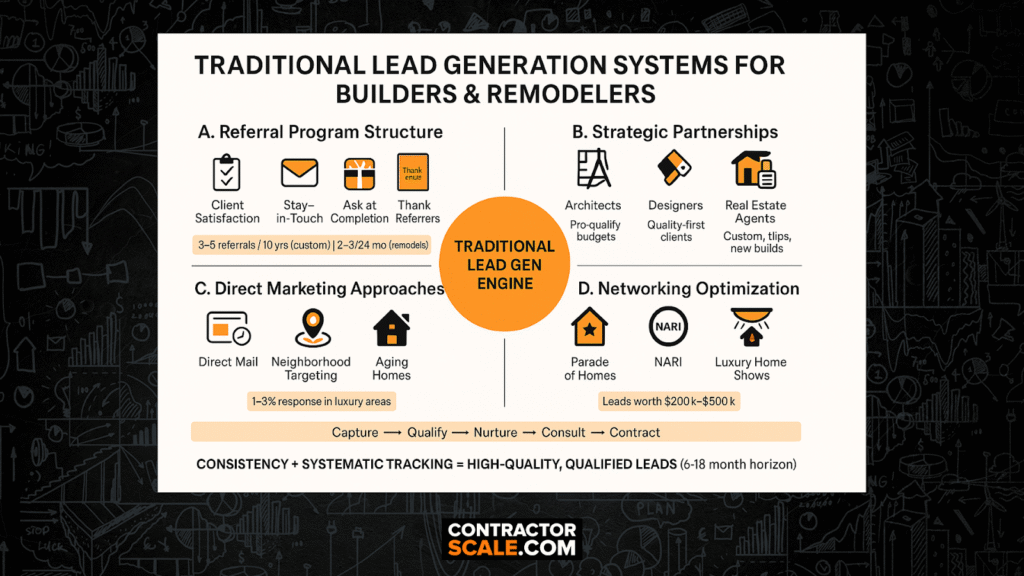
Traditional Lead Generation Systems for Builders & Remodelers
Digital marketing gets most attention today, but traditional methods still generate the highest-quality, qualified construction leads. These systems build relationships that create decades of referrals. The difference between success and failure lies in systematic execution.
Referral Program Structure
Past clients represent your most valuable lead source. A satisfied custom home owner refers 3-5 qualified prospects over 10 years. Remodeling clients generate 2-3 referrals within 24 months. Yet most builders handle referrals haphazardly.
Systematic referral generation requires:
- Client satisfaction tracking – Survey completion rates and follow-up on concerns
- Stay-in-touch campaigns – Quarterly newsletters, holiday cards, anniversary calls
- Incentive programs – Gift cards, project discounts, or charitable donations for successful referrals
- Referral request timing – Ask during project completion excitement, not months later
- Follow-up systems – Thank referrers whether leads convert or not
Past custom home clients generate referrals worth $150,000-$400,000 on average. Remodeling customer referrals typically range from $40,000-$120,000. These numbers justify significant referral incentive investments.
Common referral program failures:
- Waiting for referrals instead of systematically requesting them
- No tracking system to measure referral source effectiveness
- Forgetting to thank referrers, damaging future referral potential
- Inconsistent follow-up on referred prospects
Strategic Partnerships
Contractor marketing systems work best when multiple professionals recommend your services. Architects, interior designers, and real estate agents encounter homeowners planning construction projects before builders do.
Architect relationships generate premium custom home leads. Architects pre-qualify budgets during design phases and recommend builders who match project complexity. Building strong architect partnerships requires understanding their design vision, meeting deadlines, and providing construction expertise during planning.
Interior designer networks produce high-end remodeling opportunities. Designers work with homeowners who prioritise quality over cost. Kitchen and bathroom remodelers benefit most from designer partnerships because these projects require design coordination.
Real estate agent connections work differently:
- Luxury agents refer custom home opportunities and high-end renovations
- Investment property agents provide rental renovation and flip opportunities
- New construction agents need builder partnerships for buyer representation
Successful partnerships require mutual benefit. Refer clients to your partners when appropriate. Attend their events, promote their services, and maintain regular communication.
Direct Marketing Approaches
Targeted direct marketing still works when focused properly. Custom home builders should target luxury neighbourhoods with aging homes or vacant lots. Residential construction marketing through direct mail achieves 1-3% response rates in wealthy areas.
Effective direct marketing strategies:
- Neighbourhood targeting – Focus on areas with $800,000+ home values for custom builds
- Aging home identification – Target 20-40 year old homes needing major renovations
- New development monitoring – Contact lot purchasers planning custom homes
- Event-based timing – Mail after home sales, permits filed, or zoning changes
Remodeling companies should focus geographic farming on established neighbourhoods where homeowners have equity for major renovations. Kitchen and bathroom remodelers succeed in 15-25 year old developments where original fixtures need updating.
Networking Optimisation
Industry events generate relationship-based leads worth pursuing. Parade of Homes events, NARI chapter meetings, and luxury home shows connect builders with qualified prospects and referral partners.
Parade of Homes participation works best for custom builders showcasing completed projects. Attendees represent serious prospects researching builders for future projects. The investment ranges from $15,000-$50,000 but generates leads worth $200,000-$500,000 each.
NARI chapter involvement benefits include:
- Education on industry trends and best practices
- Networking with complementary trade professionals
- Referral opportunities from other members
- Credibility boost through association membership
Luxury home shows target homeowners planning major construction projects. Custom builders and high-end remodelers benefit most from show participation. Focus on education rather than sales during initial conversations.
Traditional system limitations for builders: Long sales cycles mean results take 6-18 months to materialise. Seasonal fluctuations affect networking event schedules and prospect availability. High-end market constraints limit the number of qualified prospects in any geographic area.
Project pipeline management becomes critical with traditional lead generation because prospects move slowly through decision processes. You need systems to maintain contact over extended periods while tracking progress through your sales funnel.
The key to traditional lead generation success is consistency combined with systematic tracking. Most builders attend events sporadically and fail to follow up properly. Successful builders treat traditional marketing as seriously as digital campaigns.
Platform-Based Lead Generation Evaluation
Lead generation platforms promise easy access to homeowners seeking builders, but most generate Tier 3 leads with intense competition and price pressure. Understanding which platforms work for specific builder types saves money and frustration.
Shared Platform Analysis
Houzz Critical for Builders
Houzz operates differently because it focuses on design inspiration rather than price shopping. Homeowners browse project photos and contact builders whose work aligns with their vision. This creates higher-quality remodeling company leads compared to generic contractor platforms.
Custom home builders benefit most from professional photography showcases and detailed project descriptions. Kitchen and bathroom remodelers see strong results because homeowners use Houzz for renovation inspiration.
HomeAdvisor Dynamics
HomeAdvisor works better for remodelers than custom home builders because it focuses on immediate project needs. The platform generates leads quickly but creates intense price competition among 4-6 contractors per lead.
Key performance metrics:
- Remodeling projects convert at 8-15% with $15,000-$75,000 average values
- Custom home inquiries convert at 3-8% with longer sales cycles
- Lead costs range from $25-$150 depending on project type
- Response time pressure requires follow-up within 5-10 minutes
When platforms make sense for builders: New market entry, supplemental lead sources during slow periods, geographic expansion, or specific service niches.
When builders should avoid platforms: Established custom builders with full pipelines, luxury market focus where price competition damages positioning, or capacity constraints.
Industry-Specific Platforms for Builders
Specialised Directories
BuildZoom caters specifically to construction projects with contractor licensing verification and project size filtering. Custom home builders see better results here compared to general platforms because homeowners understand major construction complexity.
Houzz Pro offers advanced features for design professionals and high-end builders, including construction CRM integration and enhanced portfolio presentation.
Regional Networks
Local HBA directories provide credibility but limited lead volume. NARI memberships work similarly for remodelers. Parade of Homes participation generates qualified custom home leads but requires significant investment.
Platform selection must align with your target market. Luxury custom builders need different platforms than volume remodelers. Top builders use Houzz for portfolio showcases while maintaining strong SEO presence. They avoid HomeAdvisor competition but participate in local luxury networks.
The key insight is matching your sales process to platform expectations. Houzz users research extensively before contacting builders. HomeAdvisor users want immediate responses and multiple quotes. Understanding these behavioural differences improves conversion rates significantly.
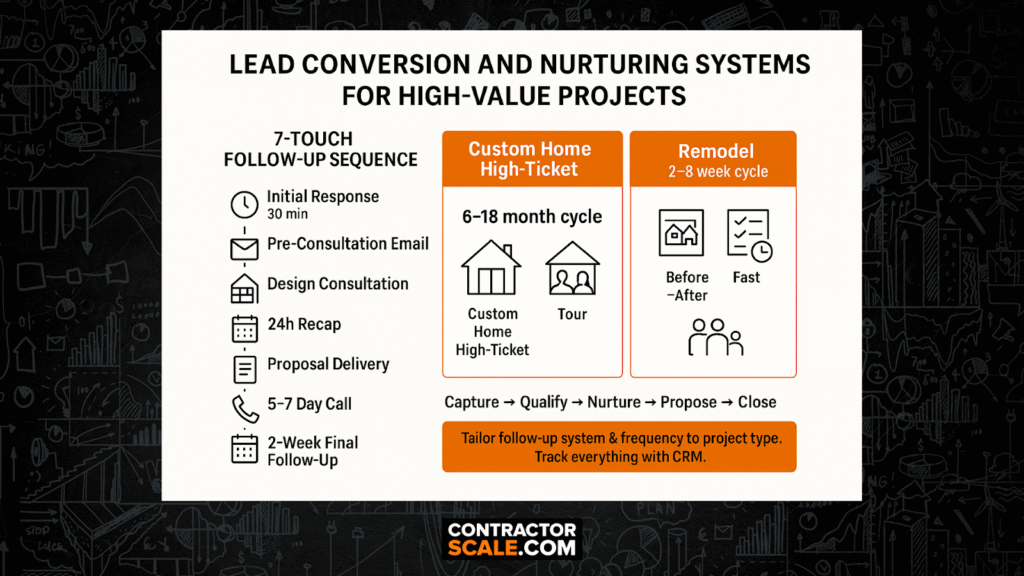
Lead Conversion and Nurturing Systems for High-Value Projects
Generating qualified construction leads is only half the battle. Most builders lose 60-70% of qualified leads due to poor follow-up processes. Converting prospects requires systematic nurturing tailored to builder sales cycles.
Builder-Specific Follow-Up Architecture
Builder sales cycles differ significantly from other trades. Custom home prospects need 6-18 months to decide. Remodeling clients typically decide within 30-90 days.
Essential 7-touch sequence:
- Initial response within 30 minutes confirming consultation
- Pre-consultation email with portfolio examples and process overview
- Design consultation meeting with budget and timeline discussion
- 24-hour follow-up summarising consultation and next steps
- Detailed proposal delivery with specifications and pricing
- Follow-up call 5-7 days later, addressing questions
- Final follow-up 2 weeks later with alternative approaches
Each touch must provide value through relevant project photos, design articles, or construction updates. Construction CRM integration becomes essential for tracking multiple prospects through lengthy sales cycles.
Quote conversion differs by project type. Custom home presentations emphasise design collaboration, timeline predictability, and quality standards. Include 3D renderings and completed project tours. Remodeling estimates need before/after comparisons, material options, and clear timelines addressing dust control and daily schedules.
Builder & Remodeler Industry Considerations
Sales cycle management varies dramatically:
- Custom homes: 6-12 months average (design phases, permits, financing)
- Kitchen remodels: 2-6 weeks typical decision timeline
- Bathroom renovations: 1-4 weeks average cycle
- Whole-home projects: 3-8 weeks due to complexity
Decision-maker identification prevents late-stage surprises. Home builder lead generation often involves couples with different priorities or investment property owners focused on ROI. Ask about decision-making processes during initial consultations.
Common follow-up failures include:
- Design phase delays losing prospect contact
- Poor budget shock preparation on complex projects
- Inadequate permit timeline explanations
- Confusion about approval decision-makers
Project pipeline management systems must accommodate different sales velocities. Custom home prospects need monthly educational content during long cycles. Remodeling prospects require immediate responsiveness and quick decision support.
The key is matching communication frequency to project complexity. Automated sequences work for initial touches, but complex projects require personalised communication. Successful builders treat lead conversion as seriously as lead generation, investing in proper CRM systems and measuring conversion rates by lead source and project type.
Performance Measurement and Optimisation for Builders
Most builders track the wrong metrics. Website traffic and social media followers don’t pay for materials or labour. Construction company digital marketing success must be measured by project value and profit margins, not vanity metrics.
Builder-Specific KPIs
Lead Quality Metrics
Track qualification rates for high-value projects rather than total lead volume. A custom home builder needs different measurements than a bathroom remodeler.
Essential qualification tracking:
- $100K+ project qualification rate – Percentage of leads meeting minimum project values
- Design consultation conversion – Prospects who attend meetings versus initial inquiries
- Contract signing percentage – Consultations that convert to signed agreements
- Average project value by source – Which channels generate the most profitable work
These metrics reveal which marketing channels generate qualified prospects versus price shoppers. A 5% conversion rate on $200K projects beats a 20% rate on $25K jobs.
Financial Performance
Customer acquisition cost (CAC) calculations must account for project complexity and timeline. Custom home CAC includes extended nurturing costs over 6-18-month sales cycles. Remodeling company leads typically convert faster but require different cost tracking.
Critical financial KPIs:
- CAC by project type – Custom homes, major remodels, smaller renovations
- Lifetime value tracking – Initial project plus referrals and repeat business
- Lead source ROI – Return on investment for each marketing channel
- Seasonal performance variance – How results change during peak/slow periods
Operational Efficiency
Response time significantly impacts conversion rates for builder leads. Design consultation response within 30 minutes improves conversion by 40-60% compared to same-day responses.
Track consultation-to-estimate timelines, proposal delivery speed, and follow-up consistency. These operational metrics directly correlate with closing rates.
Vanity metrics builders should ignore:
- Website traffic without project value qualification
- Social media followers without local engagement
- Email open rates without consultation bookings
- Brand awareness surveys without lead generation correlation
Builder Tracking Infrastructure
Attribution Modelling
Understanding lead sources becomes complex with extended sales cycles. A custom home client might discover you through SEO, follow you on social media, attend a home show, then contact you after a referral. Multi-touch attribution reveals the complete conversion path.
Track design consultation sources, referral channel analysis, and repeat client patterns. This data guides budget allocation decisions across marketing channels.
Reporting Systems
Project pipeline management requires dashboards showing lead progression through sales stages. Monitor consultation scheduling, proposal delivery, follow-up completion, and contract signatures.
Essential reporting components:
- Project pipeline dashboards with stage-by-stage progression
- Seasonal trend analysis for capacity planning
- Market segment performance comparing custom homes versus remodeling
- Lead source effectiveness by conversion rate and project value
Optimisation Protocols
A/B testing works differently for builders than for other industries. Test consultation approaches, proposal presentation methods, and follow-up messaging. Small improvements compound significantly over lengthy sales cycles.
Seasonal campaign adjustments matter more for builders than many businesses. Custom home marketing during winter targets spring construction starts. Remodeling campaigns align with indoor project seasons.
When tracking becomes counterproductive: Over-analysis during busy construction seasons diverts attention from project delivery. Micro-optimisation obsession can reduce focus on fundamental business operations.
The key is balancing measurement sophistication with practical application. Track metrics that drive decisions, not just data collection. Focus on KPIs that directly impact profitability and growth rather than impressive-sounding numbers that don’t influence business outcomes.
Successful builders review metrics monthly during slow seasons and quarterly during peak construction periods. They use data to make informed marketing investments while maintaining focus on project execution quality.
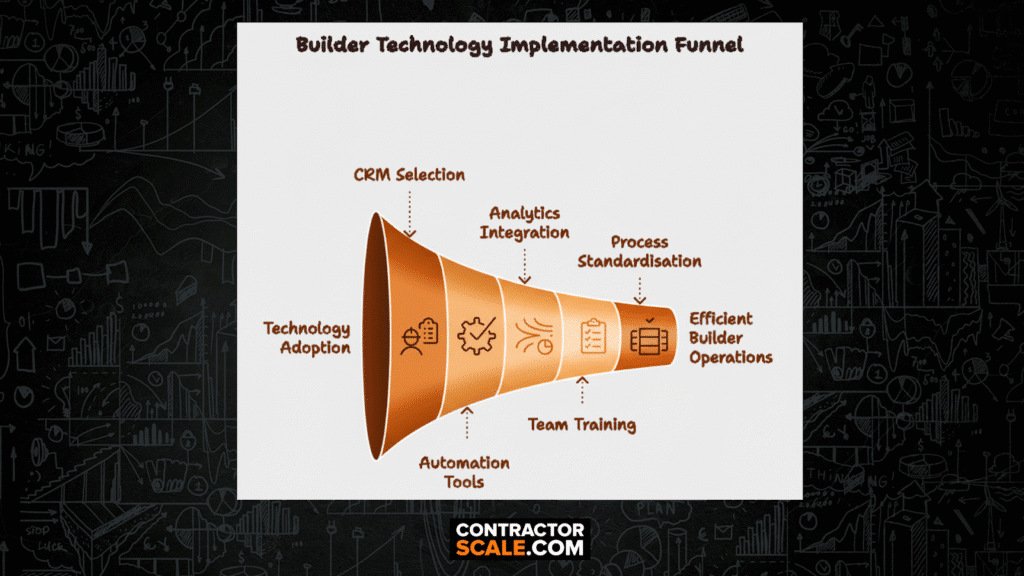
Systems Integration and Automation for Builder Operations
Technology should simplify your business, not complicate it. Most builders either avoid systems entirely or choose overly complex solutions that break down during busy seasons. The right technology stack automates routine tasks while preserving the personal touch essential for high-value projects.
Builder Technology Stack Architecture
CRM Selection for Builders
Generic CRMs fail builders because they don’t understand construction project phases. You need systems designed for lengthy sales cycles, multiple decision-makers, and project complexity tracking.
Essential CRM features for builders:
- Design phase tracking through concept, development, and finalisation stages
- Permit integration showing approval status and timeline updates
- Project timeline management from consultation to completion
- Multi-contact management for couples and investment property teams
- Referral source tracking with lifetime value calculations
Construction CRM integration with project management tools eliminates duplicate data entry. Your CRM should connect with scheduling, accounting, and communication systems.
Automation Tools
Design consultation scheduling automation saves significant administrative time. Prospects can book consultations directly while you maintain control over availability and preparation time.
Key automation opportunities:
- Consultation scheduling with automatic confirmation and reminder sequences
- Follow-up email sequences tailored to project type and consultation outcomes
- Milestone communication for permit approvals, material selections, and construction phases
- Review request automation after project completion and final payments
Avoid over-automation that removes personal connection. High-value construction projects require human interaction during critical decision points.
Analytics Platform Integration
Project value tracking requires integration between your CRM, accounting system, and marketing platforms. This integration reveals which marketing channels generate the most profitable work.
Track seasonal performance patterns, referral source optimisation, and lead qualification process effectiveness. Data should flow automatically between systems rather than requiring manual compilation.
Technology Stack Failures
Over-complicated systems create problems during busy construction seasons. Complex workflows that seemed logical during setup become barriers when you’re managing multiple active projects.
Poor project integration forces duplicate data entry across multiple platforms. This creates inconsistencies and increases administrative burden when you need efficiency most.
Builder Team Implementation
Training Protocols
Your team needs different training for home builder lead generation versus general sales approaches. Design consultation processes require understanding construction complexity, timeline variables, and budget reality checks.
Essential training areas:
- Lead qualification standards for different project types and budget ranges
- Consultation procedures covering design discussion, timeline explanation, and budget frameworks
- Follow-up protocols maintaining engagement through extended decision cycles
- System usage ensuring consistent data entry and process adherence
High-value project sales require relationship-building skills that differ from transactional sales approaches.
Process Standardisation
Custom home lead handling differs significantly from remodeling lead management. Standardise procedures for each project type while maintaining flexibility for unique situations.
Standardisation requirements:
- Initial response templates customised for different inquiry types
- Consultation preparation checklists ensuring consistency across team members
- Proposal creation workflows matching project complexity to presentation depth
- Contract negotiation procedures addressing common objection patterns
Scaling Methodology
Growth creates capacity constraints that damage lead conversion if not appropriately managed—plan for seasonal demand fluctuations and team expansion requirements.
Seasonal capacity management involves adjusting lead generation intensity in accordance with construction schedules and team availability. Don’t generate leads you lack the capacity to handle properly.
Quality maintenance during growth requires documented procedures that new team members follow consistently. Project pipeline management becomes critical as lead volume increases.
The key to successful implementation is gradual deployment rather than complete system overhauls. Start with basic automation and add complexity as your team adapts. Focus on systems that solve actual problems rather than impressive features that don’t improve operations.
Monitor team adoption rates and system effectiveness regularly. Technology should make your team more efficient, not create additional administrative burden. Adjust systems based on real usage patterns rather than theoretical best practices.
Common Failure Patterns and Solutions for Builders & Remodelers
Most builder marketing failures follow predictable patterns. Understanding these common mistakes helps you avoid expensive learning experiences while competitors repeat the same errors.
The 80% Problems Builders Face
Unqualified Lead Acceptance
The biggest mistake is accepting every inquiry regardless of project fit. A luxury custom home builder spending 3 hours quoting a $25,000 kitchen remodel wastes time and damages positioning.
Solution: Establish clear minimum project values and qualification questions. Train your team to decline inappropriate inquiries while referring them to suitable contractors politely.
Design Phase Follow-Up Failures
Custom home builders lose 40-60% of qualified prospects during extended design phases. Communication gaps lasting weeks make prospects assume you’ve lost interest. Lead nurturing automation prevents these unnecessary losses.
Budget Misalignment
Construction company digital marketing often attracts price shoppers instead of quality-focused homeowners. Generic messaging about “affordable construction” draws the wrong audience for premium builders, creating painful sticker shock conversations.
Seasonal Dependency
Many builders experience boom-bust cycles tied to construction seasons rather than maintaining year-round lead generation. This creates cash flow problems and team capacity issues.
Builder-Specific Solutions
Why 73% of builders fail at consistent lead generation:
- Lack of systematic approach – random marketing tactics
- Wrong target audience – marketing to everyone
- Poor follow-up discipline during extended sales cycles
- Inadequate qualification accepting inappropriate leads
- Reactive marketing instead of proactive pipeline management
Implementation framework:
- Systematic budget qualification – Verify budgets before scheduling consultations
- Design phase protocols – Monthly check-ins during development with progress updates
- Target market refinement – Focus on quality messaging over price competition
- Year-round pipeline planning – Generate leads 6-12 months ahead of construction schedules
- Process documentation – Written procedures for lead handling and team training
The key insight is that builder marketing requires different approaches than other industries due to extended sales cycles, high project values, and relationship-based decisions. Home builder lead generation succeeds through systematic execution of builder-specific processes rather than generic marketing tactics.
Focus on attracting fewer, better-qualified prospects rather than maximum lead volume. Build relationships through extended sales cycles instead of pushing for quick decisions.
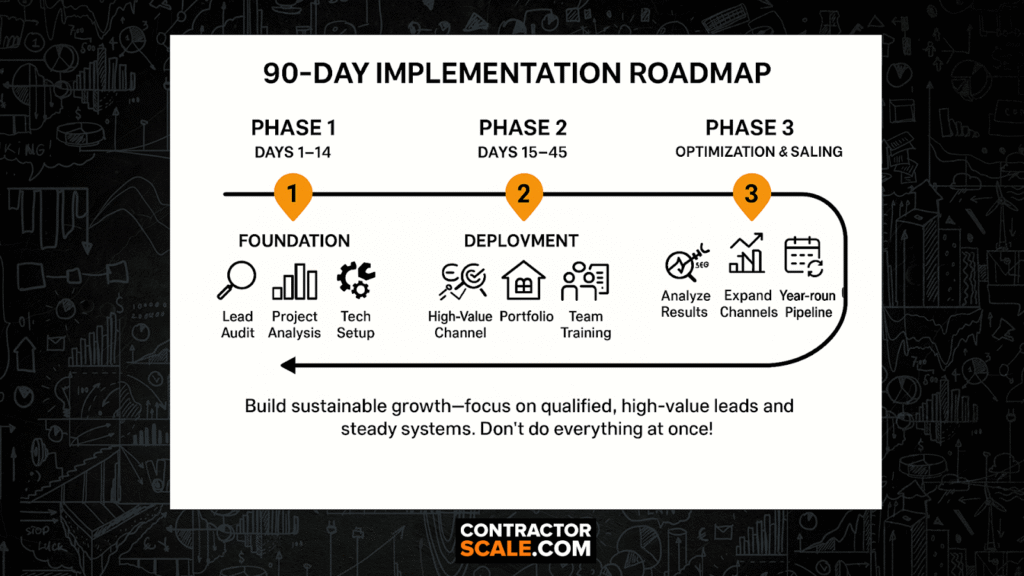
Implementation Roadmap for Builders & Remodelers
Successful construction company digital marketing implementation follows a systematic 90-day roadmap. Most builders try to launch everything simultaneously, creating chaos instead of sustainable growth. This phased approach builds momentum while maintaining construction project quality.
Phase 1 (Days 1-14): Builder Foundation Establishment
Current Lead Source Audit
Start by understanding your existing lead generation performance. Track referrals versus digital versus networking results over the past 12 months. Most builders discover they’re heavily dependent on one or two sources, creating vulnerability.
Audit essential components:
- Lead source tracking – Where qualified leads actually originate
- Conversion rate analysis – Which sources produce signed contracts
- Project value comparison – Average project size by lead source
- Cost per acquisition – True marketing costs including time investment
- Referral pattern identification – Client types who generate the most referrals
Project Value Analysis
Separate custom home leads from remodeling leads in your analysis. These require different marketing approaches, sales processes, and follow-up systems. Custom home leads typically take 6-18 months to convert while remodeling decisions happen within 30-90 days.
Builder-Specific Technology Infrastructure Setup
Choose systems designed for the construction industry requirements. Your CRM must handle extended sales cycles, multiple decision-makers, and project complexity tracking. Generic business software fails when managing custom home prospects through design phases.
Common Phase 1 mistakes for builders:
- Ignoring seasonal patterns when analysing historical data
- Incomplete project value tracking missing referrals and repeat clients
- Rushing technology selection without understanding construction-specific needs
- Starting implementation during peak construction season when attention is divided
Phase 2 (Days 15-45): Builder System Deployment
High-Value Lead Channel Implementation
Focus on one primary channel for initial implementation. Custom home builders typically succeed with SEO and referral system development first. Remodeling companies often benefit from targeted paid advertising combined with social media showcases.
Implementation priorities:
- Custom home builders – Local SEO optimisation and referral automation systems
- Kitchen/bath remodelers – Before/after portfolio development and targeted PPC campaigns
- Whole-home renovators – Content marketing showcasing transformation projects
- Luxury builders – Partnership development with architects and designers
Design Consultation Tracking
Implement systems to track prospects from initial inquiry through signed contracts. This visibility reveals bottlenecks in your sales process and identifies opportunities for conversion rate optimisation.
Builder Team Training
Train your team on new qualification standards and follow-up procedures. Home builder lead generation requires different approaches than general sales techniques. Focus on relationship building through extended decision cycles.
Phase 3 (Days 46-90): Builder Optimisation and Scaling
Performance Analysis
Analyse results by lead source, project type, and seasonal patterns. Custom home campaigns show different performance metrics than remodeling efforts. Use this data to refine targeting and messaging.
Performance metrics to track:
- Lead quality improvement – Higher percentage meeting project minimums
- Conversion rate trends – Consultation-to-contract improvement over time
- Project value increases – Average contract size growth by lead source
- Pipeline consistency – Reduced seasonal dependency through diversification
Successful System Expansion
Add secondary marketing channels once primary systems show consistent results. Geographic growth requires understanding local market dynamics and competition levels.
Long-Term Strategy Development
Build year-round pipeline management replacing seasonal boom-bust cycles. Custom home marketing during winter targets spring construction starts. Remodeling campaigns during summer focus on fall/winter indoor projects.
Builder scaling failures to avoid:
- Design phase bottlenecks when consultation volume exceeds capacity
- Team overwhelm attempting too many marketing channels simultaneously
- Quality degradation pursuing volume growth over profitable project focus
- Technology system breakdowns during rapid expansion periods
Project pipeline management becomes critical during scaling phases. Your systems must accommodate increased lead volume without sacrificing consultation quality or follow-up consistency.
90-Day Success Metrics
Measure success through qualified lead generation rather than total inquiries. A 50% increase in $100,000+ project consultations beats a 200% increase in $25,000 remodeling inquiries for most custom builders.
Focus on sustainable growth that matches your construction capacity and team capabilities. The goal is predictable, qualified construction leads that maintain profitability while supporting controlled business expansion.
Conclusions: The Path to Predictable High-Value Lead Generation
After examining every construction lead generation system available to builders and remodelers, one truth emerges: most approaches fail because they treat construction like any other business. Custom home builders and remodelers require specialised strategies for extended sales cycles and high-value projects.
What Actually Works
Quality Over Quantity
Tier 1 exclusive leads consistently outperform Tier 3 shared platform leads by 7-9 times. A $500 exclusive custom home lead converting at 80% generates far more profit than ten $50 shared leads converting at 5-10%. Focus on qualified construction leads that match your project minimums.
System Integration
No single marketing channel provides complete protection. Successful builders combine referral systems, digital marketing, and strategic partnerships to maintain a year-round pipeline stability while avoiding price-competitive platforms.
Professional Implementation
73% of builders fail to consistently generate high-value leads because they apply generic strategies to construction challenges. Customer acquisition cost (CAC) tracking, construction CRM integration, and lead nurturing automation exceed what most internal teams can develop effectively.
The Hard Truth
Most builders need professional help to generate consistent $100,000+ project leads while maintaining construction quality. The technical complexity and time requirements exceed internal capabilities.
The systems that actually work combine:
- Tier 1 exclusive lead sources through referrals and targeted campaigns
- Systematic follow-up processes for extended construction sales cycles
- Proper qualification systems filtering by project value and timeline
- Technology integration supporting complex decision processes
- Professional implementation understanding of construction industry dynamics
Home builder lead generation succeeds through relationship building and demonstrable expertise rather than price competition. Builders who consistently generate high-value projects treat lead generation as seriously as construction quality.
If you’re ready to discover which lead generation systems will actually work for your custom home or remodeling business – without the trial-and-error experimentation that wastes money and delays results – book a strategy call with Contractor Scale today and let us show you exactly how we guarantee high-value project leads within 60 days.